Have you ever charged your Tesla to 100%, started driving, lifted your foot off the accelerator, and suddenly felt like your brakes weren’t working?
If so, you’re not alone.
I experienced something similar with our Tesla Model 3, and I’ll admit, it caught me completely off guard.
We were accustomed to the way our Tesla slowed down automatically when we lifted off the accelerator. Then, after charging to 100%, the car didn’t slow down the way we expected.
For a moment, I thought we might have a major braking problem.
What I eventually learned was that our Tesla wasn’t necessarily experiencing a brake failure at all. It was behaving differently because of how regenerative braking works when the battery is fully charged.
And if you’re a new Tesla owner, this is something you absolutely need to understand.
The good news is that reduced regenerative braking after charging to 100% is generally normal.
But there’s an important distinction: reduced regenerative braking is not the same as a problem with your regular brakes. If your brake pedal doesn’t respond normally or you receive a braking-system warning, treat that as a safety issue.
Let’s explain what’s happening, why it feels so strange, and what you can do about it.
Quick Answer: Why Does Tesla Regenerative Braking Stop Working at 100%?
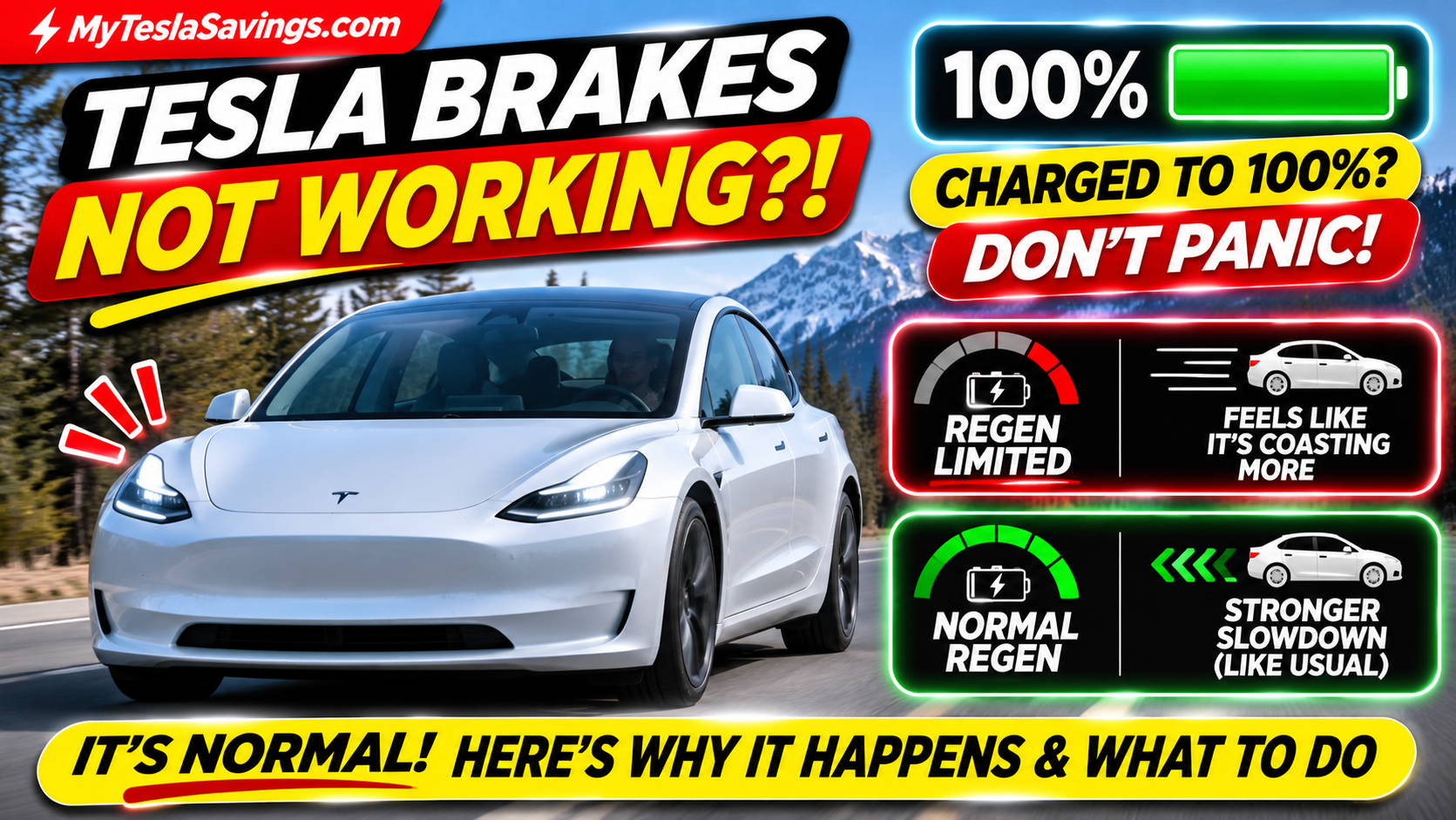
When your Tesla battery is fully charged, regenerative braking may be temporarily reduced because the battery has little room to accept additional energy.
Regenerative braking works by using the electric motor to slow the vehicle and return energy to the battery.
But when the battery is already full, there may be nowhere for that recovered energy to go.
As a result, your Tesla may not slow down as strongly when you release the accelerator pedal.
This can make the vehicle feel like it’s coasting more than usual.
That doesn’t automatically mean your regular brakes are broken.
Depending on your Tesla’s model, software, and settings, the vehicle may automatically apply the regular brakes to provide a more consistent slowing sensation.
| What you notice | Possible explanation |
|---|---|
| Tesla doesn’t slow down as strongly at 100% | Regenerative braking is limited |
| Car coasts farther when lifting off the accelerator | Reduced regenerative deceleration |
| Regenerative braking indicator appears | Battery cannot accept normal regenerative power |
| Normal regen gradually returns after driving | Battery has more room to accept energy |
| Reduced regen on freezing mornings | Battery temperature is limiting regeneration |
| Brake pedal feels abnormal or braking warning appears | Possible braking-system problem requiring attention |
My Experience: I Thought Something Was Wrong With Our Tesla Model 3
One of the things I quickly became accustomed to when driving our Tesla Model 3 was one-pedal driving.
Once you get used to it, it’s fantastic.
You accelerate normally, and when you want to slow down, you simply ease off the accelerator.
The car begins slowing down without you needing to press the brake pedal nearly as often.
Eventually, it becomes second nature.
That’s why the first time our Tesla behaved differently after charging to 100%, it was unsettling.
I lifted my foot off the accelerator expecting the usual deceleration.
Instead, the car seemed to keep rolling.
My immediate thought was:
“Wait a minute. Why isn’t the car slowing down like it normally does?”
For a moment, I genuinely wondered whether we had a serious braking problem.
But after learning more about Tesla’s regenerative braking system, everything made sense.
The battery was fully charged, and regenerative braking was limited.
The lesson I learned: Just because your Tesla suddenly feels different doesn’t automatically mean something is broken.
It’s an important lesson for anyone transitioning from a gasoline-powered vehicle to a Tesla.
1. What Is Tesla Regenerative Braking?
Regenerative braking is one of the most useful features of an electric vehicle.
In a traditional gasoline-powered car, much of the energy used during braking is converted into heat through the brake pads and rotors.
A Tesla can recover some of that energy.
When you release the accelerator pedal, the electric motor can operate as a generator.
Instead of simply using friction brakes to slow the vehicle, the motor helps reduce speed while sending recovered energy back into the battery.
Benefits of Regenerative Braking
- Recovers some energy that would otherwise be lost.
- Helps improve driving efficiency.
- Reduces how often friction brakes are needed.
- Supports one-pedal driving.
- Can reduce brake-pad wear.
Regenerative braking is one reason driving a Tesla feels different from driving a conventional vehicle.
However, its effectiveness depends on whether the battery can accept the recovered electricity.
2. Why Regenerative Braking Is Limited at 100% Battery
Think about your Tesla battery like a glass of water.
If the glass is half full, there’s room to add more water.
But if it’s completely full, you can’t keep pouring water into it.
Your Tesla battery works on a similar principle.
When regenerative braking slows your vehicle, the recovered energy needs somewhere to go.
If your battery is at or near 100%, the vehicle’s battery management system may restrict how much additional energy it accepts.
That means regenerative braking can be reduced.
What Happens When You Lift Off the Accelerator?
Under normal conditions:
- You release the accelerator.
- The electric motor provides regenerative braking.
- Your Tesla slows down.
- Recovered energy flows into the battery.
When the battery is full:
- You release the accelerator.
- The battery may not accept normal regenerative energy.
- The vehicle limits regenerative braking.
- Your Tesla may slow down less strongly unless the regular brakes provide compensation.
The important takeaway: Your Tesla isn’t necessarily malfunctioning. The battery management system is protecting the battery from accepting more energy than it should.
3. Why Your Tesla Might Feel Like the Brakes Aren’t Working
This is probably the most surprising part for new Tesla owners.
After driving with regenerative braking for a while, your brain begins expecting a certain amount of deceleration every time you release the accelerator.
You become accustomed to slowing down without using the brake pedal.
Then suddenly, after a full charge, the car behaves differently.
You lift your foot, but the familiar deceleration isn’t there.
It can feel like the car is rolling too freely.
Here’s the Difference
Regenerative braking: Uses the electric motor to slow the car and recover energy.
Regular friction brakes: Use the brake pads and rotors to slow the vehicle when you press the brake pedal, or when the vehicle automatically applies them through a supported feature.
These are related but different systems.
If regenerative braking is limited, you should still be able to stop using the regular brake pedal.
Safety reminder: Never assume unexpected braking behavior is harmless. If the vehicle does not respond properly to the brake pedal, displays a braking-system warning, or cannot stop normally, stop driving as soon as safely possible and seek professional assistance.
4. Does Regenerative Braking Return After the Battery Drops Below 100%?
Usually, yes.
As you drive, your Tesla consumes electricity.
That creates additional room in the battery to accept energy recovered through regenerative braking.
When battery conditions allow, regenerative braking availability can increase.
Is There a Specific Battery Percentage?
Not necessarily.
You might notice regenerative braking improving after the battery drops below 100%, but there’s no universal percentage where every Tesla suddenly restores full regenerative braking.
The amount available depends on several factors:
- Battery state of charge.
- Battery temperature.
- Battery chemistry.
- Vehicle model.
- Software and braking configuration.
Don’t assume that 99%, 95%, or any other particular percentage guarantees full regenerative braking.
The system adjusts based on battery conditions.
5. Tesla Has a Feature That Can Make Braking Feel More Consistent
Here’s something many Tesla owners don’t realize.
Some Tesla vehicles offer a feature called:
Apply Brakes When Regenerative Braking Is Limited
When enabled, this feature can automatically use the regular braking system to help maintain a familiar level of deceleration when regenerative braking is restricted.
For example, if your battery is fully charged, the vehicle may use the friction brakes to compensate for unavailable regenerative braking.
This can make the transition much less noticeable.
How to Find the Setting
On supported Tesla Model 3 and Model Y vehicles, the setting may be located under:
Controls → Dynamics → Apply Brakes When Regenerative Braking Is Limited
The exact location and availability depend on model year, region, and software version.
Some newer Model Y configurations automatically provide friction-brake compensation rather than exposing the same optional setting.
Should You Enable It?
If your Tesla offers the setting, it can help make deceleration feel more consistent.
However, it does not restore the ability to recover energy into a full battery.
Instead, it uses the regular braking system when regenerative braking is unavailable.
Always remain ready to use the brake pedal, even with this feature enabled.
6. How to Tell If Your Tesla Regenerative Braking Is Limited
Your Tesla may display an indicator when regenerative braking is restricted.
Depending on the vehicle and software, you may see a regenerative braking limitation icon or a change in the power meter display.
The power meter provides information about energy use and energy recovery.
When regenerative braking is available, recovered energy is shown in green on supported displays.
When it is limited, the display can indicate reduced energy recovery.
What to Check
If your Tesla isn’t slowing down normally when you lift off the accelerator:
- Check your battery percentage.
- Look for regenerative braking limitation indicators.
- Consider whether the battery is cold.
- Review the vehicle’s braking settings.
- Monitor whether normal regenerative braking gradually returns.
If the regular brake pedal is behaving normally and the battery is fully charged, limited regenerative braking may explain the change.
If the problem persists without an apparent explanation, have the vehicle inspected.
7. Cold Weather Can Cause the Same Problem
Here’s another situation where Tesla owners may think something is wrong.
You wake up on a freezing morning, get into your Tesla, and notice that regenerative braking feels weaker than usual.
But your battery isn’t at 100%.
What’s happening?
Cold batteries can also have reduced regenerative braking.
When the battery is cold, the vehicle may limit how quickly it accepts energy.
That can reduce the amount of regenerative braking available.
Signs of Cold-Weather Regenerative Braking Limitations
- Reduced deceleration after releasing the accelerator.
- A cold-battery or regenerative braking limitation indicator.
- Less energy recovery than usual.
- Regenerative braking improving as the battery warms.
How to Help
Preconditioning your Tesla before driving can help warm the battery and reduce cold-related limitations.
This is especially helpful during winter.
Related article: Tesla Model Y Juniper Preconditioning: When to Start, How Much Battery It Uses & Does It Really Save Range?
8. Should You Stop Charging Your Tesla to 100%?
Not necessarily.
Charging to 100% can be appropriate depending on your battery type and driving needs.
However, Tesla’s recommended charging limits vary by vehicle and battery chemistry.
For some Tesla vehicles, the recommended daily charging limit is below 100%.
Other battery configurations may have different recommendations.
What We Recommend
Follow the daily charging recommendation displayed in your Tesla or specified in your Owner’s Manual.
If you’re charging to 100% before a long trip, remember that regenerative braking may initially be limited.
That means you should be prepared for a different deceleration feel.
What About Charging to 100% Before a Road Trip?
If a full charge is appropriate for your vehicle and trip, it’s fine to plan accordingly.
Just understand that:
- Regenerative braking may be temporarily reduced.
- Your Tesla may coast farther than you’re accustomed to.
- You may need to use the regular brake pedal more frequently.
- Regenerative braking may increase as battery conditions change.
If your vehicle supports automatic friction-brake compensation, it may help maintain a more consistent driving feel.
9. Does Reduced Regenerative Braking Hurt Your Tesla’s Range?
It can reduce the amount of energy recovered while slowing down.
Normally, regenerative braking helps improve efficiency by returning some energy to the battery.
When regeneration is restricted, less energy may be recovered.
Example
Imagine driving down a long hill after charging your Tesla to 100%.
Under normal conditions, regenerative braking might recover some of the energy generated while descending.
But with a full battery, the vehicle may limit that energy recovery.
You may need to rely more heavily on the regular brakes.
This doesn’t necessarily mean your battery has a problem.
It simply means the vehicle cannot accept the usual amount of recovered energy.
Important: Never rely solely on regenerative braking when descending hills. Use the brake pedal as necessary and follow your vehicle’s braking guidance.
10. When Should You Actually Worry About Tesla Braking?
Reduced regenerative braking at a full state of charge is a known operating characteristic.
But not every braking concern should be dismissed.
Usually Normal
- Regenerative braking feels weaker near 100%.
- Regenerative braking is limited in cold weather.
- The car coasts more than usual when regeneration is restricted.
- Normal regeneration returns as battery conditions improve.
- A regenerative braking limitation indicator appears without other concerning symptoms.
Potentially Serious
- The brake pedal doesn’t respond normally.
- A braking-system fault warning appears.
- The vehicle has difficulty stopping.
- Braking performance suddenly deteriorates without an obvious explanation.
- You experience unusual brake-pedal travel or persistent abnormal braking behavior.
If you suspect a problem with the regular braking system, don’t continue driving simply because regenerative braking limitations are sometimes normal.
Contact Tesla Service or arrange appropriate roadside assistance.
Tesla Regenerative Braking FAQs
Why is my Tesla regenerative braking not working after charging to 100%?
A fully charged battery may not have enough capacity available to accept additional recovered energy. Tesla therefore limits regenerative braking until battery conditions allow more energy recovery.
Is it normal for my Tesla to coast after charging to 100%?
Yes, reduced regenerative braking can make a Tesla coast farther than usual. The effect depends on your vehicle’s braking configuration and whether friction-brake compensation is active.
Are my Tesla brakes broken if regenerative braking stops working?
Not necessarily. Regenerative braking and the regular friction brakes are different systems. However, abnormal brake-pedal response or braking warnings require attention.
When does regenerative braking return after charging to 100%?
It generally becomes more available as the battery uses energy and conditions permit. There is no single battery percentage that applies to every Tesla.
Does Tesla regenerative braking work at 99%?
It may, but regeneration can still be limited. Availability depends on battery temperature, state of charge, and other conditions.
Can I use the brake pedal when regenerative braking is limited?
Yes. You should always use the regular brake pedal whenever necessary to slow or stop safely.
What does Apply Brakes When Regenerative Braking Is Limited do?
On supported vehicles, it automatically uses friction brakes to help provide consistent deceleration when regenerative braking is restricted.
Why does my Tesla have weak regenerative braking in winter?
Cold battery temperatures can limit how much recovered energy the battery accepts. Preconditioning may help reduce these limitations.
Does this happen on the Tesla Model Y Juniper?
The underlying limitation can occur on the Model Y Juniper too. However, some newer Model Y configurations automatically compensate with the regular brakes, so drivers may not notice the same change in deceleration.
Does this happen on the Model 3, Model Y, Model S, and Model X?
Yes. Regenerative braking can be limited by battery conditions across Tesla models, although the exact driving feel and compensation features vary.
Does regenerative braking save money?
It can improve efficiency by recovering energy that would otherwise be lost and can reduce reliance on friction brakes. Actual savings vary with driving conditions.
Can regenerative braking completely replace regular brakes?
No. Tesla drivers must always be prepared to use the brake pedal. Road conditions, battery limitations, slopes, and other factors can affect how strongly the vehicle slows down.
Final Thoughts: Your Tesla Regenerative Braking Probably Isn’t Broken — But Know the Difference
When I first experienced reduced regenerative braking in our Tesla Model 3 after charging to 100%, I genuinely thought something might be wrong.
The car simply didn’t slow down the way I had become accustomed to.
But once I understood how regenerative braking works, it made complete sense.
When your battery is full, your Tesla may not be able to accept additional energy from regenerative braking.
That’s why the car can feel different.
It’s a normal characteristic of electric vehicle battery management, not automatically a sign of a broken braking system.
And once you know what to expect, it becomes much less surprising.
My advice to Tesla owners is simple:
Don’t panic just because regenerative braking feels different after a full charge — but always take actual braking problems seriously.
Understand how the system works, know when to use the brake pedal, and familiarize yourself with your Tesla’s braking settings.
Sometimes, the most valuable Tesla ownership tips are the ones you learn from experience.
More Helpful Tesla Owner Guides
If you found this article helpful, check out these related guides on MyTeslaSavings.com:
- Tesla Model Y Juniper Preconditioning Guide.
- Tesla Model Y Juniper Winter Range.
- Tesla Battery Draining Overnight: Causes and Fixes.
- Tesla Charging Savings Calculator.
- Tesla Troubleshooting Library.
MyTeslaSavings.com — Save More. Drive Smarter.
Disclaimer: This article is for general educational purposes and does not replace your Tesla Owner’s Manual or professional vehicle inspection. Always use the brake pedal when needed. If you experience abnormal regular braking performance or braking-system warnings, seek professional assistance.