
If you recently purchased a 2025 or 2026 Tesla Model Y Juniper, your first winter might bring an unpleasant surprise: your estimated range can drop noticeably when temperatures fall.
You might leave home with 80% battery, drive your normal commute, and arrive with less charge remaining than you expected.
Does that mean your Tesla battery is degrading? Is something wrong with the new Model Y Juniper? Or is winter simply harder on electric vehicles?
The good news is that cold-weather range loss is normal, and there are several ways to minimize it.
In this guide, we’ll explain how much winter range you could lose, what happens to the Juniper’s battery in freezing temperatures, and the best ways to save energy during cold-weather driving.
How Much Range Does the Tesla Model Y Juniper Lose in Winter?
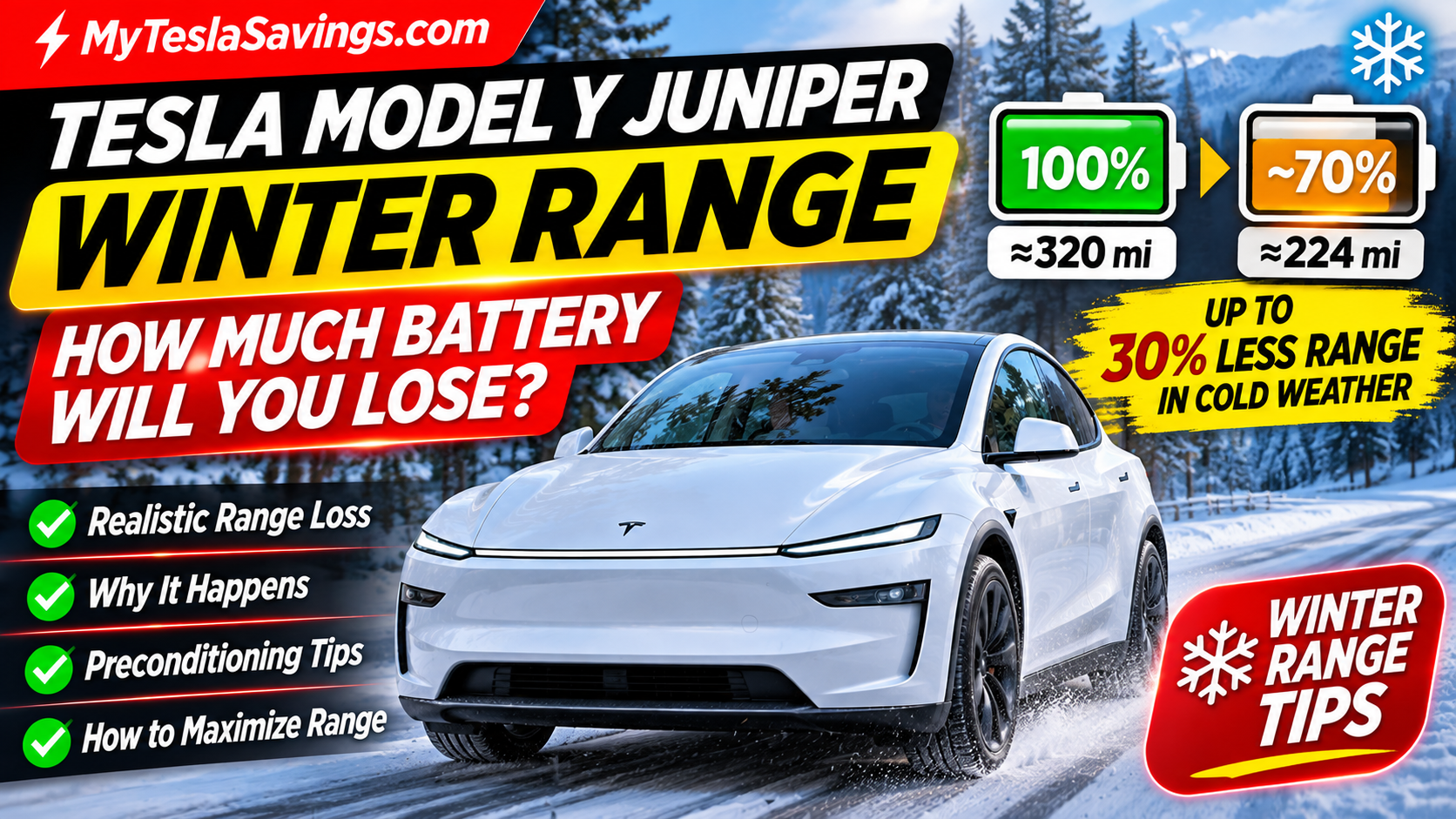
A reasonable starting point for winter trip planning is to allow for approximately 15–30% less usable driving range than you experience in mild weather. In severe conditions, especially during high-speed highway driving or repeated short trips, the reduction can be greater.
This is a planning guideline, not a measured winter-range result for every Juniper configuration.
Real-world EV research from Recurrent, published in November 2025, found that 34 EV models averaged approximately 78% of their ideal-temperature range at 32°F and 70% at 20°F.
That represents average reductions of approximately 22% and 30%, respectively.
However, the study covers multiple electric vehicles and should not be interpreted as a precise Juniper-specific test.
Tesla Model Y Juniper Winter Range: Example Estimates
Let’s use a Model Y that delivers 320 miles of driving range under favorable conditions.
| Winter Range Reduction | Estimated Remaining Range | Miles Lost |
|---|---|---|
| 10% | 288 miles | 32 miles |
| 15% | 272 miles | 48 miles |
| 20% | 256 miles | 64 miles |
| 25% | 240 miles | 80 miles |
| 30% | 224 miles | 96 miles |
| 35% | 208 miles | 112 miles |
Important: These are mathematical examples using a hypothetical 320-mile starting range, not official EPA ratings or independently tested Juniper winter results.
Your actual range depends on your Model Y configuration, battery charge, temperature, driving speed, wind, road conditions, tires, and heating usage.
A Tesla Model Y driven at 25°F on a clear road may perform very differently from the same vehicle traveling at 5°F through snow and strong headwinds.
Why Does the Tesla Model Y Juniper Lose Range in Cold Weather?
The refreshed Model Y Juniper includes efficiency-focused engineering, but it still operates under the same basic battery and physics limitations as other electric vehicles.
Here are the biggest reasons winter affects your range.
1. Cold Batteries Are Less Efficient
Tesla’s lithium-ion battery operates best within an appropriate temperature range.
When the battery becomes cold, internal resistance increases and some stored energy may temporarily become less accessible.
Your Model Y may need to warm the battery before it can deliver its normal performance.
This process consumes energy.
You may also notice reduced regenerative braking or charging performance until the battery warms up.
2. Heating the Cabin Uses Energy
Unlike a gasoline vehicle, which can use substantial waste heat from its engine, an EV must manage its available electrical and thermal energy carefully.
Your Tesla uses a heat pump to heat the cabin and manage battery temperatures.
Heat pumps are generally more efficient than conventional resistance heating under many conditions, but cabin heating still requires energy.
The colder the outside temperature, the harder the heating system may need to work.
3. Highway Driving Increases Energy Consumption
Cold air is denser than warm air, increasing aerodynamic resistance.
This matters especially at highway speeds.
Driving at 75 mph in freezing weather can consume significantly more energy than driving at 55–60 mph in mild conditions.
Add snow, wet pavement, strong winds, and winter tires, and energy consumption can climb further.
4. Short Trips Can Be Surprisingly Inefficient
Imagine your Tesla sits outside overnight in 15°F weather.
You drive five miles to the store, park for an hour, and drive home.
The vehicle may use energy warming the cabin and battery for both trips.
Because you’re traveling such a short distance, that initial heating energy represents a large percentage of the total energy consumed.
This is one reason winter efficiency can look especially poor during repeated short errands.
5. Tire Pressure Drops in Cold Weather
Cold weather reduces tire pressure.
Underinflated tires increase rolling resistance and can reduce efficiency.
Tesla notes that tire pressure changes by approximately 1 PSI for every 10°F change in ambient temperature.
Check your tires when cold and maintain the pressure recommended for your specific vehicle.
Does the New Model Y Juniper Handle Winter Better Than the Older Model Y?
The refreshed Model Y benefits from Tesla’s ongoing improvements to vehicle efficiency, comfort, aerodynamics, and thermal management.
However, that does not mean the Juniper is immune to winter range loss.
Both the previous-generation Model Y and the refreshed Juniper use heat-pump-based thermal management.
A direct comparison requires testing similarly equipped vehicles under the same temperature, speed, tire, battery, and road conditions.
Without that controlled comparison, it would be misleading to claim that the Juniper loses a specific percentage less range than the older Model Y.
The bottom line: The Juniper is designed to be an efficient electric SUV, but winter driving still requires planning.
The Best Way to Improve Tesla Model Y Juniper Winter Range: Preconditioning
If you only make one change to your winter driving routine, make it this:
Precondition your Tesla before leaving home, preferably while it’s plugged into your home charger.
Preconditioning prepares the cabin and battery before you start driving.
This can reduce the amount of energy your Tesla needs to use for heating once you’re on the road.
How to Schedule Tesla Model Y Juniper Preconditioning
- Open the Tesla mobile app.
- Select Schedule.
- Choose your home location.
- Create a preconditioning schedule.
- Set your usual departure time and days.
- Leave your vehicle plugged in when practical.
You can also configure the schedule through your vehicle’s touchscreen under Controls → Schedule.
Tesla automatically determines when to begin warming the vehicle based on your scheduled departure.
Why Preconditioning While Plugged In Matters
Let’s say your Tesla needs energy to warm the cabin and battery before a morning commute.
If the car is unplugged, that energy comes from the battery.
If the car is connected to a home charger, some or all of the heating energy can come from the charging system instead, depending on available charging power and conditions.
This helps preserve more of your battery’s stored energy for driving.
It doesn’t eliminate winter energy consumption, but it can improve your driving range and comfort.
Should You Charge Your Tesla Model Y to 100% in Winter?
Not necessarily.
Your recommended daily charging limit depends on your Model Y’s battery configuration and Tesla’s current guidance for that vehicle.
Some battery chemistries have different recommended charging practices.
Follow the charging recommendation displayed in your Tesla rather than assuming every Model Y Juniper should charge to 80% or 100%.
For longer winter road trips, charging to a higher level may be appropriate when recommended and permitted by your vehicle.
If you plan to depart with a high state of charge, scheduling charging to finish shortly before departure can be beneficial.
This reduces the time the battery sits cooling down after charging.
Does the Tesla Model Y Juniper Heat Pump Save Winter Range?
Yes, the heat pump helps the vehicle manage heating energy efficiently.
Instead of relying entirely on electrical resistance heating, a heat pump transfers heat between different parts of the vehicle’s thermal system.
Tesla’s system can make use of available heat from components such as the battery and powertrain.
That can reduce the energy required for heating under suitable conditions.
But the heat pump is not a magic solution.
At very low temperatures, maintaining comfortable cabin and battery temperatures still requires significant energy.
Winter range loss can happen even when the heat pump is operating normally.
10 Ways to Maximize Tesla Model Y Juniper Winter Range
Here are ten practical changes that can make a difference.
1. Precondition Before Every Morning Commute
Use Tesla’s scheduled preconditioning feature, especially if your car sits outside overnight.
2. Keep Your Tesla Plugged In When Possible
A plugged-in vehicle can use external power for heating and battery management, helping preserve battery energy.
3. Use Seat Heaters Efficiently
Tesla recommends using seat heaters and lowering the cabin temperature slightly to reduce heating demand.
Never sacrifice visibility or safe defogging to save energy.
4. Reduce Highway Speed
Aerodynamic drag increases rapidly with speed.
Even a modest reduction in highway speed can improve efficiency, especially on longer winter trips.
5. Check Tire Pressure Regularly
Maintain Tesla’s recommended cold tire pressure.
Do not intentionally overinflate your tires to chase extra range.
6. Remove Unnecessary Cargo and Exterior Accessories
Roof racks, cargo boxes, and other external accessories can increase aerodynamic drag.
Remove them when not needed.
7. Use Navigation for Supercharger Stops
When you navigate to a Supercharger, Tesla can prepare the battery for faster charging.
This may consume some energy before arrival but can reduce charging delays.
8. Avoid Excessive Cabin Heating While Parked
Climate Keep, Camp Mode, and extended preheating while unplugged can consume battery energy.
Use them when needed, but understand their impact.
9. Monitor Your Tesla Energy App
Your vehicle’s Energy app helps you understand which conditions and systems are affecting consumption.
Look for changes in driving, climate, elevation, and other energy use.
10. Plan Winter Road Trips With a Larger Charging Buffer
Don’t plan to arrive at a charger with almost no battery remaining.
Snow, traffic, detours, wind, and charging-station availability can change your energy needs.
Give yourself extra flexibility during severe weather.
How Much More Does It Cost to Charge a Tesla Model Y in Winter?
Winter range loss also means your Tesla may require more electricity to drive the same distance.
Let’s use a simplified example.
Assume your Model Y consumes 260 Wh per mile in mild weather.
During winter, energy consumption rises to 325 Wh per mile.
That’s a 25% increase in electricity consumption per mile.
For 1,000 miles of driving:
| Measurement | Mild Weather | Winter |
|---|---|---|
| Energy consumption | 260 Wh/mi | 325 Wh/mi |
| Electricity needed | 260 kWh | 325 kWh |
| Electricity price | $0.15/kWh | $0.15/kWh |
| Estimated energy cost | $39.00 | $48.75 |
Additional winter electricity cost: $9.75 per 1,000 miles.
These examples exclude charging losses, utility fees, and energy used while parked.
Your actual costs will depend on your electricity rate, driving conditions, and charging habits.
Calculate Your Own Tesla Charging Costs
Want to see how much you’re spending to charge your Tesla?
Use our free Tesla charging and savings tools at:
MyTeslaSavings.com Savings Calculators
Compare home charging, public charging, and your overall Tesla ownership savings.
Does Supercharging Take Longer in Winter?
It can.
A cold Tesla battery may not accept high charging power immediately.
If you arrive at a Supercharger with a cold battery, charging speed can be reduced while the battery warms.
Tesla recommends navigating to your Supercharger destination through the vehicle’s navigation system so the battery can be prepared ahead of arrival.
Winter Supercharging Tips
- Navigate to the Supercharger before arriving.
- Allow the vehicle to manage battery preconditioning.
- Avoid planning charging stops with an extremely low arrival percentage in severe weather.
- Expect charging speeds to vary with battery temperature, state of charge, charger conditions, and vehicle configuration.
- Build additional time into long winter road trips.
Does Winter Permanently Damage Your Tesla Model Y Battery?
Normal cold-weather range loss does not automatically mean permanent battery degradation.
When temperatures rise and the battery returns to an appropriate operating temperature, some temporary range limitations may disappear.
Permanent battery degradation is a separate process that develops over time and depends on numerous factors.
If you notice a large reduction in usable capacity that continues in mild weather, review your vehicle’s energy information and consult Tesla Service if necessary.
Why Does My Tesla Show a Snowflake Icon?
A blue snowflake icon can appear when your Tesla’s battery is cold.
It indicates that some stored battery energy is temporarily unavailable.
You may also experience reduced regenerative braking, acceleration, or charging performance.
As the battery warms, those restrictions may decrease.
The icon by itself does not mean your battery is defective.
Best Tesla Model Y Juniper Winter Accessories
Some accessories won’t directly increase battery range, but they can make winter ownership safer and more convenient.
1. Winter Floor Mats
All-weather mats help protect your interior from snow, road salt, mud, and moisture.
2. Windshield Snow Cover
A properly fitted snow cover can make morning snow and ice removal easier.
Remove it completely before driving and ensure it doesn’t interfere with cameras or vehicle components.
3. Winter Tires
Winter tires can improve traction and braking performance in cold, snowy, or icy conditions.
They may affect efficiency, but safety should always come first.
4. Portable Tire Inflator
A portable inflator makes it easier to maintain recommended tire pressure as temperatures change.
5. Snow Brush and Ice Scraper
Choose tools suitable for automotive glass and finishes, and follow Tesla’s winter care guidance.
Explore Tesla accessories: Visit the MyTeslaSavings.com Tesla Accessories section for more owner recommendations and product guides.
Affiliate disclosure: MyTeslaSavings.com may earn commissions from qualifying purchases through affiliate links.
Tesla Model Y Juniper Winter Road Trip: What Should You Expect?
Imagine you’re planning a 300-mile winter highway trip.
In mild weather, your Tesla may complete much of the trip with relatively little charging, depending on your battery, starting charge, and driving conditions.
In winter, you could need an additional charging stop or a longer stop.
That doesn’t necessarily make the trip impractical.
It means you should plan using real driving conditions instead of assuming you’ll always achieve your best summertime range.
Use Tesla’s navigation system to estimate charging stops and arrival battery levels.
Keep a reasonable buffer, particularly when traveling through areas with limited charging options.
And remember that stopping for meals, restrooms, or breaks can often overlap with charging.
Frequently Asked Questions About Tesla Model Y Juniper Winter Range
How much range does the Tesla Model Y Juniper lose in winter?
A 15–30% reduction is a useful starting allowance for winter planning, although real results vary considerably. Severe cold, high speeds, snow, wind, and short trips can cause larger reductions.
Does the 2026 Tesla Model Y Juniper have better winter range?
The refreshed Model Y includes efficiency improvements, but its exact winter-range advantage over older Model Y versions depends on controlled comparisons. No universal percentage improvement should be assumed.
Does preconditioning really save battery?
Preconditioning can help preserve driving range, particularly when the vehicle is plugged into a charger and the battery and cabin are warmed before departure.
Should I precondition my Tesla every winter morning?
It’s generally beneficial when temperatures are low, especially if you have a regular departure time and access to home charging.
Should I charge my Tesla to 100% before a winter trip?
Follow your vehicle’s battery-specific charging recommendations. A higher charge level may be appropriate before some long trips, but not every Model Y battery has the same daily charging guidance.
Why does my Tesla lose battery overnight in winter?
Cold-weather battery management, cabin preconditioning, Sentry Mode, and other parked features may consume energy. Some temporarily unavailable energy can also affect the displayed battery indication.
Is Tesla Model Y Juniper AWD better in snow?
All-wheel drive can improve traction when accelerating, but it does not eliminate the need for appropriate tires, cautious driving, or longer stopping distances.
Does using heated seats save more energy than heating the cabin?
Heated seats generally use less energy than heating the entire cabin. Tesla recommends using seat heaters while moderately reducing cabin heating when appropriate.
Does winter permanently reduce Tesla battery capacity?
Cold temperatures can temporarily reduce available energy and performance. That is different from permanent battery degradation.
Can I take a Tesla Model Y Juniper on a long winter road trip?
Yes. Plan charging stops using Tesla navigation, account for weather and road conditions, and maintain an appropriate charging buffer.
Final Verdict: Is the Tesla Model Y Juniper Good in Winter?
Yes. The Tesla Model Y Juniper can be a capable winter vehicle, but owners should expect lower efficiency in cold temperatures.
The biggest mistake is assuming your Tesla will travel exactly the same distance in January as it does in June.
Cold batteries, cabin heating, winter tires, wind, and highway driving all affect energy consumption.
Fortunately, Tesla provides useful tools to manage those challenges.
Precondition your vehicle while plugged in, maintain proper tire pressure, use seat heaters efficiently, and plan charging stops carefully.
For everyday commuting, these simple habits can make winter Tesla ownership much easier.
For road trips, realistic range expectations and a little extra charging time can help prevent unnecessary stress.
Want to spend less on Tesla ownership?
Explore the charging calculators, owner guides, and accessory recommendations at MyTeslaSavings.com.
Because owning a Tesla should be about enjoying the drive — not worrying about every percentage point of battery.
Research note: The 15–30% winter range allowance is a general planning estimate, not a Juniper-specific laboratory result. The example range and charging-cost calculations are illustrative. Vehicle configuration, battery chemistry, temperature, driving conditions, and charging behavior affect actual results.