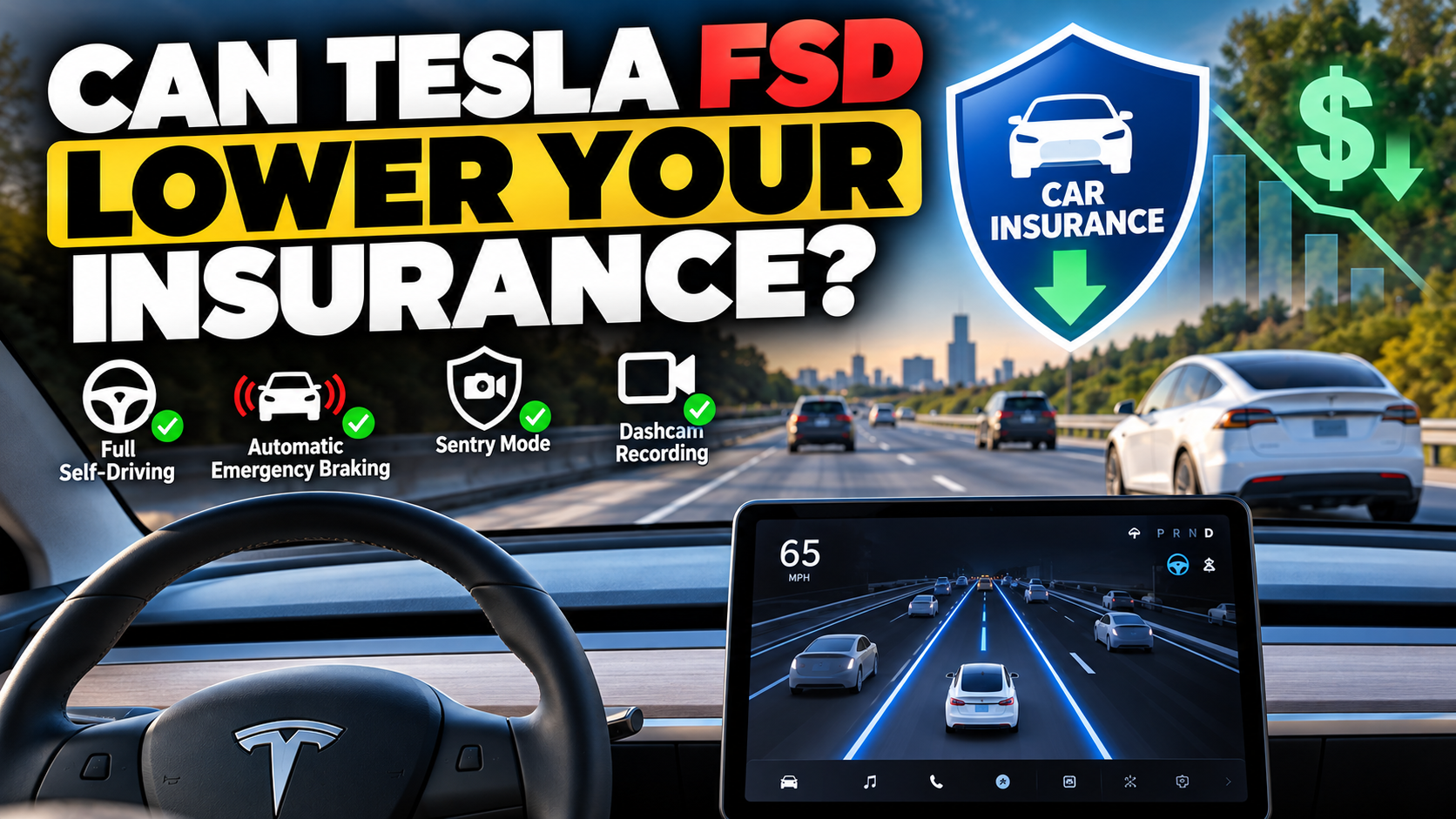
Tesla vehicles are packed with advanced safety technology, but can features like Full Self-Driving, Sentry Mode, and automatic emergency braking actually lower your insurance bill? Here’s what Tesla owners need to know.
If you own a Tesla, you’ve probably experienced some of the technology that makes these vehicles different from traditional cars. From Full Self-Driving (Supervised) to automatic emergency braking and built-in Dashcam recording, Tesla offers an impressive collection of safety and driver-assistance features.
But there’s one question that doesn’t get discussed enough:
Can Tesla’s technology actually save you money on car insurance?
The answer might surprise you.
Tesla Insurance offers eligible drivers a way to potentially reduce their insurance costs based on how frequently they use Full Self-Driving (FSD). And depending on your insurance provider, other safety features may also influence your premiums.
However, not every insurance company offers these benefits, and owning a Tesla with advanced safety technology doesn’t automatically mean you’ll pay less.
Let’s break down how it works, which features might help you save, and what you should check before your next insurance renewal.
Can Tesla Full Self-Driving Lower Your Insurance Premium?
Yes! Eligible Tesla Insurance customers can potentially save money based on how much they use Full Self-Driving (Supervised).
Tesla has introduced insurance pricing benefits that recognize FSD usage.
Instead of simply checking whether your vehicle has Full Self-Driving installed, Tesla can evaluate the percentage of miles you actually drive with FSD engaged.
Here’s an Example
Imagine you drive 1,000 miles in a month.
| Driving Type | Miles Driven |
|---|---|
| Full Self-Driving engaged | 700 miles |
| Manual driving | 300 miles |
| Total mileage | 1,000 miles |
| FSD usage | 70% |
In this example, 70% of your driving was completed with FSD engaged.
For eligible Tesla Insurance customers, that percentage can affect the calculation used to determine their insurance premium.
Tesla has described different approaches depending on the policy and state, including an earlier FSD discount on qualifying coverages and a newer approach that incorporates FSD usage into its Safety Score system.
The important takeaway: If you already use FSD regularly, your driving habits may qualify you for an insurance benefit without changing how much you drive.
However, the actual savings depend on your policy, location, and eligibility.
How Tesla’s Safety Score Can Help Lower Insurance Costs
Tesla Insurance uses a system called Safety Score to evaluate certain driving behaviors.
In participating states, that score can help determine your insurance premium.
Tesla’s Safety Score evaluates factors associated with driving risk, while its newer FSD-adjusted scoring method can recognize miles driven using Full Self-Driving.
How Does the FSD-Adjusted Safety Score Work?
Tesla’s published Safety Score version 3.0 methodology uses this calculation:
Adjusted Safety Score = (FSD mileage percentage × 100) + (Manual mileage percentage × regular Safety Score)
Let’s use a simple example.
Suppose your regular Safety Score is 85.
You drive 70% of your miles using FSD and 30% manually.
Your calculation would look like this:
(0.70 × 100) + (0.30 × 85)
70 + 25.5 = 95.5
Your adjusted score would be 95.5 instead of 85.
That’s a significant improvement in the score used for eligible insurance pricing.
A higher adjusted Safety Score may result in a lower insurance premium, although the amount saved varies.
Does That Mean You Should Use FSD All the Time?
Not necessarily.
Tesla Full Self-Driving is still a supervised driver-assistance system.
It does not make your Tesla fully autonomous.
Drivers must remain attentive, monitor their surroundings, and be ready to take control whenever necessary.
You should never activate FSD solely to increase your insurance savings when road conditions make its use inappropriate.
Which Tesla Safety Features Could Help You Save on Insurance?
Full Self-Driving isn’t the only technology that might affect insurance costs.
Tesla vehicles include several safety and security features that insurers may consider when evaluating risk.
Some insurers offer discounts for qualifying equipment, while others already factor vehicle safety technology into their standard pricing.
Here’s a closer look.
1. Automatic Emergency Braking
Tesla’s Automatic Emergency Braking system is designed to help reduce the severity of certain collisions by applying the brakes when the vehicle detects a potential collision.
Depending on the situation, it may help prevent an accident or reduce its impact.
Insurance savings potential: Some insurers offer discounts for qualifying accident-prevention technology, but a separate discount is not guaranteed.
2. Forward Collision Warning
Tesla’s Forward Collision Warning system alerts drivers when it detects a potential frontal collision.
This feature is also relevant to Tesla’s Safety Score methodology.
Drivers who maintain safe following distances and avoid situations that trigger warnings may improve certain driving metrics.
Insurance savings potential: Safer driving behavior may positively influence eligible usage-based insurance programs.
3. Blind Spot and Lane Departure Safety Features
Tesla vehicles may include blind spot warnings, lane departure avoidance, and other active safety systems.
These features can help drivers recognize potential hazards.
Insurance savings potential: Some insurers account for vehicle safety equipment when determining premiums, although individual discounts vary.
4. Tesla Sentry Mode
Sentry Mode is one of Tesla’s most recognizable security features.
When activated under the appropriate conditions, it can monitor certain activity around your parked vehicle and potentially record footage.
This can be particularly useful when your Tesla is parked in public areas.
Insurance savings potential: Some insurers offer anti-theft or security equipment discounts, but Sentry Mode does not automatically qualify.
Even without a discount, recorded footage may help document an incident.
5. Tesla Dashcam
Tesla’s built-in Dashcam can capture footage while driving when properly configured and supported by functioning storage.
That footage may become valuable if you’re involved in an accident.
For example, imagine another driver backs into your Tesla and then claims you were responsible.
If your Dashcam recorded the incident, the footage could help your insurance company understand what happened.
Insurance savings potential: Dashcam footage generally doesn’t guarantee a premium discount, but it may help support an insurance claim.
Tesla owner tip: Make sure your Dashcam is configured to save footage automatically and that your USB storage is functioning properly. Don’t wait until after an accident to test it.
Why Is Tesla Insurance Sometimes So Expensive?
With all these safety features, you might wonder why Tesla insurance premiums can still be expensive.
The answer is that insurance companies consider much more than accident-prevention technology.
Tesla Repair Costs
Tesla vehicles contain specialized components, cameras, sensors, and electronics.
Certain repairs require specialized parts, equipment, or labor.
Even seemingly minor accidents can result in expensive repairs.
Vehicle Replacement Value
Insurance companies consider how much it would cost to replace your vehicle after a total loss.
A newer Tesla with a higher replacement value may cost more to insure than an older vehicle.
Your Location
Insurance premiums vary significantly depending on where you live.
Insurers consider factors such as local accident rates, repair costs, theft trends, and state insurance requirements.
Your Driving History
Accidents, traffic violations, and previous claims can affect your insurance premiums.
Even if you use FSD regularly, your driving record still matters.
Your Coverage and Deductibles
A policy with higher liability limits, comprehensive coverage, collision coverage, and lower deductibles may cost more than a policy with less protection.
That doesn’t necessarily mean the cheaper policy is the better choice.
The bottom line: Advanced safety technology is only one part of the insurance pricing equation.
Does Sentry Mode Help With Insurance Claims?
Sentry Mode may not directly lower your insurance premium, but it can still be useful when something happens to your vehicle.
Imagine returning to your Tesla in a parking lot and discovering damage to the front bumper.
You don’t know who caused it.
If Sentry Mode captured the event, you may have video evidence showing what happened.
That footage could potentially help with:
- Hit-and-run investigations
- Parking lot damage claims
- Vandalism reports
- Disputes about how damage occurred
- Providing additional evidence to an insurance adjuster
However, Sentry Mode doesn’t capture every incident.
Its effectiveness depends on factors such as your settings, available storage, battery level, and whether the event triggers recording.
For the best protection, review your Sentry Mode settings and regularly confirm your USB storage is working.
Can Traditional Insurance Companies Give Discounts for Tesla FSD?
This is where Tesla owners need to pay attention.
Tesla Insurance’s FSD-related pricing benefits are not necessarily available through traditional insurance companies.
Most insurers calculate premiums using factors such as driving history, vehicle type, location, annual mileage, and coverage selections.
Some also offer usage-based insurance programs that evaluate driving habits.
However, many traditional insurers do not advertise a separate discount based specifically on the percentage of miles driven using Tesla Full Self-Driving.
That doesn’t mean your Tesla’s safety technology provides no value.
Some insurers may already consider advanced driver-assistance systems when pricing your particular vehicle.
Others may offer qualifying safety equipment discounts.
The best way to find out is to ask.
Questions to Ask Your Insurance Company
When requesting a Tesla insurance quote, consider asking:
- Do you offer discounts for automatic emergency braking or other advanced safety systems?
- Does my Tesla’s factory-installed security equipment qualify for an anti-theft discount?
- Do you offer usage-based insurance or low-mileage discounts?
- Do you offer any specific discounts for Full Self-Driving?
- Would adjusting my deductible meaningfully reduce my premium?
These questions can help uncover potential savings you might otherwise miss.
5 Smart Ways to Save Money on Tesla Insurance
You don’t need to rely entirely on Full Self-Driving to potentially lower your insurance bill.
Here are five strategies worth considering.
1. Check Your FSD Insurance Benefits
If you have Tesla Insurance, review your policy to determine whether your FSD usage qualifies for a premium benefit.
You may already be receiving a benefit based on your driving activity.
2. Compare Tesla Insurance Quotes
One of the simplest ways to look for savings is to compare multiple insurance companies.
Rates can vary considerably between insurers.
A company offering the lowest rate for one Tesla owner may not be the most affordable for another.
When comparing quotes, make sure you’re looking at similar coverage limits and deductibles.
3. Ask About Available Discounts
Don’t assume your insurer automatically applies every discount.
Ask about:
- Vehicle safety equipment
- Anti-theft systems
- Multi-vehicle policies
- Bundling home and auto insurance
- Low annual mileage
- Safe driving programs
- Automatic payment discounts
Eligibility varies by insurer and state.
4. Review Your Annual Mileage
If you work from home or drive less than you used to, your annual mileage estimate may be outdated.
Some insurers offer more favorable pricing for lower-mileage drivers.
Make sure your policy reflects your actual driving habits.
5. Consider Your Deductible
Choosing a higher deductible may reduce your monthly premium.
However, it also increases the amount you would pay out of pocket after a covered claim.
Make sure any deductible you choose fits your financial situation.
Is Full Self-Driving Worth Buying Just for Insurance Savings?
This is one of the most important questions Tesla owners should ask.
If you’re thinking about purchasing or subscribing to FSD primarily because it might lower your insurance premium, you need to compare the costs.
Let’s look at a hypothetical example.
| Expense or Savings | Monthly Amount |
|---|---|
| Example FSD subscription cost | $99 |
| Example insurance savings | $15 |
| Net additional monthly cost | $84 |
These are illustrative amounts, not a current FSD subscription quote or a guaranteed insurance discount.
In this scenario, paying for FSD solely to save money on insurance wouldn’t make financial sense.
However, if you already subscribe to FSD because you enjoy its features, a qualifying insurance benefit could help offset some of the expense.
Our recommendation: Treat insurance savings as a potential bonus rather than the primary reason to purchase Full Self-Driving.
How to Check Whether FSD Is Lowering Your Insurance
If you’re an eligible Tesla Insurance customer, you may be able to review your FSD usage and insurance information directly in the Tesla app.
Step 1: Open the Tesla App
Launch the Tesla app on your smartphone.
Step 2: Find Your Safety Score
If available for your policy, navigate to the Safety Score section.
Step 3: Review Your FSD Mileage
Look for information showing the percentage of your miles driven with FSD engaged.
Step 4: Review Your Insurance Premium
Check your estimated upcoming premium and available policy details.
Step 5: Compare Your Current Coverage
Review your coverage limits, deductibles, and any applicable discounts before deciding whether to make changes.
Important: Not every Tesla Insurance policy uses the same Safety Score or FSD pricing methodology. Availability depends on state and policy eligibility.
For current program details, visit Tesla’s official insurance information at tesla.com/support/insurance.
Frequently Asked Questions About Tesla Insurance Discounts
Does Tesla Full Self-Driving automatically lower insurance?
No. Eligible Tesla Insurance customers may receive a premium benefit based on FSD usage, but simply having FSD installed doesn’t guarantee a discount.
How much can Full Self-Driving save on insurance?
There isn’t one guaranteed savings amount. Tesla has described an earlier discount of up to 10% on qualifying coverages, while newer eligible policies may incorporate FSD mileage into an adjusted Safety Score. Your actual savings depend on your policy.
Does Tesla Autopilot lower insurance premiums?
Not automatically. Standard Autopilot should not be assumed to qualify for the same benefits as Full Self-Driving. Ask your insurer whether it recognizes specific driver-assistance features.
Can Sentry Mode lower my Tesla insurance?
Possibly, but not automatically. Some insurers offer discounts for qualifying anti-theft equipment. Whether your Tesla qualifies depends on your insurer and policy.
Does Tesla Dashcam footage help with insurance claims?
It can. If your Dashcam captures an accident or damage, the footage may provide useful evidence during a claim investigation.
Is Tesla Insurance cheaper than traditional insurance?
Sometimes, but not always. Pricing depends on your location, driving history, vehicle, coverage, and other factors. Comparing quotes is the best way to evaluate your options.
Is it worth subscribing to FSD just for insurance savings?
Usually, you should evaluate the subscription cost separately from any potential insurance benefit. A discount may offset part of the expense, but it may not cover the full cost of FSD.
Can I save on Tesla insurance without FSD?
Yes. Comparing insurers, maintaining a good driving record, reviewing discounts, reporting accurate mileage, and selecting appropriate deductibles can all help.
Final Thoughts: Are Tesla’s Safety Features Actually Saving You Money?
Tesla vehicles offer some of the most recognizable driver-assistance and security features on the road.
And for eligible Tesla Insurance customers, Full Self-Driving usage can now play a direct role in insurance pricing.
That’s an interesting development for Tesla owners who already use FSD regularly.
But FSD isn’t the only feature worth considering.
Automatic emergency braking, vehicle security equipment, Sentry Mode, and Dashcam may provide additional safety, security, or claims-related benefits—even when they don’t qualify for direct insurance discounts.
The biggest opportunity may be something much simpler:
Make sure you’re not overpaying for your Tesla insurance in the first place.
Before your next renewal, review your coverage, ask about available discounts, and compare quotes from multiple insurance providers.
Your Tesla is designed to be smart. Your insurance shopping should be, too.
Disclaimer: This article is for general educational purposes and does not constitute insurance, legal, or financial advice. Insurance rates, discounts, program availability, and eligibility vary by state, insurer, and policy. Tesla Full Self-Driving (Supervised) requires an attentive driver and does not make the vehicle autonomous. Verify current insurance program terms directly with your provider.