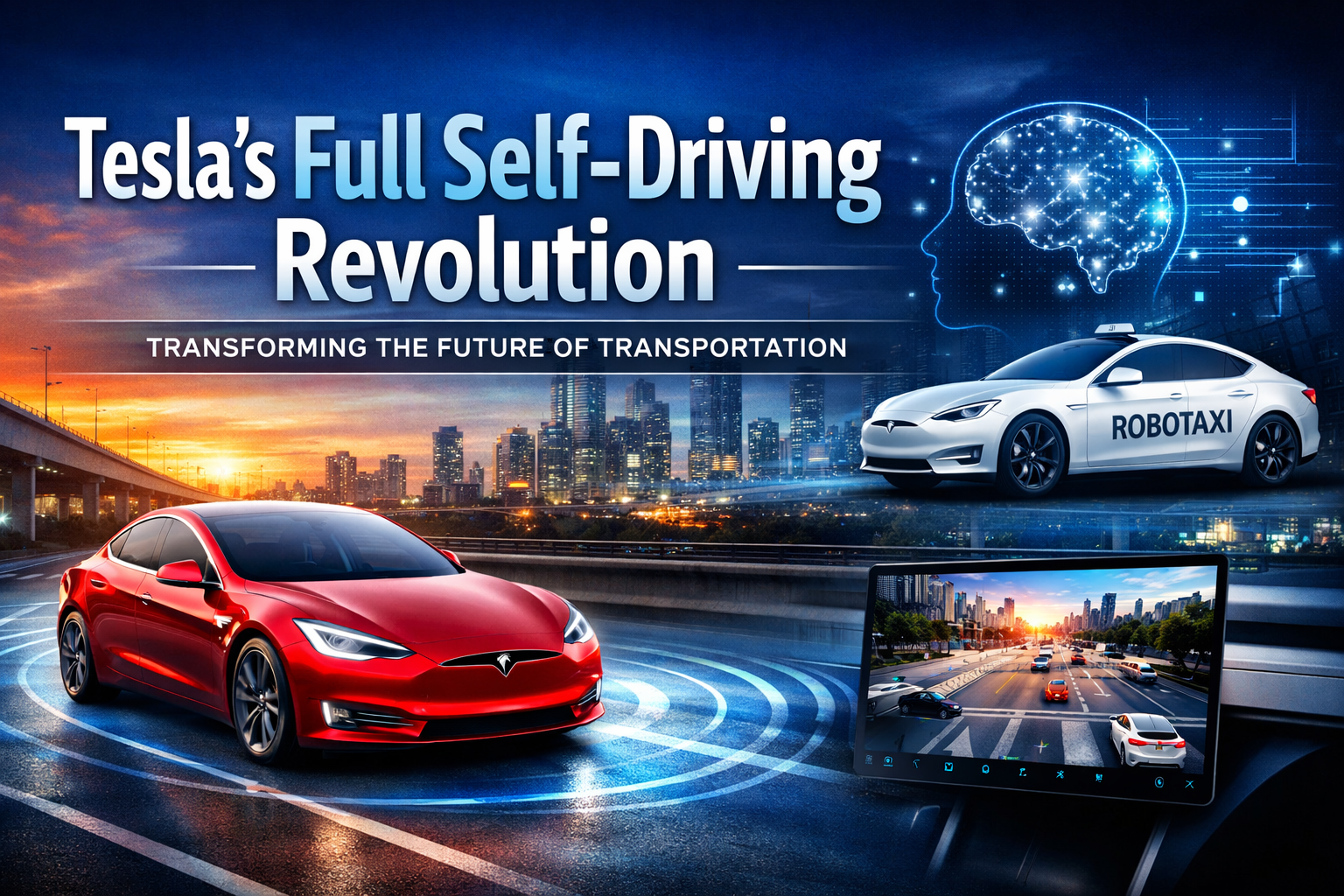
Explore how Tesla’s Full Self-Driving (FSD) technology is changing transportation, autonomy, safety, and the future of electric vehicles in 2026 and beyond.
Introduction
Tesla has never been just another car company. Since its early days, Tesla has positioned itself as a technology company that happens to build vehicles. While electric vehicles (EVs) brought Tesla into the spotlight, its most revolutionary innovation may actually be software—specifically Tesla’s Full Self-Driving (FSD) technology.
Over the past few years, Tesla has been aggressively developing autonomous driving capabilities that aim to eliminate the need for human drivers entirely. In 2026, the conversation around Tesla is no longer just about range, acceleration, or charging speed. Instead, the most exciting discussion centers on autonomous driving and the coming robotaxi economy.
Tesla’s FSD system has evolved dramatically through neural networks, AI training using billions of miles of real-world driving data, and over-the-air updates that continually improve vehicle intelligence.
In this article, we’ll explore:
- What Tesla Full Self-Driving actually is
- How it works using AI and neural networks
- Why Tesla’s approach is different from other automakers
- How FSD is changing road safety
- The coming Tesla robotaxi network
- How Tesla owners can benefit financially
- What the future of autonomy may look like
If Tesla succeeds, the next decade may fundamentally change how humans travel.
Understanding Tesla Full Self-Driving (FSD)
Tesla’s Full Self-Driving capability is an advanced driver-assistance system designed to allow Tesla vehicles to navigate roads with minimal human intervention.
While the name suggests complete autonomy, the current version still requires driver supervision. However, Tesla’s long-term goal is Level 4 or Level 5 autonomy, where vehicles operate fully independently.
Tesla FSD includes several features:
Navigate on Autopilot
This allows the car to automatically:
- Enter highways
- Change lanes
- Navigate interchanges
- Exit highways
The system calculates optimal routes while responding to surrounding traffic conditions.
Automatic Lane Changes
Tesla vehicles can automatically switch lanes to maintain traffic flow or prepare for turns.
Autopark
FSD allows Teslas to detect parking spaces and automatically park without driver input.
Smart Summon
Your Tesla can navigate a parking lot to reach you.
Traffic Light and Stop Sign Control
The vehicle can recognize traffic lights and stop signs and respond accordingly.
City Street Driving (FSD Beta)
One of the most advanced features is city navigation, where the car:
- Handles intersections
- Turns at traffic lights
- Navigates complex urban roads
- Responds to pedestrians and cyclists
This capability is where Tesla’s AI breakthroughs become most apparent.
The AI Behind Tesla’s Self-Driving Technology
Unlike traditional automakers that rely heavily on lidar and pre-mapped environments, Tesla uses a vision-based AI system.
This means Tesla vehicles rely primarily on:
- Cameras
- Neural networks
- Real-world driving data
- AI training models
Tesla calls this approach Tesla Vision.
The Neural Network Advantage
Tesla vehicles are constantly collecting driving data from millions of cars around the world.
Every mile driven helps train Tesla’s neural networks.
These networks learn to recognize:
- Road markings
- Pedestrians
- Vehicles
- Traffic signals
- Construction zones
- Weather conditions
Tesla feeds this data into its massive AI training infrastructure known as the Dojo supercomputer.
Dojo trains neural networks at an incredible scale, allowing Tesla to rapidly improve driving intelligence.
This approach gives Tesla an advantage because no other company has access to such a massive real-world dataset.
Tesla’s Vision-Only Strategy
Many autonomous driving companies rely heavily on lidar sensors, which use lasers to create detailed 3D maps of the environment.
Tesla has rejected lidar.
Elon Musk famously described lidar as “a crutch.”
Instead, Tesla believes that human drivers rely primarily on vision, so autonomous vehicles should do the same.
Tesla vehicles rely on:
- Multiple cameras
- Radar (on some older vehicles)
- Ultrasonic sensors (earlier models)
- AI interpretation of visual data
This camera-based system dramatically reduces hardware costs while allowing Tesla vehicles to scale autonomy globally.
If Tesla succeeds with vision-only autonomy, it could make autonomous driving far more affordable than competing systems.
Over-the-Air Updates: Tesla’s Secret Weapon
One of Tesla’s biggest advantages is the ability to improve vehicles through over-the-air (OTA) software updates.
Unlike traditional automakers that require dealership visits, Tesla owners receive updates automatically.
These updates can improve:
- Driving performance
- Battery efficiency
- Entertainment features
- Safety systems
- Self-driving capabilities
For Tesla owners, this means their cars actually get better over time.
Many FSD users have experienced dramatic improvements in autonomous driving simply through software updates.
This constant improvement cycle allows Tesla to iterate faster than competitors.
Tesla FSD and Road Safety
One of the most important goals of autonomous driving is improving road safety.
Human drivers are responsible for the vast majority of accidents due to:
- Distraction
- Fatigue
- Impairment
- Human error
According to safety studies, autonomous driving has the potential to reduce accidents significantly.
Tesla’s AI never:
- Gets tired
- Uses a phone while driving
- Drives impaired
- Loses focus
While FSD is still improving, Tesla continues to release safety data showing strong performance compared to average human drivers.
As the technology evolves, autonomous driving may eventually become far safer than human driving.
The Tesla Robotaxi Vision
One of the most exciting developments tied to Tesla FSD is the Tesla robotaxi network.
Tesla’s long-term vision involves a fleet of autonomous vehicles that can operate as ride-sharing taxis.
Owners may be able to:
- Add their Tesla to the robotaxi network
- Allow the vehicle to drive passengers while they are not using it
- Earn income from autonomous rides
This could fundamentally change vehicle ownership.
Instead of sitting parked for most of the day, Teslas could become income-generating assets.
Imagine your Tesla driving passengers to work while you are at home or asleep.
The robotaxi model could reshape transportation economics.
Tesla’s Competitive Advantage in Autonomous Driving
Tesla faces competition from companies such as:
- Waymo
- Cruise
- Apple (rumored projects)
- Traditional automakers
- AI startups
However, Tesla holds several major advantages.
Massive Data Collection
Tesla vehicles have already driven billions of miles using Autopilot and FSD.
This real-world data is incredibly valuable for training AI.
Large Installed Fleet
Millions of Teslas are already on the road collecting data.
Each vehicle helps improve the neural networks.
Vertical Integration
Tesla controls:
- Hardware
- Software
- AI training
- Vehicle manufacturing
This vertical integration allows faster innovation.
Over-the-Air Updates
Tesla can deploy improvements instantly to millions of vehicles.
Tesla Hardware 4 and the Future of FSD
Tesla’s newest vehicles include Hardware 4 (HW4), which significantly upgrades the car’s computing capabilities.
HW4 includes:
- Higher-resolution cameras
- More powerful onboard AI chips
- Improved neural network processing
These upgrades allow Teslas to process driving environments more accurately and react faster.
Tesla continues to refine both hardware and software as it moves closer to full autonomy.
Future Tesla vehicles may include even more powerful AI processors capable of handling extremely complex driving scenarios.
Regulatory Challenges
While Tesla’s technology is advancing rapidly, regulatory approval remains a major challenge.
Different countries and states have varying rules regarding autonomous driving.
Key challenges include:
- Safety validation
- Liability concerns
- Insurance policies
- Government regulations
Tesla must prove that FSD is safe enough for large-scale deployment.
However, once regulators become confident in the technology, adoption could accelerate quickly.
What Tesla Owners Should Know About FSD
Tesla offers FSD as either:
- A one-time purchase
- A monthly subscription
Pricing has fluctuated over the years as Tesla continues improving the system.
Many Tesla owners choose FSD because they believe the value will increase significantly once full autonomy is achieved.
For those considering purchasing a Tesla, the ability to upgrade software later makes Tesla vehicles highly future-proof.
Saving Money on a Tesla
If you’re considering purchasing a Tesla, you can save $1,000 on your order by using a referral link.
👉 Use this referral link:
https://www.tesla.com/referral/krista64171
Tesla referral programs occasionally change, but they often provide buyers with discounts, credits, or other incentives.
For Tesla enthusiasts looking to learn more about ownership tips, accessories, and cost-saving strategies, check out MyTeslaSavings.com for more guides and resources.
The Future of Autonomous Transportation
Tesla’s FSD technology may be just the beginning.
Autonomous vehicles could transform:
- Transportation
- Urban design
- Car ownership
- Logistics and delivery
- Public transportation
Potential future impacts include:
Fewer Traffic Accidents
Autonomous vehicles could significantly reduce crashes.
Lower Transportation Costs
Robotaxi networks may make transportation cheaper than owning a car.
Increased Mobility
Autonomous vehicles could help:
- Elderly individuals
- People with disabilities
- Non-drivers
Reduced Traffic Congestion
AI-controlled vehicles may optimize traffic flow.
New Economic Opportunities
Entire industries could emerge around autonomous transportation.
Final Thoughts
Tesla’s Full Self-Driving technology represents one of the most ambitious technological challenges of our time.
While the system is still evolving, the progress made over the past few years has been remarkable.
If Tesla succeeds in achieving true autonomy, it could reshape transportation in ways similar to how smartphones transformed communication.
For Tesla owners and enthusiasts, the next decade will likely be one of the most exciting periods in automotive history.
Autonomous vehicles are no longer science fiction.
With Tesla leading the charge, the future of driving may soon mean not driving at all.

