
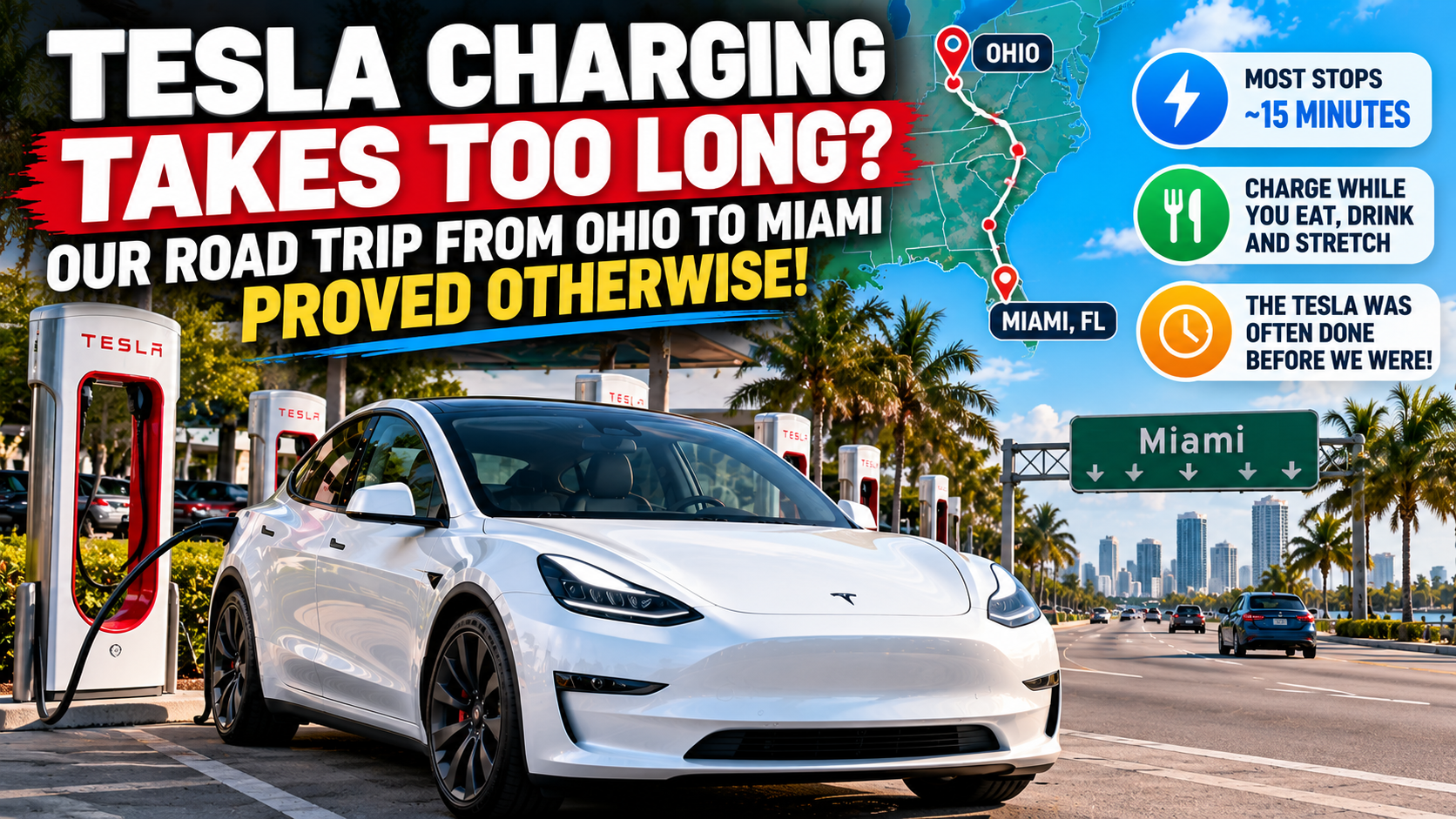
One of the biggest misconceptions about owning a Tesla is that charging takes too long, especially on a road trip. But after driving our Tesla from Ohio to Miami, Florida, we discovered something surprising: most charging stops took around 15 minutes, and more often than not, the car was ready to leave before we were.
If you’ve ever considered buying a Tesla, you’ve probably heard the same argument:
“I don’t want to sit around for 45 minutes waiting for my car to charge.”
Or maybe:
“I can fill up my gas tank in five minutes. Why would I want an electric vehicle?”
It’s one of the most common criticisms of electric vehicles, and it’s understandable. Nobody wants to spend their vacation sitting in a parking lot waiting for a battery to charge.
But here’s what many people don’t realize.
Taking a road trip in a Tesla is very different from what most people imagine.
The car doesn’t simply tell you when you’re almost out of battery. It intelligently plans charging stops along your route, calculates how much energy you’ll need, and recommends how long to charge before continuing.
And sometimes, the biggest delay at a charging stop isn’t the Tesla.
It’s you finishing your lunch.
Our Real-World Tesla Road Trip: Ohio to Miami, Florida
We recently took our Tesla on a road trip from Ohio to Miami, Florida.
That’s a substantial drive, covering roughly 1,200 miles or more depending on your starting point and route.
Before making a long trip in an electric vehicle, it’s natural to wonder whether charging stops will make the drive significantly longer.
Would we constantly be looking for chargers?
Would we have to sit around waiting for the battery?
Would charging become frustrating after several stops?
Our experience was almost the complete opposite.
Most of our Tesla Supercharging stops were completed in approximately 15 minutes.
And here’s the part that surprised us most:
At many stops, the Tesla was finished charging before we were finished eating, grabbing drinks, using the restroom, or stretching our legs.
Instead of standing beside a gas pump and then making a separate stop for food, we simply combined everything into one break.
By the time we returned to the car, it was often ready to continue.
That experience completely changes the conversation about how long charging really takes.
The Biggest Misconception: You Have to Charge Your Tesla to 100% at Every Stop
One of the main reasons people assume EV road trips take forever is that they imagine stopping to fully recharge the battery every time.
But that’s generally not how Tesla road-trip charging works.
You don’t necessarily need to charge from 10% to 100% at every Supercharger.
In fact, charging all the way to 100% at every stop can be an inefficient way to travel.
Why?
Because Tesla batteries typically accept energy much faster at lower states of charge than they do when approaching a full battery.
For many trips, it’s more efficient to charge just enough to comfortably reach the next recommended charging stop or your destination.
Your Tesla’s navigation system helps calculate that.
Instead of waiting for a full charge, you may only need a relatively short charging session before getting back on the road.
That’s exactly what made our Ohio-to-Miami trip so convenient.
Your Tesla Is Smarter Than You Think: How It Optimizes Road-Trip Charging
One of the most impressive features of Tesla ownership is the built-in navigation and trip-planning system.
When you enter a long-distance destination, your Tesla can automatically incorporate Supercharger stops into your route.
It considers factors such as:
- Your current battery level.
- The estimated energy needed to reach your destination.
- Available Supercharger locations along the route.
- Expected energy consumption.
- Driving conditions and other factors affecting range.
- How much charging is needed before continuing.
As you drive, the vehicle updates its energy predictions based on real-world conditions.
The result is a road trip that requires much less manual charging planning than many people expect.
The Tesla Doesn’t Always Want You to Fully Charge
Here’s an important detail.
Your Tesla may recommend charging for only 10, 15, or 20 minutes before continuing to the next stop.
That’s intentional.
The navigation system is trying to get you to your destination efficiently, not necessarily maximize your battery percentage at every charging location.
Depending on the route and charging conditions, several shorter stops may be faster than fewer, longer charging sessions.
This is why comparing a five-minute gasoline fill-up to a full Tesla battery charge doesn’t tell the whole story.
On a road trip, the important measurement is how much charging time you actually need to continue driving.
What a Typical 15-Minute Tesla Charging Stop Looked Like for Us
Here’s how many of our stops worked during the drive to Miami.
We’d pull into a Tesla Supercharger, plug in the vehicle, and head inside a nearby business.
While the Tesla charged, we’d take care of the things we would normally do on any road trip.
Grab something to eat.
Use the restroom.
Get a drink or coffee.
Stretch our legs.
Check our phones.
After about 15 minutes, the Tesla was often ready to continue.
Sometimes we weren’t.
And that was the interesting part.
The charging wasn’t holding up our road trip. Our normal travel breaks were taking longer than the charging itself.
That’s something you rarely hear in conversations about electric vehicles.
People often imagine charging as wasted time.
But when you combine charging with activities you were already planning to do, much of that time isn’t wasted at all.
Gas Cars Need Breaks Too
There’s another part of the conversation that often gets overlooked.
Gasoline-powered vehicles don’t eliminate the need for road-trip breaks.
Sure, filling a gas tank might only take a few minutes.
But what happens after that?
You still need to use the restroom.
You might want a coffee.
Someone in the car gets hungry.
You stop for lunch.
You need to stretch after driving for several hours.
And if you’re traveling with family, those stops can take longer than expected.
The difference with a Tesla is that you can charge the vehicle while you’re doing those things.
Instead of treating charging as a separate activity, it becomes part of your normal break.
A More Realistic Road-Trip Comparison
Consider two hypothetical stops:
| Activity | Gas Vehicle | Tesla |
|---|---|---|
| Refuel or plug in | 5 minutes | About 1 minute to plug in |
| Restroom break | 5 minutes | During charging |
| Grab food or drinks | 10–15 minutes | During charging |
| Stretch and relax | 5 minutes | During charging |
| Total stop | Approximately 20–30 minutes | Approximately 15–25 minutes, depending on charging needs |
These are illustrative examples, not measured results from a controlled test.
The important point is that activities overlap during a Tesla charging stop.
A 15-minute charging session doesn’t necessarily add 15 minutes to your trip if you were already going to stop for food or a restroom break.
Why Tesla Superchargers Make Such a Difference
Not all electric vehicle charging is the same.
There’s a major difference between plugging into a standard household outlet, charging at home with a Level 2 charger, and using a high-powered DC fast charger.
Tesla Superchargers are designed for faster charging during travel.
At compatible Supercharger locations, supported Tesla vehicles can charge at high power when battery conditions allow.
However, charging speeds depend on several factors:
- Your Tesla model and battery configuration.
- The Supercharger’s maximum supported power.
- Your battery’s state of charge.
- Battery temperature and preconditioning.
- Site conditions and available charging power.
Tesla’s V3 Superchargers can provide up to 250 kW under appropriate conditions, but that doesn’t mean every vehicle will charge at 250 kW throughout a session.
Charging power generally changes as the battery fills.
That’s another reason shorter, strategically planned charging stops can make sense.
Battery Preconditioning Helps
When you navigate to a Supercharger using Tesla’s built-in navigation, the vehicle can prepare its battery for fast charging when necessary.
This process, known as battery preconditioning, helps the battery reach a more suitable temperature for charging.
It can improve charging performance, particularly when arriving with a cold battery.
It’s one of the features that makes Tesla’s integrated road-trip planning so useful.
But Doesn’t Charging Make the Overall Trip Longer?
Sometimes, yes.
It’s important to acknowledge that charging can add travel time compared with driving a gasoline vehicle, especially on routes where a gas-powered car could complete the trip with fewer stops.
But the actual difference depends on how you travel.
If you’re the type of driver who wants to cover hundreds of miles with almost no breaks, an electric road trip may require more stops than you’re accustomed to.
However, if you normally stop every few hours for food, drinks, restroom breaks, or stretching, the charging sessions may fit naturally into your routine.
That’s what happened on our Ohio-to-Miami drive.
Most of our charging stops were short enough that we didn’t feel like we were spending our vacation waiting for the Tesla.
Our experience wasn’t that charging took forever. It was that the Tesla often finished before we did.
Of course, that’s not a guarantee for every trip.
Some charging stops will be longer, especially during cold weather, heavy traffic, unfavorable charging conditions, or when additional energy is needed to reach the next destination.
What About Range Anxiety?
Range anxiety is another concern that frequently comes up when people discuss electric vehicles.
What happens if you run out of battery?
What if there’s no charger nearby?
What if you miss your charging stop?
Tesla’s navigation system helps reduce these concerns by showing estimated battery levels at upcoming charging stops and at your destination.
It can also adjust predictions as conditions change.
That doesn’t mean drivers should ignore battery levels or blindly rely on navigation.
You should still pay attention to charging recommendations, weather, road closures, and your projected arrival percentage.
But for our trip to Miami, having the Tesla plan charging stops made the process much easier than manually figuring out where and when to charge.
Instead of constantly worrying about the next charging station, we could focus on enjoying the drive.
Five Tips for Faster Tesla Road Trips
If you’re planning your first long-distance Tesla road trip, here are five practical tips that can make the experience easier.
1. Use Tesla’s Built-In Navigation
Enter your final destination before starting your trip.
Let the vehicle recommend charging locations and monitor your estimated battery percentage.
This is one of the easiest ways to take advantage of Tesla’s trip-planning capabilities.
2. Don’t Automatically Charge to 100%
Charging to 100% isn’t necessary at every Supercharger stop.
Follow the navigation system’s charging recommendations while keeping an appropriate buffer for your travel conditions.
Higher battery percentages often charge more slowly.
3. Combine Charging With Normal Breaks
Choose opportunities to eat, use the restroom, grab coffee, or stretch while your Tesla charges.
This was one of the biggest reasons our Ohio-to-Miami trip felt so convenient.
4. Navigate Directly to Your Supercharger
Using Tesla navigation for your Supercharger destination allows the vehicle to precondition the battery when appropriate.
That can help improve charging performance.
5. Monitor Charging Progress in the Tesla App
You don’t have to sit inside the vehicle watching the charging screen.
The Tesla app lets you check charging progress from your phone.
Just be mindful of idle fees or congestion-related fees that may apply after charging is complete or when the vehicle should be moved.
Is a Tesla Good for Long Road Trips?
Based on our experience driving from Ohio to Miami, absolutely.
We enjoyed having the Tesla plan charging stops automatically, and we found the stops much less inconvenient than many people assume.
There are also other benefits to Tesla road trips.
A Comfortable Driving Experience
Tesla vehicles offer a quiet electric drivetrain, responsive acceleration, and technology designed to make driving more convenient.
Driver-assistance features may also help reduce some of the workload on long highway drives when used properly, although the driver must remain attentive and responsible for the vehicle.
Convenient Charging Planning
The built-in navigation system helps identify where charging is needed and estimates how much energy you’ll have upon arrival.
Natural Breaks During Long Drives
Stopping periodically gives everyone an opportunity to move around, grab refreshments, and take a break from sitting.
Potential Energy Cost Savings
Depending on local electricity prices, vehicle efficiency, and charging rates, traveling in a Tesla may cost less in energy than driving a comparable gasoline vehicle.
However, public fast charging is typically more expensive than home charging, so savings aren’t guaranteed on every route.
Want to estimate your costs?
Try our free Tesla Savings Calculator to compare electric driving expenses with gasoline.
You can also read our Tesla Charging Cost by State (2026) comparison to see how home electricity prices vary across the country.
Frequently Asked Questions About Tesla Road-Trip Charging
How long does it take to charge a Tesla at a Supercharger?
Charging sessions vary by vehicle, battery level, charger, and conditions.
Some road-trip stops may take approximately 10–20 minutes, while others require longer.
On our Ohio-to-Miami trip, most stops took around 15 minutes.
Do you need to charge a Tesla to 100% on a road trip?
No. Tesla’s navigation system can recommend shorter charging sessions based on the energy needed to continue your route.
Charging to a higher percentage may be useful in some situations, but it isn’t required at every stop.
Does Tesla automatically plan charging stops?
Yes. When using the vehicle’s built-in navigation for a longer trip, Tesla can include recommended Supercharger stops and estimate charging requirements.
Is Tesla Supercharging faster than charging at home?
Generally, yes. DC fast charging at a Supercharger can deliver substantially more power than typical home charging equipment under suitable conditions.
Can you leave your Tesla while it’s Supercharging?
Yes. You can step away to eat, use the restroom, or take a break while monitoring charging progress through the Tesla app.
Be sure to return promptly when charging is complete to avoid applicable fees and free up the stall for other drivers.
Is driving a Tesla from Ohio to Florida practical?
Our experience driving from Ohio to Miami was very positive. Tesla’s integrated route planning and relatively short charging stops made the trip manageable and convenient.
Actual results depend on the vehicle, route, weather, charging availability, and driving habits.
Final Thoughts: The Tesla Charging Stigma Doesn’t Tell the Whole Story
Before taking a long road trip in a Tesla, it’s easy to imagine charging as a major inconvenience.
You picture yourself sitting in a parking lot for an hour while everyone else drives past.
But our Ohio-to-Miami experience told a very different story.
The Tesla planned our charging stops.
Most charging sessions took approximately 15 minutes.
We used that time to eat, grab drinks, use the restroom, and stretch.
And on many occasions, the car was waiting for us—not the other way around.
That’s the part of Tesla ownership that deserves more attention.
Yes, charging takes longer than pumping gasoline.
But a road trip isn’t just about how fast you can fill your tank.
It’s about how efficiently you can travel while taking the breaks you already need.
And for us, Tesla made that process surprisingly easy.
So the next time someone tells you that taking a Tesla on a road trip means spending hours waiting at charging stations, remember this:
Sometimes the Tesla is ready to go before you’ve even finished your sandwich.
Have You Taken a Long Road Trip in a Tesla?
We’d love to hear about your experience!
Have you driven your Tesla across several states? Were your charging stops faster or slower than expected?
Leave a comment below and tell us where you’ve traveled and how long your typical charging stops took.
For more Tesla road-trip tips, charging advice, and ways to save money, explore MyTeslaSavings.com.
Disclaimer: This article shares our personal road-trip experience. Charging times and trip results vary by Tesla model, route, battery condition, weather, Supercharger availability, and driving habits. MyTeslaSavings.com is an independent website and is not affiliated with Tesla, Inc.