
The electric vehicle market is evolving rapidly. While range, battery technology, and vehicle performance often dominate the headlines, one of the most important developments in the EV industry is happening quietly behind the scenes.
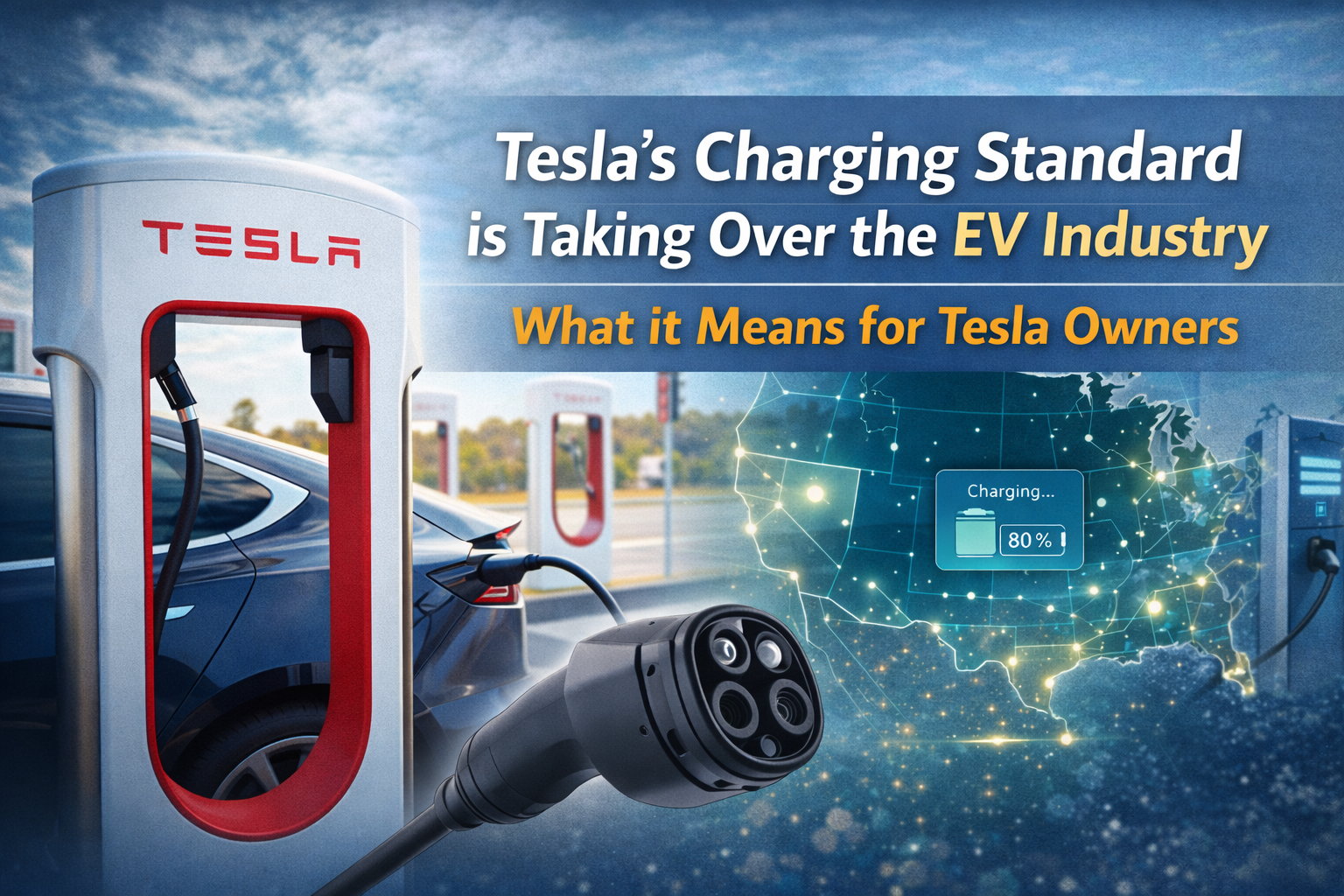
That development is Tesla’s North American Charging Standard (NACS) becoming the dominant charging connector across the EV industry.
In just a few years, Tesla’s once-proprietary charging connector has become the new standard adopted by major automakers, dramatically changing how electric vehicles charge and travel.
For Tesla owners, this shift could bring significant advantages—from improved infrastructure access to increased resale value and broader EV adoption.
In this article, we’ll explore:
- What the Tesla NACS charging standard is
- Why other automakers are adopting it
- How Tesla’s Supercharger network is reshaping EV ownership
- What this trend means for Tesla drivers
- Why Tesla may maintain a major competitive advantage in the EV market
The EV Charging Problem That Tesla Solved
For years, one of the biggest challenges facing EV adoption has been charging infrastructure.
Many early EV owners experienced issues such as:
- Broken charging stations
- Incompatible connectors
- Slow charging speeds
- Confusing payment systems
- Limited availability on road trips
This problem created range anxiety, which became one of the biggest barriers preventing people from switching to electric vehicles.
Tesla approached this problem differently from other automakers.
Instead of relying on third-party charging networks, Tesla built its own global Supercharger network.
Today, that network has grown into one of the most reliable EV charging systems in the world.
By the end of 2025, Tesla had built more than 8,000 fast-charging stations with over 77,000 connectors globally, representing rapid annual growth of nearly 20%.
For Tesla owners, the result is simple:
Plug in. Charge. Continue driving.
No apps, no payment confusion, and no compatibility problems.
What Is the Tesla NACS Charging Standard?
Tesla’s North American Charging Standard (NACS) is the physical charging connector used by Tesla vehicles in North America.
The connector is:
- Smaller than most competing plugs
- Lightweight and easy to use
- Capable of fast charging
- Compatible with both AC and DC charging
Initially, Tesla kept this connector proprietary.
But as Tesla’s charging network became the most reliable in the industry, other automakers began to notice.
In 2023 Tesla made a major move by opening the NACS standard to other automakers.
Now the industry is rapidly shifting toward Tesla’s charging system.
Automakers Are Adopting Tesla’s Charging Plug
In one of the most significant shifts in EV infrastructure history, multiple major automakers have announced plans to adopt Tesla’s NACS connector.
Companies including:
- Ford
- General Motors
- Rivian
- Volvo
- Polestar
- Mercedes-Benz
- Nissan
have either adopted or committed to supporting the Tesla charging standard.
Ford and GM were among the first major automakers to announce they would integrate Tesla’s charging connector into future vehicles.
This means future EVs from many manufacturers will be able to plug directly into Tesla’s Supercharger network.
In addition, adapters allow many existing EVs to access Tesla chargers while automakers transition to NACS ports.
This shift has been called by many analysts “the great NACS migration.”
Why Tesla’s Charging Network Is So Valuable
Tesla’s biggest advantage in the EV market may not actually be its vehicles.
It may be its charging network.
Tesla spent more than a decade building out infrastructure that allows drivers to travel long distances without worrying about charging.
The Supercharger network offers several advantages:
Reliability
Tesla chargers are widely known for high uptime compared to many third-party charging stations.
Simplicity
Tesla vehicles automatically authenticate with the charger, making payment seamless.
Strategic placement
Superchargers are often placed along highways, making road trips easy.
Speed
Modern Tesla Superchargers can add hundreds of miles of range in minutes.
For Tesla drivers, this network has made EV ownership dramatically easier.
Faster Charging Is Transforming the EV Experience
Charging speed is another major area of innovation across the EV industry.
Tesla continues to improve its charging capabilities with each generation of Superchargers.
Meanwhile, competitors are pushing even faster charging technology.
Some companies are now testing systems capable of adding hundreds of miles of range in just minutes.
For example, experimental systems in China claim to add around 200 miles of range in about five minutes, approaching the convenience of gasoline refueling.
Although these technologies are still emerging, the broader trend is clear:
EV charging is becoming dramatically faster.
For Tesla drivers, this means future vehicles and charging stations could reduce charging stops to just a few minutes.
The Expansion of EV Charging Infrastructure
Charging infrastructure across the United States and globally is expanding rapidly.
New fast-charging stations are being deployed by both private companies and governments.
This growth has dramatically improved EV travel corridors across major highways.
While charging access still has room for improvement—especially in rural areas—the overall trend is clear.
Charging networks are becoming:
- Larger
- More reliable
- Faster
- Easier to use
In many cases, private networks and automakers are leading the expansion rather than government programs.
And Tesla remains one of the largest contributors to this infrastructure growth.
EV Adoption Is Still Growing Worldwide
Even though the EV market occasionally experiences temporary slowdowns, the long-term trend is clear.
Electric vehicles are becoming a larger share of global vehicle sales each year.
Globally, EVs accounted for more than 20% of new car sales in 2024, with projections suggesting they could exceed a quarter of global sales soon.
Meanwhile, the used EV market is expanding rapidly, with used EV sales increasing significantly in recent years.
This growth creates an ecosystem that benefits Tesla owners in several ways:
- Better charging infrastructure
- More competition driving innovation
- Lower battery costs
- Wider EV adoption
Rising Gas Prices Could Boost EV Interest
Another factor influencing EV adoption is fuel prices.
When gasoline prices rise, electric vehicles become more attractive.
Electricity prices are typically far more stable than gasoline prices.
This can result in significantly lower operating costs for EV owners.
Recent price trends show gasoline climbing while electricity costs remain relatively steady, potentially giving EVs a cost advantage for drivers.
For Tesla owners, this advantage can translate into meaningful long-term savings.
Tesla’s Future: Beyond Cars
Tesla’s long-term strategy extends far beyond electric vehicles.
The company is investing heavily in areas such as:
- autonomous driving
- robotaxis
- robotics
- AI software
Tesla has already launched early robotaxi services in cities like Austin, allowing autonomous Teslas to transport passengers within defined service areas.
If Tesla succeeds in scaling this technology, it could transform transportation entirely.
And Tesla’s charging infrastructure would play a key role in supporting autonomous fleets.
What This Means for Tesla Owners
For current Tesla owners, these industry changes bring several potential benefits.
Increased Charging Availability
As more automakers adopt Tesla’s charging standard, more investment will flow into Tesla-compatible charging infrastructure.
Higher Resale Value
Tesla vehicles may maintain strong resale values due to their compatibility with the largest charging network.
Easier Road Trips
Expanding Supercharger networks and new EV charging stations make long-distance travel increasingly convenient.
Stronger Ecosystem
Tesla owners benefit from an integrated ecosystem that includes:
- vehicles
- charging infrastructure
- software updates
- mobile apps
- energy storage solutions
The EV Industry Is Entering a New Phase
The early years of EV adoption were filled with experimentation.
Different charging connectors, competing standards, and inconsistent infrastructure created confusion for consumers.
Now the industry is beginning to standardize around a smaller number of technologies.
Tesla’s NACS charging connector appears poised to become the dominant standard in North America.
This shift could simplify EV ownership dramatically.
Drivers may soon be able to travel across the country using a unified charging system.
Why Tesla Still Holds a Major Advantage
Even as competition grows, Tesla maintains several major advantages in the EV industry.
These include:
Charging infrastructure
Tesla’s Supercharger network remains one of the largest and most reliable charging systems.
Software integration
Tesla vehicles receive over-the-air updates that continuously improve features and performance.
Manufacturing scale
Tesla produces electric vehicles at a scale many competitors are still trying to achieve.
Brand recognition
Tesla remains the most recognizable EV brand globally.
These advantages give Tesla a strong position as the EV market continues to evolve.
Final Thoughts
Electric vehicles are entering a new stage of growth and innovation.
The rise of Tesla’s NACS charging standard, expanding charging infrastructure, and ongoing battery improvements are making EV ownership easier than ever.
For Tesla owners, these trends reinforce the long-term value of owning a vehicle connected to the world’s most extensive fast-charging network.
As the EV industry continues to mature, Tesla’s ecosystem of vehicles, charging infrastructure, and software may prove to be one of the most powerful advantages in the transition to electric transportation.
And for drivers considering their first electric vehicle, the future is becoming clearer.
Electric cars are no longer the future.
They are the present—and Tesla remains at the center of that transformation.
Save $1,000 or receive 3 months of FSD using our referral link here.

