
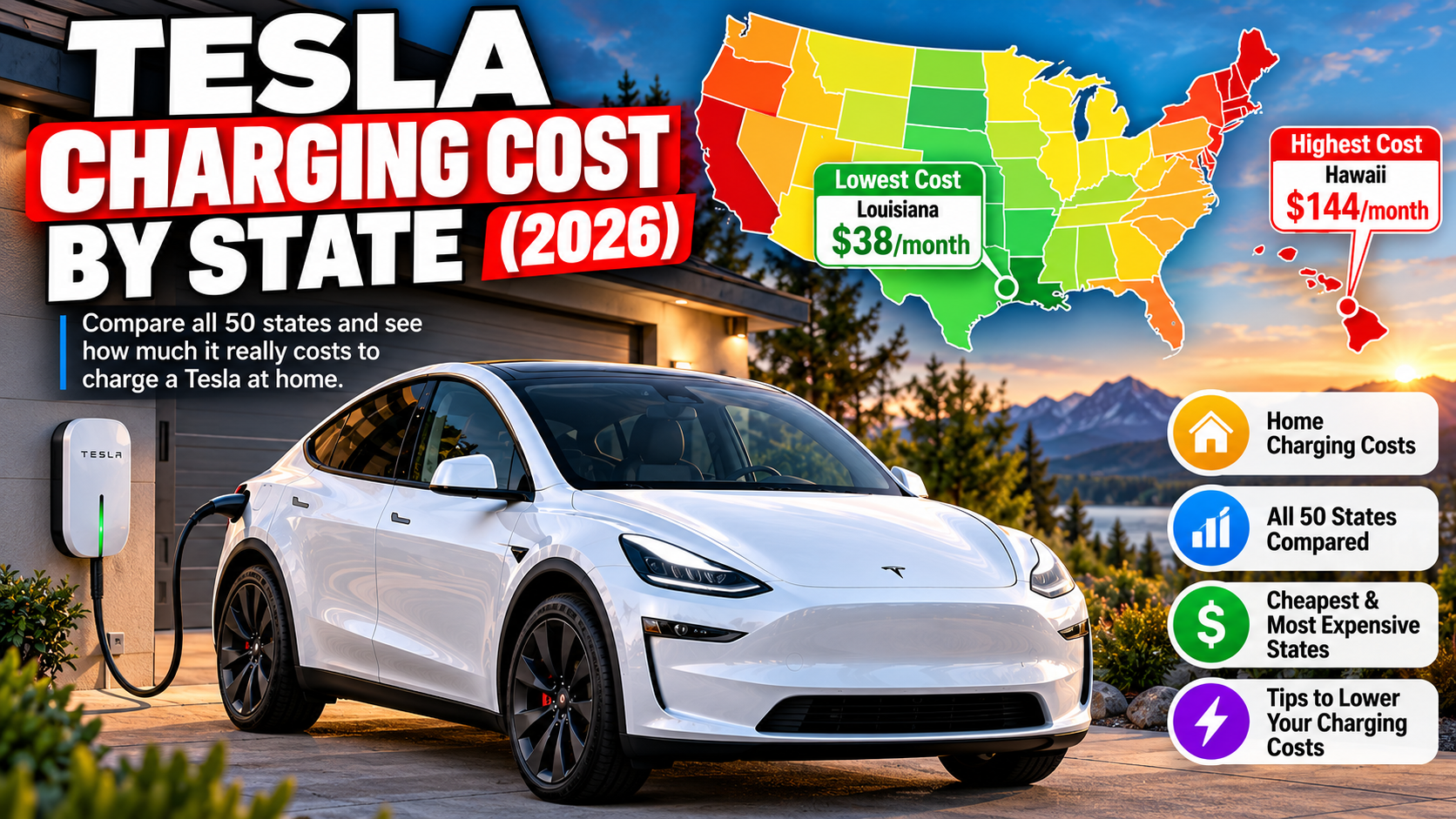
Updated October 20, 2026 | Based on the latest available EIA residential electricity price data
How much does it cost to charge a Tesla in 2026? The answer depends heavily on where you live.
A Tesla owner charging at home in Louisiana may spend considerably less on electricity than someone driving the same vehicle in California, New York, or Hawaii.
Even though both drivers own the same Tesla and travel the same number of miles, their monthly charging costs can be dramatically different.
To help Tesla owners understand these differences, MyTeslaSavings.com analyzed residential electricity prices across all 50 states using data from the U.S. Energy Information Administration (EIA).
We then calculated the estimated cost of charging a Tesla for 1,000 miles per month using the same electricity consumption assumption in every state.
In this guide, you’ll discover:
- Estimated Tesla charging costs in all 50 states.
- Which states have the cheapest and most expensive home electricity.
- How much you could spend charging a Tesla each month and year.
- Why home charging can cost significantly less than public fast charging.
- How to calculate your own Tesla charging expenses.
- Practical ways to reduce electricity costs.
How Much Does It Cost to Charge a Tesla in 2026?
Using the national average residential electricity price of 18.31 cents per kilowatt-hour, a Tesla requiring 30 kWh of purchased electricity per 100 miles would cost approximately:
| Driving Distance | Estimated Electricity Cost |
|---|---|
| 100 miles | $5.49 |
| 500 miles | $27.47 |
| 1,000 miles | $54.93 |
| 1,500 miles | $82.40 |
| 12,000 miles annually | $659.16 |
These estimates assume home charging and use the July 2026 national average residential electricity price.
Your actual costs will depend on your Tesla model, driving efficiency, weather, charging equipment, utility rates, and charging habits.
Tesla Charging Cost by State: Complete 2026 Comparison
The following table compares all 50 states using July 2026 EIA residential electricity prices, the latest monthly state data available when this article was updated.
To make the comparison consistent, we assume:
- 1,000 miles driven per month.
- 30 kWh of electricity purchased per 100 miles.
- 300 kWh purchased monthly.
- 3,600 kWh purchased annually.
- All charging takes place at home at the state’s average residential electricity price.
The 30 kWh figure is a standardized comparison assumption, not a specification for every Tesla. It represents electricity purchased from the grid, including charging losses within that assumed total.
Tesla Home Charging Costs in All 50 States
| State | Electricity (¢/kWh) | Monthly Cost |
|---|---|---|
| Alabama | 16.40¢ | $49.20 |
| Alaska | 28.83¢ | $86.49 |
| Arizona | 15.38¢ | $46.14 |
| Arkansas | 14.33¢ | $42.99 |
| California | 33.61¢ | $100.83 |
| Colorado | 17.00¢ | $51.00 |
| Connecticut | 24.16¢ | $72.48 |
| Delaware | 18.48¢ | $55.44 |
| Florida | 15.03¢ | $45.09 |
| Georgia | 16.27¢ | $48.81 |
| Hawaii | 48.00¢ | $144.00 |
| Idaho | 13.73¢ | $41.19 |
| Illinois | 19.22¢ | $57.66 |
| Indiana | 16.73¢ | $50.19 |
| Iowa | 15.99¢ | $47.97 |
| Kansas | 15.27¢ | $45.81 |
| Kentucky | 13.81¢ | $41.43 |
| Louisiana | 12.72¢ | $38.16 |
| Maine | 32.41¢ | $97.23 |
| Maryland | 21.41¢ | $64.23 |
| Massachusetts | 30.49¢ | $91.47 |
| Michigan | 23.05¢ | $69.15 |
| Minnesota | 17.45¢ | $52.35 |
| Mississippi | 14.54¢ | $43.62 |
| Missouri | 16.09¢ | $48.27 |
| Montana | 14.99¢ | $44.97 |
| Nebraska | 13.78¢ | $41.34 |
| Nevada | 12.77¢ | $38.31 |
| New Hampshire | 26.60¢ | $79.80 |
| New Jersey | 25.19¢ | $75.57 |
| New Mexico | 16.09¢ | $48.27 |
| New York | 29.90¢ | $89.70 |
| North Carolina | 15.16¢ | $45.48 |
| North Dakota | 13.41¢ | $40.23 |
| Ohio | 19.45¢ | $58.35 |
| Oklahoma | 14.35¢ | $43.05 |
| Oregon | 15.97¢ | $47.91 |
| Pennsylvania | 21.72¢ | $65.16 |
| Rhode Island | 28.29¢ | $84.87 |
| South Carolina | 15.47¢ | $46.41 |
| South Dakota | 15.37¢ | $46.11 |
| Tennessee | 13.71¢ | $41.13 |
| Texas | 15.88¢ | $47.64 |
| Utah | 13.12¢ | $39.36 |
| Vermont | 23.75¢ | $71.25 |
| Virginia | 17.55¢ | $52.65 |
| Washington | 14.71¢ | $44.13 |
| West Virginia | 15.78¢ | $47.34 |
| Wisconsin | 19.06¢ | $57.18 |
| Wyoming | 14.36¢ | $43.08 |
| U.S. Average | 18.31¢ | $54.93 |
Source: U.S. Energy Information Administration, Electric Power Monthly, Table 5.6.A, July 2026. Monthly charging costs are calculated by MyTeslaSavings.com using 300 kWh per month. Washington, D.C., is excluded from the 50-state table.
The 10 Cheapest States to Charge a Tesla at Home
Based on July 2026 residential electricity prices, these states offer the lowest estimated home charging costs.
| Rank | State | Cost per 1,000 Miles |
|---|---|---|
| 1 | Louisiana | $38.16 |
| 2 | Nevada | $38.31 |
| 3 | Utah | $39.36 |
| 4 | North Dakota | $40.23 |
| 5 | Tennessee | $41.13 |
| 6 | Idaho | $41.19 |
| 7 | Nebraska | $41.34 |
| 8 | Kentucky | $41.43 |
| 9 | Arkansas | $42.99 |
| 10 | Oklahoma | $43.05 |
Why Is Tesla Charging So Affordable in Some States?
States with lower residential electricity prices generally offer lower home charging costs when vehicle efficiency and driving distance are held constant.
For example, Louisiana’s average residential electricity price was 12.72 cents per kWh.
At our standardized electricity consumption of 300 kWh per month, that’s approximately $38 per month to drive 1,000 miles.
Drivers with access to favorable overnight charging rates may spend even less.
However, statewide averages don’t represent every utility customer. Your actual electric rate could be higher or lower.
The 10 Most Expensive States to Charge a Tesla
Some states have substantially higher residential electricity prices.
| Rank | State | Cost per 1,000 Miles |
|---|---|---|
| 1 | Hawaii | $144.00 |
| 2 | California | $100.83 |
| 3 | Maine | $97.23 |
| 4 | Massachusetts | $91.47 |
| 5 | New York | $89.70 |
| 6 | Alaska | $86.49 |
| 7 | Rhode Island | $84.87 |
| 8 | New Hampshire | $79.80 |
| 9 | New Jersey | $75.57 |
| 10 | Connecticut | $72.48 |
Hawaii is the most expensive state in this comparison.
At 48 cents per kWh, the estimated electricity cost for 1,000 miles is $144.
California follows at approximately $101 per month, based on the statewide residential average.
These higher costs don’t automatically mean driving a Tesla is more expensive than driving a comparable gasoline vehicle. That comparison also depends on local gasoline prices and vehicle fuel economy.
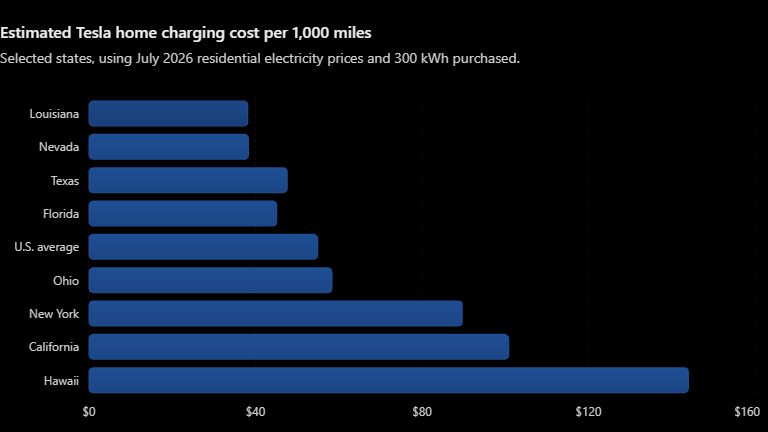
Tesla Charging Costs in California, Texas, Florida, New York and Ohio
Let’s take a closer look at five states where Tesla ownership costs may be of particular interest.
California: Approximately $101 Per Month
California’s residential electricity price averaged 33.61 cents per kWh.
Under our assumptions, charging for 1,000 miles costs approximately $100.83.
California Tesla owners may benefit from researching utility-specific EV rates, off-peak charging plans, and home solar arrangements.
The most important step is understanding your own utility’s rate structure rather than relying solely on a statewide average.
Texas: Approximately $48 Per Month
Texas averaged 15.88 cents per kWh.
That works out to approximately $47.64 for 1,000 miles.
Texas electricity plans can vary significantly by provider, location, and time of use.
Some drivers may find favorable overnight rates, but always review the complete plan, including delivery charges, minimum-use conditions, and other fees.
Florida: Approximately $45 Per Month
Florida’s average residential electricity price was 15.03 cents per kWh.
Estimated monthly charging cost: $45.09.
Florida’s warm climate can reduce some cold-weather efficiency penalties, although air-conditioning use and other factors still affect actual consumption.
New York: Approximately $90 Per Month
New York averaged 29.90 cents per kWh.
That produces an estimated monthly charging cost of $89.70.
Drivers should compare their utility’s actual rate and available off-peak plans.
Ohio: Approximately $58 Per Month
Ohio averaged 19.45 cents per kWh.
Estimated monthly charging cost: $58.35.
Drivers in Ohio should also account for winter conditions, which can increase electricity consumption through cabin heating, battery conditioning, and other cold-weather effects.
How to Calculate Your Tesla Charging Cost
You can estimate charging costs using a simple formula.
Charging cost = Electricity purchased (kWh) × Electricity price ($/kWh)
For driving expenses, you can calculate electricity use based on distance:
Monthly electricity purchased = (Miles driven ÷ 100) × kWh purchased per 100 miles
Example: Driving 1,200 Miles Per Month
Suppose you drive 1,200 miles per month and your Tesla requires an estimated 30 kWh of electricity purchased for every 100 miles.
Your monthly electricity use would be:
1,200 ÷ 100 × 30 = 360 kWh
If your electricity rate is 15 cents per kWh:
360 × $0.15 = $54 per month
Your estimated annual charging cost would be:
$54 × 12 = $648 per year
This calculation is useful for comparing states and electricity plans.
For a more personalized estimate, use your actual utility rate and charging energy consumption.
How Much Does It Cost to Fully Charge a Tesla?
The cost of charging a Tesla battery depends on battery capacity, how much charge you’re adding, charging losses, and electricity prices.
For example, suppose a Tesla has a hypothetical 75 kWh usable battery capacity.
Charging from 20% to 80% adds approximately 45 kWh to the battery.
At 15 cents per kWh, that energy would cost $6.75 before accounting for charging losses.
If the charging session requires 50 kWh purchased from the grid, the cost becomes $7.50.
This example illustrates why the amount of electricity added to the battery and the amount purchased from the grid aren’t always identical.
Tesla battery sizes vary by model, configuration, and production period. Owners should avoid assuming every Model 3 or Model Y has the same battery capacity.
Is It Cheaper to Charge a Tesla at Home or at a Supercharger?
For many Tesla owners, home charging can be substantially cheaper than public DC fast charging.
However, the difference depends on the rates available in your area.
Home Charging
Home charging costs generally follow your residential electricity plan.
Advantages include convenience, the ability to charge overnight, and potential access to off-peak pricing.
Tesla Supercharging
Supercharger prices vary by location, time, and other factors.
A public fast charger may charge significantly more per kWh than your home electricity provider.
For illustration, suppose your home electricity rate is $0.15 per kWh and a public fast charger costs $0.40 per kWh.
| Charging Location | Illustrative Rate | Cost for 50 kWh |
|---|---|---|
| Home | $0.15/kWh | $7.50 |
| Public fast charger | $0.40/kWh | $20.00 |
That’s a $12.50 difference for the same amount of purchased electricity.
These rates are examples, not current Tesla Supercharger price quotes.
Always check the Tesla navigation system or app for actual charging prices.
Does Cold Weather Make Tesla Charging More Expensive?
Yes, cold weather can increase electricity consumption.
In colder conditions, a Tesla may use additional energy for cabin heating, battery temperature management, and other vehicle functions.
Short trips can be particularly affected because the vehicle may spend a larger share of the journey warming the cabin and battery.
Drivers in northern states should expect their real-world winter charging costs to differ from a simple annual average.
Ways to Improve Winter Efficiency
- Precondition your Tesla while it’s plugged in when appropriate.
- Use scheduled departure or climate controls.
- Maintain recommended tire pressure.
- Drive smoothly and avoid unnecessary high speeds.
- Plan charging stops with battery temperature in mind.
Your actual results will vary with vehicle model, trip length, temperature, and driving habits.
Five Ways to Lower Your Tesla Charging Costs in 2026
1. Charge During Off-Peak Hours
Some electricity providers offer lower rates during specific overnight periods.
If your utility offers time-of-use pricing, scheduling charging for lower-cost periods may reduce expenses.
Check the complete plan before switching.
2. Compare Utility EV Charging Programs
Certain utilities offer electric vehicle charging incentives or specialized rate plans.
Eligibility and savings vary.
3. Use Scheduled Charging
Tesla’s scheduled charging features can help you charge during preferred hours.
Set your schedule based on your actual electricity rate plan.
4. Monitor Your Driving Efficiency
Your Tesla’s energy consumption display can help identify changes in efficiency.
Driving speed, tire pressure, climate settings, and weather all influence electricity use.
5. Compare Home and Public Charging Prices
If you regularly use public charging, compare the cost with charging at home.
Even small differences per kWh can add up over thousands of miles.
Is Charging a Tesla Cheaper Than Buying Gas in 2026?
Often, but not always.
The answer depends on your electricity price, gasoline price, Tesla efficiency, and the fuel economy of the gasoline vehicle you’re comparing.
Consider this illustrative example:
A gasoline vehicle averages 30 miles per gallon, and gasoline costs $3.50 per gallon.
Driving 12,000 miles would require:
12,000 ÷ 30 = 400 gallons
400 × $3.50 = $1,400 annually
Using our national average Tesla electricity estimate, 12,000 miles costs approximately $659 annually.
That creates an illustrative energy-cost difference of:
$1,400 − $659 = $741 per year
The $3.50 gasoline price is a hypothetical comparison assumption, not a verified national average for October 2026.
This example also excludes vehicle purchase costs, insurance, maintenance, taxes, charging equipment, and other ownership expenses.
To compare costs using your own driving habits, visit our Tesla Savings Calculator.
Frequently Asked Questions About Tesla Charging Costs
What is the average cost to charge a Tesla in 2026?
Using July 2026 national residential electricity prices and an assumed 30 kWh purchased per 100 miles, charging for 1,000 miles costs approximately $54.93.
What is the cheapest state to charge a Tesla?
Louisiana had the lowest average residential electricity price among the 50 states in July 2026, at 12.72 cents per kWh.
Under our assumptions, that’s approximately $38.16 per 1,000 miles.
What is the most expensive state to charge a Tesla?
Hawaii had the highest residential electricity price in the July 2026 data, at 48 cents per kWh.
That equals approximately $144 per 1,000 miles using our standardized assumptions.
How much does charging a Tesla cost per mile?
At the national average residential electricity price and our standardized consumption assumption, electricity costs approximately 5.5 cents per mile.
Your actual cost per mile may be lower or higher.
Is Tesla Supercharging more expensive than home charging?
It often is, but not universally. Prices vary by location, charging time, electricity plan, and public charging provider.
Does a Tesla Model Y cost more to charge than a Model 3?
It can. Electricity consumption varies by model, drivetrain, wheels, tires, weather, and driving conditions.
Compare the EPA efficiency rating for the specific vehicle configuration.
Can solar panels reduce Tesla charging costs?
Potentially. Home solar can offset electricity purchased from the utility, but actual savings depend on system costs, generation, self-consumption, and local compensation rules.
Will these state electricity prices change?
Yes. The figures in this article represent a specific reporting month, not fixed rates for the entire year.
Electricity prices may change with seasons, fuel costs, utility rate adjustments, and other factors.
Our Methodology: How MyTeslaSavings Calculated These Costs
To make this comparison useful and reproducible, we used the following approach.
Electricity data source: U.S. Energy Information Administration, Electric Power Monthly, Table 5.6.A.
Reporting period: July 2026.
Publication date: September 24, 2026.
Geographic coverage: All 50 U.S. states.
Electricity price metric: Average residential electricity price, measured in cents per kWh.
Driving assumption: 1,000 miles per month, or 12,000 miles annually.
Electricity consumption assumption: 30 kWh purchased per 100 miles.
Monthly electricity purchased: 300 kWh.
Annual electricity purchased: 3,600 kWh.
Calculation: State residential electricity price multiplied by estimated purchased electricity.
Important limitations: These are estimates based on statewide residential averages. They are not utility-specific charging tariffs, Tesla billing records, or final full-year 2026 averages. Real-world charging costs vary by vehicle efficiency, charging losses, utility pricing, seasonal conditions, and charging location.
The national average is the EIA’s reported U.S. residential average, not a simple arithmetic average of the 50 state prices.
Data source: U.S. Energy Information Administration – Electric Power Monthly, Table 5.6.A.
Final Thoughts: Your State Makes a Big Difference in Tesla Charging Costs
The cost of charging a Tesla can vary substantially depending on where you live.
Based on July 2026 electricity prices, our standardized monthly charging estimate ranges from approximately $38 in Louisiana to $144 in Hawaii.
That’s a difference of more than $100 per month for the same assumed driving distance and electricity consumption.
But your state is only part of the equation.
Your utility rate, driving habits, vehicle efficiency, and charging schedule can make an equally important difference.
For the most accurate estimate, use your actual electricity bill and your Tesla’s energy consumption information.
Calculate Your Own Tesla Savings
Want to find out how much driving electric could save you compared with gasoline?
Try our free Tesla Savings Calculator.
You can also explore our Tesla Owner Guides for more charging, maintenance, and money-saving tips.
How much are you paying per kWh to charge your Tesla at home?
Leave a comment with your state and electricity rate. We’d love to see how real Tesla owners’ costs compare with these statewide estimates!
MyTeslaSavings.com is an independent website and is not affiliated with Tesla, Inc. All charging-cost calculations are estimates for educational purposes.