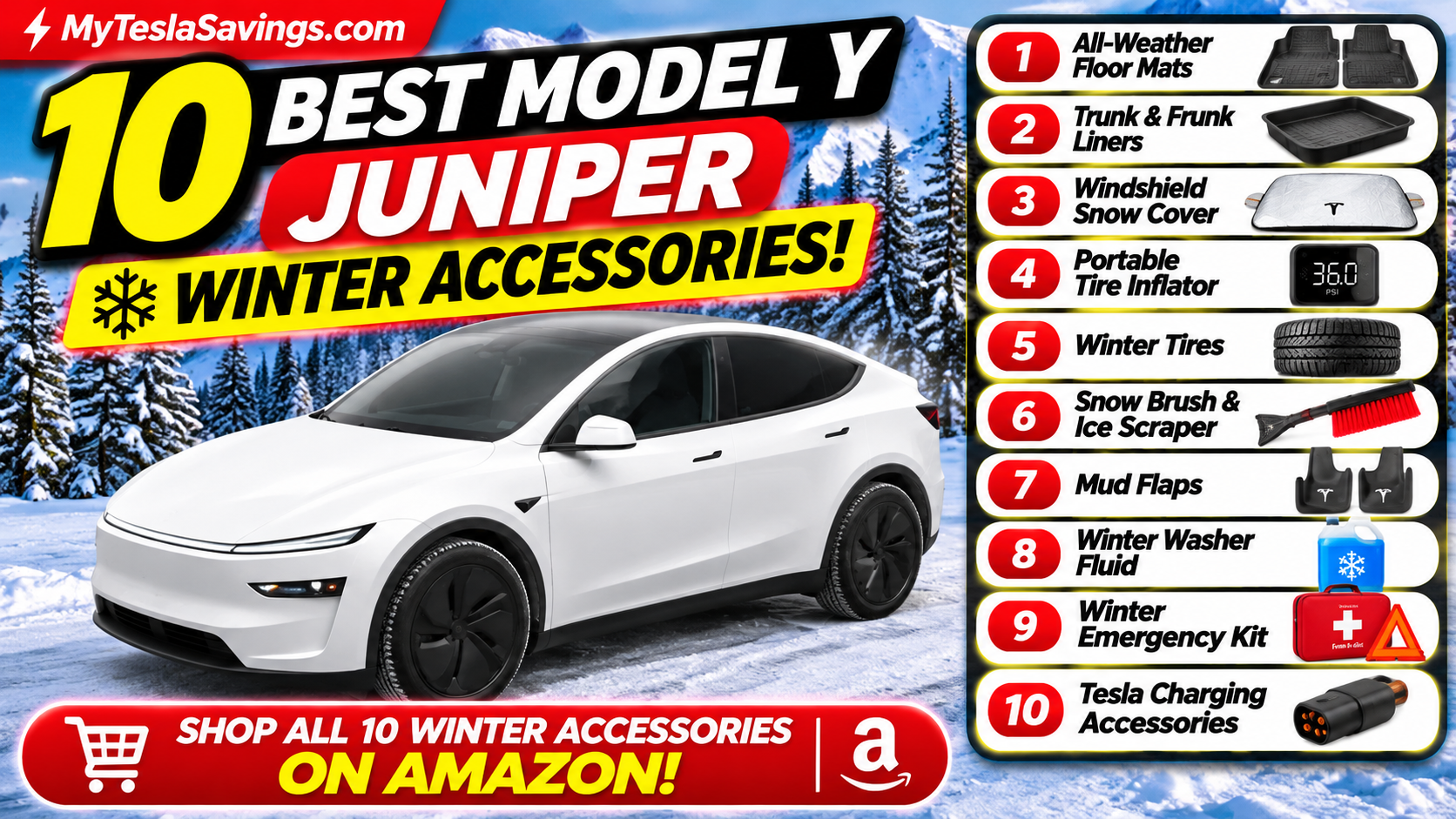
Winter is coming, and if you own a Tesla Model 3, Model Y, Model S, or Model X, now is the perfect time to prepare your vehicle for colder temperatures.
Driving a Tesla in winter can be a great experience. You can warm up your vehicle from your phone, schedule charging around your electricity rates, and take advantage of advanced traction control.
However, freezing temperatures bring a few challenges.
Your battery may deliver less usable range, charging can take longer, and heating the cabin requires additional energy. Snow, ice, and road salt also create maintenance and safety concerns.
The good news? You can reduce many of these problems with a few simple changes to your daily routine.
In this guide, we’ll cover 15 practical ways to prepare your Tesla for winter, including how to lower charging costs, maximize cold-weather range, improve safety, and choose accessories that make winter driving easier.
1. Precondition Your Tesla Before Leaving Home
One of the best things you can do during winter is precondition your Tesla before driving.
Preconditioning warms the battery and cabin so your vehicle is better prepared for cold-weather driving.
A cold battery is less efficient and may temporarily limit regenerative braking and charging performance.
Instead of waiting until you start driving to warm everything up, Tesla lets you prepare the vehicle in advance.
How to Schedule Tesla Preconditioning
- Open the Tesla app.
- Select Schedule.
- Choose your home or desired location.
- Set your departure time.
- Enable preconditioning for the days you normally drive.
You can also configure scheduling from your Tesla touchscreen under Controls > Schedule on supported software versions.
For example, if you leave for work at 7:30 AM, schedule your Tesla to be ready at 7:30 AM.
The vehicle will determine when to begin warming the cabin and battery.
Money-Saving Tip
Precondition while your Tesla is plugged in whenever possible.
This allows the vehicle to draw energy from your charging connection rather than relying entirely on the battery.
You’ll begin your drive with a comfortable cabin and more battery energy available for the trip.
Remember that preconditioning still consumes electricity. The benefit is improved comfort, battery readiness, and potentially reduced energy consumption during the drive—not free heating.
2. Charge During Off-Peak Electricity Hours
One of the biggest advantages of owning a Tesla is being able to charge at home.
But the time you charge can make a big difference in your electricity bill.
Some electric utilities offer time-of-use plans with lower electricity rates overnight.
If your utility charges less during off-peak hours, scheduling your Tesla to charge during those periods could save money.
Example: Winter Charging Costs
Let’s assume you drive 1,000 miles per month.
Your Tesla averages 300 Wh per mile during winter.
That means you’ll use approximately 300 kWh for driving.
Accounting for an illustrative 10% charging loss, you’d purchase approximately 333 kWh from your electric utility.
| Electricity Rate | Monthly Charging Cost |
|---|---|
| $0.12 per kWh | $40 |
| $0.18 per kWh | $60 |
| $0.25 per kWh | $83 |
In this example, charging at $0.12 instead of $0.25 per kWh could save approximately $43 per month.
Over four winter months, that’s around $173 in potential savings.
Actual savings depend on your utility plan, vehicle efficiency, charging losses, and driving habits.
To more accurately determine your savings, check out our Tesla Offpeak Charging Calculator.
How to Schedule Tesla Charging
- Open your Tesla app.
- Navigate to Schedule.
- Select your home location.
- Configure the charging start and end times.
- Match those times to your utility’s lower-rate period.
If your utility doesn’t offer off-peak rates, scheduling charging to finish near your departure time may still help reduce the need to rewarm a cold battery.
Use our Tesla Charging Savings Calculator at MyTeslaSavings.com to compare your electricity costs.
3. Keep Your Tesla Plugged In During Freezing Weather
Tesla recommends leaving your vehicle plugged in when practical during cold weather.
Why?
Your Tesla uses energy to manage battery temperature and support normal vehicle functions.
When connected to a charger, it can use external power rather than relying entirely on the stored battery energy.
This is particularly helpful if your vehicle is parked outside overnight.
You don’t necessarily need to charge to 100%.
Simply leaving your Tesla connected while following the recommended charge limit for your specific battery can be beneficial.
What Should You Set Your Winter Charge Limit To?
There isn’t one ideal charging percentage for every Tesla.
Some Tesla batteries have different daily charging recommendations.
For example, certain lithium iron phosphate (LFP) battery configurations may recommend periodic charging to 100%, while other battery types generally use a lower daily limit.
Follow the charging recommendation displayed in your Tesla’s Charging screen or Owner’s Manual.
Before a long winter road trip, you may choose a higher charge limit when appropriate, ideally timing charging to finish shortly before departure.
4. Expect Reduced Tesla Range in Cold Weather
If you’ve owned a Tesla through winter, you’ve probably noticed that your estimated driving range can decrease when temperatures drop.
This is normal for electric vehicles.
Several factors contribute to increased energy consumption:
- Battery heating
- Cabin heating
- Cold tires
- Higher rolling resistance
- Snow-covered or wet roads
- Increased aerodynamic drag in dense cold air
- Winter driving conditions
The exact range reduction varies depending on the temperature, vehicle, speed, trip length, and heating settings.
Short winter trips can be particularly inefficient because the vehicle may spend a significant portion of the journey warming up.
Example of Winter Range Loss
Suppose your Tesla normally provides 300 miles of usable range under your typical driving conditions.
| Illustrative Range Reduction | Remaining Range |
|---|---|
| 10% | 270 miles |
| 20% | 240 miles |
| 30% | 210 miles |
These are examples, not guaranteed winter performance figures.
A vehicle that loses 20% of its typical range still has plenty of capability for many daily commutes.
But it’s important to plan accordingly, especially during long road trips.
My Recommendation
Avoid planning winter trips that depend on arriving with almost no battery remaining.
Give yourself a comfortable buffer for unexpected traffic, detours, snow, or colder-than-expected temperatures.
5. Use Seat Heaters to Reduce Cabin Heating Costs
Here’s an easy way to improve winter efficiency.
Use your heated seats and heated steering wheel, if equipped, instead of relying entirely on high cabin temperatures.
Tesla’s seat heaters warm occupants directly and generally consume less energy than heating the entire cabin.
For example, instead of setting your cabin temperature extremely high, try a comfortable moderate setting and use the seat heater.
This can help reduce energy consumption, particularly on longer drives.
However, don’t sacrifice visibility or safety to save electricity.
Always use enough cabin heating and defrosting to keep your windshield and windows clear.
Comfort matters, but visibility matters more.
6. Check Your Tire Pressure More Frequently
Cold temperatures cause tire pressure to decrease.
As the temperature drops, you may notice your Tesla displaying a low tire pressure warning.
Underinflated tires can reduce efficiency, affect handling, and increase tire wear.
That’s especially concerning during winter, when traction is already limited.
How to Check Your Tesla Tire Pressure
- Check tire pressure when the tires are cold.
- Find the recommended pressure on the driver’s door-pillar label.
- Use a reliable digital tire pressure gauge.
- Inflate the tires to the vehicle’s recommended cold pressure.
- Inspect for uneven wear or visible damage.
Don’t inflate based solely on the maximum pressure printed on the tire sidewall.
Recommended Winter Accessory
A compact digital tire pressure gauge is an inexpensive accessory worth keeping in your Tesla.
[CHECK DIGITAL TIRE PRESSURE GAUGES ON AMAZON]
7. Consider Winter Tires for Snow and Ice
One of the most important winter safety upgrades is having the right tires.
Tesla’s traction control systems can help manage wheel slip, but they cannot create grip that your tires don’t have.
If you live in an area with frequent snow, freezing rain, or icy roads, dedicated winter tires may be a worthwhile investment.
Winter tires use rubber compounds and tread designs intended to perform better in cold conditions.
They can improve traction, braking, and handling compared with tires not designed for winter conditions.
All-Season vs. Winter Tires
| Feature | All-Season Tires | Winter Tires |
|---|---|---|
| Mild winter conditions | Generally suitable | Suitable |
| Heavy snow | Varies by tire | Typically better |
| Ice traction | Limited | Generally improved |
| Warm-weather use | Designed for broader use | Not recommended |
| Seasonal tire changes | Usually unnecessary | Usually required |
If you live somewhere with occasional light snow, a quality all-season tire may meet your needs.
If your area experiences significant snow and ice, dedicated winter tires deserve serious consideration.
Make sure any replacement tires meet Tesla’s required size, load, and speed specifications.
8. Use Chill Mode for Smoother Winter Driving
Tesla vehicles are known for their instant acceleration.
That’s fun on dry pavement, but aggressive acceleration isn’t ideal when roads are slippery.
Chill Mode reduces the sharpness of accelerator response on supported vehicles.
It can make acceleration smoother and help discourage unnecessary energy consumption.
How to Enable Chill Mode
On many Tesla models:
- Open Controls.
- Select Dynamics or Pedals & Steering, depending on your model.
- Find the acceleration setting.
- Choose Chill.
Menu locations vary by vehicle and software version.
Chill Mode doesn’t replace careful driving or appropriate tires, but it can make winter driving more predictable.
Money-Saving Benefit
Gentler acceleration can reduce unnecessary energy consumption.
Over an entire winter season, smoother driving habits may help improve efficiency.
9. Understand Regenerative Braking in Cold Weather
Regenerative braking is one of the features that makes electric vehicles efficient.
When you slow down, your Tesla can recover some energy and return it to the battery.
But during freezing weather, regenerative braking may be temporarily limited.
That’s because a cold battery cannot always accept energy at its normal rate.
You may see a blue snowflake icon or other indications of limited battery performance.
What This Means for Winter Driving
- Your Tesla may not slow down as strongly when you release the accelerator.
- Regenerative braking may gradually improve as the battery warms.
- You should always be prepared to use the brake pedal.
- Stopping distances can increase on snow and ice.
Some Tesla vehicles offer a setting that automatically applies conventional brakes to simulate regenerative deceleration when regeneration is limited.
Availability depends on the vehicle and software.
Regardless of your settings, always maintain extra following distance during winter conditions.
10. Prepare Your Tesla Charging Port for Ice and Snow
A frozen charging port can be frustrating, especially when you’re trying to leave for work.
Snow and ice can accumulate around the charge port door and connector.
In extremely cold conditions, the charging cable latch may freeze.
How to Help Prevent Charging Port Problems
- Keep the charging area clear of accumulated snow.
- Avoid allowing water to collect around the connector.
- Use scheduled preconditioning when appropriate.
- Keep charging equipment clean and dry.
- Follow the manufacturer’s outdoor charging instructions.
What If Your Tesla Charging Port Freezes?
Try using Defrost Car in the Tesla app.
On some models, Tesla also provides a charge port heater or inlet heater setting.
Allow time for the ice to thaw.
Never force a frozen charging connector or use sharp tools to remove ice.
Avoid pouring boiling water on the charging port, since it can damage components or refreeze.
Helpful Winter Accessory
EV Charging Connector Weather Cover
A compatible weather cover may help reduce exposure to snow and freezing precipitation when charging outdoors.
Only use covers designed for your charging equipment that do not interfere with the connector, cable, or safe operation.
[CHECK EV CHARGING WEATHER COVERS ON AMAZON]
11. Use Tesla Navigation Before Supercharging
This is one of the easiest ways to improve winter road-trip charging.
When you navigate to a Tesla Supercharger using the vehicle’s built-in navigation, your Tesla can automatically prepare the battery for fast charging.
This process is called battery preconditioning.
A battery that’s too cold may charge more slowly.
By warming the battery before arrival, your Tesla can improve its readiness to accept charging power.
How to Do It
- Open your Tesla’s navigation system.
- Enter your destination.
- Select the recommended Supercharger stop.
- Follow the route.
- Allow the vehicle to precondition the battery when needed.
For longer winter trips, this can help reduce charging delays.
However, battery preconditioning consumes energy, so it isn’t always worthwhile for every short drive or charging stop.
Use Tesla’s Trip Planner to help make the decision.
12. Reduce Unnecessary Energy Consumption While Parked
Your Tesla can use electricity even when you’re not driving.
Features such as Sentry Mode, cabin climate controls, and frequent vehicle wake-ups can increase parked energy consumption.
During winter, this matters even more because the battery may also need thermal management.
Ways to Reduce Parked Energy Use
- Disable Sentry Mode in safe locations when you don’t need it.
- Avoid leaving climate control running unnecessarily.
- Reduce frequent app checks that wake the vehicle.
- Turn off features you aren’t using.
- Leave the vehicle plugged in when practical.
Important: Sentry Mode provides security benefits. Don’t disable it solely to save electricity if your parking location presents a meaningful theft or vandalism risk.
It’s about finding the right balance between security, convenience, and energy savings.
13. Protect Your Tesla From Road Salt and Winter Damage
Road salt helps improve winter driving conditions, but it can be tough on vehicles.
Salt, slush, and road debris can accumulate around your Tesla’s wheels, brakes, and underbody.
Regular cleaning can help reduce corrosion and keep your vehicle looking better.
Winter Maintenance Checklist
- Wash road salt from the vehicle regularly.
- Clean wheel wells and lower body panels.
- Inspect windshield wipers.
- Refill washer fluid with a winter-rated formula.
- Check door seals and weatherstripping.
- Keep cameras, headlights, and sensors clear.
- Inspect tires for damage and unusual wear.
Tesla also recommends brake caliper cleaning and lubrication at specified intervals for certain models used in regions where roads are salted.
Check your vehicle’s maintenance recommendations to see whether this applies.
Recommended Winter Accessories
Tesla All-Weather Floor Mats
Snow, mud, and road salt can quickly make a mess of your interior.
All-weather floor mats help protect carpeting and make cleanup easier.
[CHECK TESLA ALL-WEATHER FLOOR MATS ON AMAZON]
Winter Windshield Washer Fluid
Choose washer fluid rated for the temperatures in your area and compatible with your vehicle.
Avoid plain water in freezing weather.
14. Build a Tesla Winter Emergency Kit
Even with good preparation, winter weather can be unpredictable.
A sudden snowstorm, highway closure, flat tire, or charging delay can turn a normal drive into an extended stop.
That’s why every Tesla owner should consider keeping a winter emergency kit in the vehicle.
Tesla Winter Emergency Kit Essentials
- Warm blanket
- Gloves and winter hat
- Flashlight
- Portable tire inflator
- Digital tire pressure gauge
- First-aid kit
- Ice scraper and snow brush
- Reflective warning triangles
- Phone charging cable
- Water and shelf-stable snacks
- Compact snow shovel
- Traction aids suitable for your vehicle
A portable tire inflator is particularly useful because Tesla vehicles generally don’t include a traditional spare tire.
Amazon Accessory Recommendations
Portable Tire Inflator
Useful for maintaining tire pressure and dealing with minor pressure loss.
[CHECK PORTABLE TIRE INFLATORS ON AMAZON]
Compact Winter Emergency Kit
Look for a kit that includes visibility equipment, basic emergency supplies, and cold-weather essentials.
[CHECK WINTER EMERGENCY KITS ON AMAZON]
Tesla-Compatible Snow Brush and Ice Scraper
Choose a soft, vehicle-safe snow brush that won’t unnecessarily scratch painted surfaces.
[CHECK TESLA SNOW BRUSHES ON AMAZON]
15. Calculate Your Real Winter Tesla Charging Costs
Here’s something many Tesla owners overlook.
Your vehicle may use more electricity during winter, but that doesn’t automatically mean driving it becomes more expensive than driving a gasoline vehicle.
Let’s compare an example.
Assume:
- 1,000 miles driven per month
- Gasoline vehicle averages 28 MPG
- Gasoline costs $3.50 per gallon
- Tesla winter efficiency is 300 Wh per mile
- Home electricity costs $0.15 per kWh
- Charging losses are approximately 10%
Gasoline Vehicle
1,000 miles ÷ 28 MPG = 35.7 gallons.
35.7 gallons × $3.50 = $125 per month.
Tesla in Winter
1,000 miles × 0.300 kWh = 300 kWh used while driving.
Accounting for approximately 10% charging losses:
300 ÷ 0.90 = 333 kWh purchased.
333 kWh × $0.15 = $50 per month.
Estimated Monthly Savings
$125 − $50 = $75 per month.
Over four winter months, that could mean approximately $300 in energy savings.
These calculations are illustrative. They exclude additional parked energy consumption, insurance, maintenance, and other vehicle expenses.
Even with reduced winter efficiency, home charging can still offer a significant cost advantage over gasoline.
How Much Does Cold Weather Affect Your Tesla Charging Costs?
Use this interactive example to see how changes in winter driving efficiency can affect your estimated home charging bill.
❄️ Tesla Winter Charging Cost Calculator
Adjust the sliders to estimate how much it costs to charge your Tesla during winter.
Estimates assume 90% charging efficiency. Actual costs vary with battery heating, parked energy use, utility fees, and driving conditions.
Tesla Winter Preparation Checklist
Before temperatures drop, go through this checklist.
❄️ Tesla Winter Preparation Checklist
Check off each task as you prepare your Tesla for winter.
0 of 12 complete
Frequently Asked Questions About Tesla Winter Driving
How much range does a Tesla lose in winter?
Range reduction varies depending on temperature, driving speed, cabin heating, road conditions, and vehicle configuration. Cold weather can noticeably reduce usable range, especially on short trips.
Should I charge my Tesla to 100% in winter?
Not necessarily. Follow the charge limit recommended for your specific battery. Some battery configurations have different charging recommendations, and 100% may be appropriate before certain trips.
Should I leave my Tesla plugged in during winter?
Yes, when practical. Tesla recommends keeping the vehicle plugged in during cold weather so it can use external power for battery management and preconditioning.
Does preconditioning save battery?
Preconditioning while plugged in can preserve more battery energy for driving. However, it still uses electricity, and the total savings depend on the trip and conditions.
Is it safe to drive a Tesla in snow?
Yes, with appropriate tires, careful driving, and suitable road conditions. Tesla’s traction control can help, but it cannot overcome poor tire grip or unsafe driving speeds.
Why is my Tesla charging slowly in freezing weather?
A cold battery may not accept charging power as quickly. Preconditioning before fast charging can help improve charging performance.
Can I use a Tesla Supercharger during a snowstorm?
Yes, if the station is operational and safely accessible. Plan extra travel time, check charging availability, and allow additional range for difficult conditions.
Are winter tires worth it for a Tesla?
If you regularly drive in snow or icy conditions, winter tires can provide meaningful traction and braking advantages. They are particularly important in regions with severe winters.
Final Thoughts: Save Money and Stay Safe This Winter
Preparing your Tesla for winter doesn’t have to be complicated or expensive.
In fact, some of the best winter improvements don’t require buying anything.
Simply scheduling preconditioning, charging during lower-cost electricity periods, maintaining tire pressure, and adjusting your driving habits can make a noticeable difference.
For safety, focus on tire condition, visibility, charging equipment, and emergency preparation.
And remember that winter driving efficiency doesn’t have to eliminate the financial benefits of owning an electric vehicle.
Even with additional battery heating and reduced range, charging your Tesla at home may still cost substantially less than buying gasoline.
My recommendation: Start by setting up scheduled charging and preconditioning, checking your tires, and assembling a basic winter emergency kit. Those three steps can make a big difference before the first major snowstorm arrives.
For more ways to save money on Tesla ownership, explore our savings calculators, charging guides, and Tesla accessory reviews at MyTeslaSavings.com.
Disclosure: As an Amazon Associate, MyTeslaSavings earns from qualifying purchases. Product links may be affiliate links.
Disclaimer: Winter performance and charging costs vary by Tesla model, battery configuration, software version, weather, driving conditions, and electricity rates. Always follow your vehicle’s Owner’s Manual and current safety recommendations.