
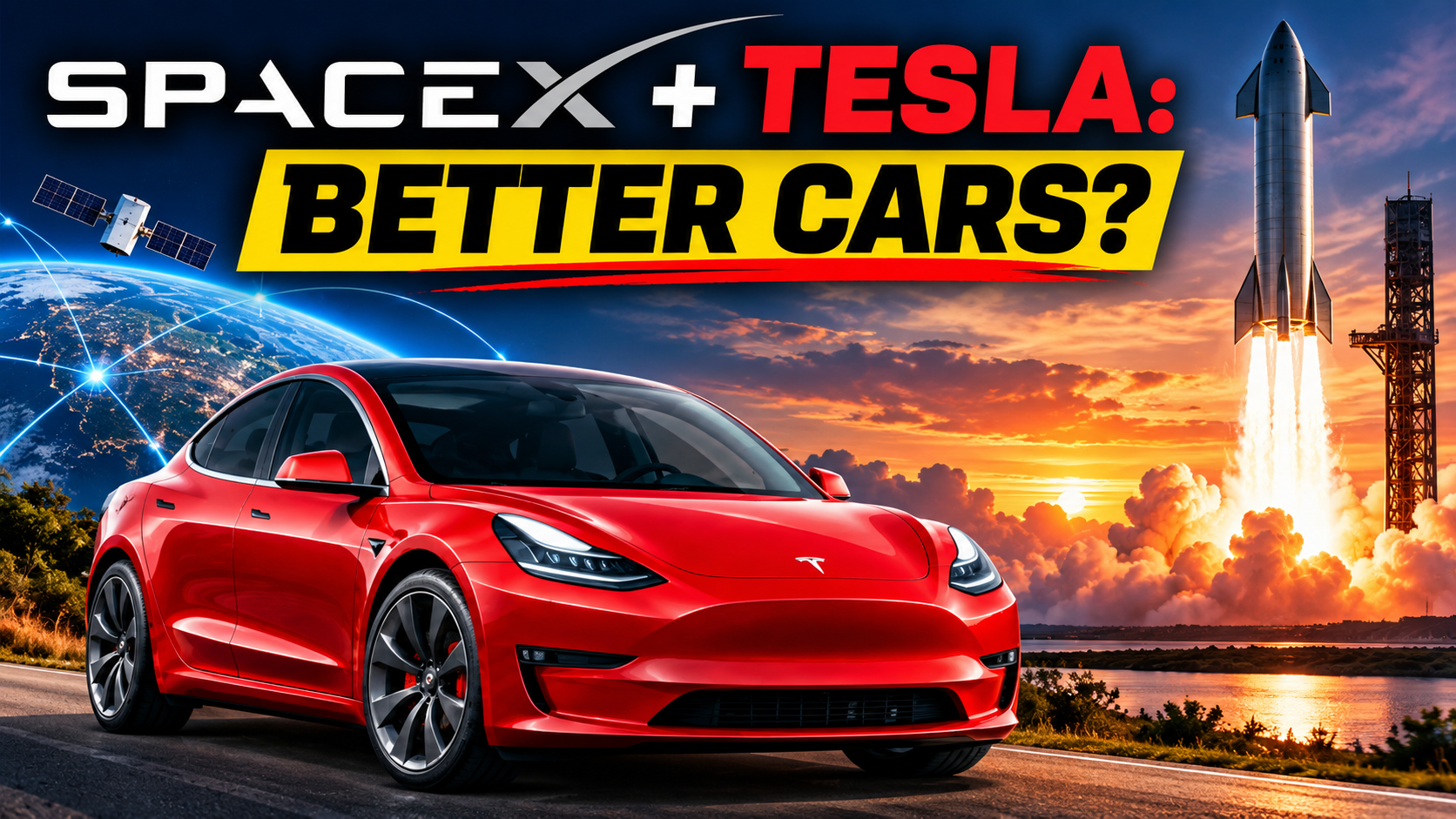
Could a SpaceX-Tesla merger bring better batteries, Starlink connectivity, smarter self-driving technology, and lower vehicle prices? Here’s what it could mean for Tesla owners.
The possibility of a merger or acquisition involving Tesla and SpaceX has sparked an interesting question among Tesla owners: Could combining Elon Musk’s two technology companies actually make Tesla vehicles better?
While investors may focus on company valuations and financial implications, everyday Tesla drivers are interested in something much more practical.
Will this mean longer driving range, faster charging, improved Full Self-Driving, better connectivity, or more affordable Teslas?
Tesla and SpaceX already share an interest in artificial intelligence, advanced manufacturing, energy systems, and cutting-edge engineering. A closer corporate relationship could potentially accelerate innovations that benefit future Tesla vehicles.
However, a merger could also create challenges, including increased costs, divided engineering resources, and less attention to Tesla’s core automotive business.
Let’s explore how a potential SpaceX-Tesla merger could affect the cars we drive.
Editor’s note: This article discusses a potential corporate transaction and its possible implications. The benefits described are speculative unless otherwise identified as existing technology or confirmed company plans.
1. Starlink Could Give Tesla Vehicles Better Internet Connectivity
One of the most exciting possibilities involves SpaceX’s Starlink satellite internet technology.
Tesla vehicles currently rely heavily on cellular connectivity for features such as navigation data, streaming services, and remote vehicle communication.
For drivers traveling through cities and populated areas, cellular connectivity generally works well. However, coverage can become unreliable in remote locations.
Imagine driving your Tesla through the mountains, across rural highways, or into a national park without worrying as much about losing your connection.
A closer relationship between Tesla and SpaceX could encourage the development of more advanced satellite connectivity options.
Potential benefits for Tesla owners
- Improved connectivity in rural areas.
- More reliable connected navigation services.
- Better communication capabilities for future autonomous vehicles.
- Enhanced emergency communication options.
- Greater connectivity during long-distance road trips.
This could be especially valuable for Tesla owners who regularly take road trips.
However, Starlink integration would require compatible communications technology. A merger would not automatically give existing Tesla vehicles full satellite internet capabilities.
Why it matters: Better connectivity could make Tesla ownership more convenient, particularly for drivers who frequently travel beyond major metropolitan areas.
2. Tesla Full Self-Driving Could Become More Advanced
Artificial intelligence is one of Tesla’s biggest areas of investment.
Tesla continues developing its Full Self-Driving (Supervised) technology, vehicle perception systems, and AI-powered robotics.
SpaceX also depends on sophisticated software, computing systems, automation, and engineering.
Combining resources could potentially accelerate certain areas of AI research and development.
How could this improve Tesla vehicles?
Smarter driving decisions
More advanced AI models could help Tesla vehicles better interpret unusual road conditions, complicated intersections, and unpredictable traffic situations.
Improved object recognition
Future vehicle software could potentially become better at identifying pedestrians, cyclists, vehicles, and obstacles.
More capable in-car assistants
AI advancements could support smarter voice controls, navigation assistance, and vehicle information systems.
Faster software development
Shared computing resources and engineering expertise might help streamline certain development processes.
Tesla’s over-the-air software updates could make some future improvements available to compatible existing vehicles.
However, a corporate merger alone would not make Tesla vehicles fully autonomous.
Tesla’s current Full Self-Driving (Supervised) system still requires an attentive driver, and any future improvements would need extensive testing and validation.
3. SpaceX Engineering Could Help Tesla Build Better Cars
SpaceX has developed advanced manufacturing techniques to build rockets and spacecraft capable of operating under extreme conditions.
Tesla has developed expertise in electric vehicle production, battery management, vehicle software, and large-scale manufacturing.
Although rockets and passenger vehicles have very different engineering requirements, the companies could potentially share useful research and production methods.
Areas that could benefit
Lightweight materials
Reducing vehicle weight can improve energy efficiency and driving range.
Thermal management
Improved cooling and temperature-control systems could potentially benefit batteries, motors, and vehicle electronics.
Manufacturing efficiency
Shared automation techniques might reduce production complexity and manufacturing costs.
Component durability
Research into advanced materials and electronics could eventually influence future vehicle components.
For example, a lighter Tesla Model 3 or Model Y could potentially travel farther using the same amount of battery energy.
These improvements would likely happen gradually rather than appearing immediately after a merger.
4. Could Tesla Batteries Get Better?
Battery technology is one of the biggest factors affecting electric vehicle performance.
Tesla owners want batteries that offer:
- Longer driving range.
- Faster charging speeds.
- Better cold-weather performance.
- Longer battery lifespan.
- Lower replacement costs.
- More affordable vehicle prices.
A combined Tesla-SpaceX organization could potentially coordinate investments in energy storage, materials research, electronics, and thermal management.
These investments might contribute to more efficient battery systems over time.
Could we see a Tesla Model 3 with 500 miles of range?
It’s an exciting possibility, but there is no confirmed evidence that a merger would produce a 500-mile Model 3.
Achieving significantly longer range requires improvements in battery energy density, vehicle efficiency, weight, and other engineering factors.
A merger could provide additional resources, but it would not guarantee a battery breakthrough.
For existing Tesla owners, improvements in battery management software might offer more immediate benefits than entirely new battery technology.
5. The Tesla Roadster Could Benefit From SpaceX Technology
The next-generation Tesla Roadster is one of the most obvious examples of potential collaboration between Tesla and SpaceX.
Elon Musk has previously discussed the possibility of incorporating SpaceX-inspired propulsion technology into a future Roadster.
The concept has generated considerable attention because it suggests performance capabilities beyond those of traditional electric sports cars.
A merger could potentially make collaboration on specialized engineering projects easier.
What could this mean?
Future Tesla performance vehicles might benefit from:
- Advanced lightweight materials.
- Innovative propulsion research.
- Improved aerodynamics.
- Specialized electronics.
- New manufacturing techniques.
However, proposed Roadster features should not be considered confirmed production specifications until Tesla officially demonstrates and delivers them.
And while the Roadster could showcase exciting technology, it doesn’t necessarily mean those features would appear in affordable Tesla models.
The real long-term benefit would come if engineering advances eventually made their way into everyday vehicles.
6. Could a SpaceX Merger Make Tesla Cars Cheaper?
This may be the most important question for prospective Tesla buyers.
Tesla and SpaceX both invest heavily in engineering, robotics, manufacturing, software, and advanced electronics.
Combining certain resources could potentially reduce duplicated development efforts and improve operational efficiency.
Possible areas of cost savings
- Shared research and development.
- More efficient manufacturing processes.
- Coordinated purchasing of certain components.
- Improved factory automation.
- Shared expertise in electronics and computing.
If Tesla reduces production costs, the company could potentially offer more competitive vehicle prices.
But there is an important catch.
Lower manufacturing costs do not automatically mean lower Tesla prices.
Tesla could decide to reinvest those savings into future vehicle development, artificial intelligence, robotics, or other projects.
For buyers, the most meaningful outcome would be a more affordable Model 3 or Model Y with better standard features.
Whether a merger would actually produce that result remains uncertain.
7. What Would Happen to Existing Tesla Owners?
If you already own a Tesla, you might wonder whether a SpaceX merger could improve the car sitting in your garage.
The answer is potentially yes, particularly through software updates.
Tesla’s over-the-air update system allows the company to deliver improvements without requiring owners to purchase a new vehicle.
Some potential benefits could include smarter navigation, improved voice controls, and more advanced driving-assistance software.
However, hardware-dependent improvements would likely require newer vehicles.
Potential improvements for existing Teslas
| Technology | Could existing Teslas benefit? |
|---|---|
| AI software improvements | Possibly, depending on hardware |
| Improved navigation features | Potentially through software updates |
| Smarter voice assistant | Potentially through software updates |
| Full Starlink satellite internet | May require additional hardware |
| New battery technology | Generally requires a different battery or vehicle |
| New vehicle materials | Primarily future Tesla models |
Existing owners should not expect a merger announcement to immediately unlock new vehicle capabilities.
The biggest benefits would depend on actual products and software updates Tesla chooses to deliver.
8. Could a Merger Hurt Tesla’s Automotive Business?
Not every potential outcome is positive.
One concern is that Tesla could become even more focused on artificial intelligence, robotics, satellite communications, and other large-scale technology projects.
These industries require enormous investments.
A combined company could face difficult decisions about where to allocate money and engineering talent.
Potential disadvantages for Tesla owners
Less focus on affordable vehicles
Tesla could prioritize advanced technology projects rather than developing lower-cost electric cars.
Slower improvements to existing models
Engineering resources might shift away from practical vehicle upgrades.
Service and repair challenges
Tesla owners already care about parts availability, service center access, and repair turnaround times. These areas need continued investment.
Higher organizational complexity
Combining two major technology companies could create additional management and regulatory challenges.
Greater financial demands
Large investments in space infrastructure and AI could compete with automotive development priorities.
A merger would only benefit Tesla drivers if the company continued prioritizing vehicle quality, reliability, affordability, and customer service.
9. Does SpaceX Actually Need to Buy Tesla?
Interestingly, Tesla and SpaceX don’t necessarily need to merge to share technology.
The companies could collaborate through research partnerships, technology licensing, engineering agreements, or joint development programs.
For example, Tesla could potentially explore satellite connectivity solutions involving Starlink without SpaceX acquiring the automaker.
Similarly, engineering teams could collaborate on selected projects while maintaining separate corporate structures.
From a vehicle owner’s perspective, the most important question isn’t whether Tesla and SpaceX operate under one company.
It’s whether their collaboration produces better vehicles and a better ownership experience.
A merger could simplify certain business decisions, but it could also introduce complications that wouldn’t exist in a traditional partnership.
10. When Would Tesla Drivers See Any Improvements?
Even if Tesla and SpaceX complete a merger or acquisition, major automotive improvements would probably take time.
Short-term possibilities
- More coordinated engineering research.
- Increased collaboration on AI technology.
- New announcements involving connected services.
- Shared development initiatives.
Medium-term possibilities
- Improved vehicle software.
- More advanced AI systems.
- Better manufacturing processes.
- New connected-vehicle services.
Long-term possibilities
- New battery technologies.
- Advanced vehicle platforms.
- Greater satellite connectivity.
- More innovative vehicle electronics and materials.
These are potential development paths, not confirmed timelines.
For Tesla owners, it could take years before some engineering improvements become available in production vehicles.
Frequently Asked Questions About a Tesla-SpaceX Merger
Is SpaceX acquiring Tesla?
A possible merger or acquisition has been the subject of reports and discussions, but readers should verify the latest official company announcements before treating any proposed transaction as finalized.
Will Tesla cars get Starlink internet?
A closer Tesla-SpaceX relationship could encourage satellite connectivity development. However, full Starlink internet access has not been confirmed for existing Tesla vehicles as a result of a merger.
Could SpaceX improve Tesla Full Self-Driving?
Shared AI research, computing infrastructure, and engineering expertise could potentially support future improvements. However, a merger alone would not change the capabilities or supervision requirements of existing systems.
Will Tesla vehicles become cheaper?
Possibly, if shared technology and manufacturing efficiencies reduce production costs and Tesla passes those savings along to customers. Lower vehicle prices are not guaranteed.
Could a merger improve Tesla battery range?
Shared research could contribute to future battery and efficiency improvements, but no specific range increase has been confirmed as a result of a potential merger.
Would existing Tesla owners benefit?
Some improvements could potentially arrive through software updates, while new hardware features might be limited to future vehicles.
Final Verdict: Would a SpaceX-Tesla Merger Be Good for Tesla Cars?
A SpaceX merger or acquisition of Tesla could eventually benefit Tesla vehicles, particularly in artificial intelligence, connectivity, engineering, and manufacturing.
The most promising opportunities include better connected services, smarter vehicle software, improved production efficiency, and more advanced future vehicle technology.
However, the biggest concern is whether Tesla would remain focused on building affordable, reliable electric vehicles while also supporting ambitious space and AI projects.
For everyday Tesla owners, the best outcome wouldn’t simply be a bigger technology company.
It would be a better Tesla.
That means longer driving range, more reliable software, lower ownership costs, improved connectivity, and vehicles that continue getting better over time.
Our take: A closer Tesla-SpaceX relationship could produce exciting automotive innovations, but drivers should judge its success by actual improvements to their vehicles rather than merger speculation.
Until concrete plans and products are announced, the potential benefits remain possibilities.
Get More From Your Tesla Today
While the future of Tesla and SpaceX continues to develop, you don’t have to wait for a merger to make Tesla ownership more affordable and enjoyable.
At MyTeslaSavings.com, we offer free tools and guides to help Tesla owners save money, plan better trips, and get more from their vehicles.
Explore our free Tesla tools:
- Tesla Savings Calculator — Estimate how much money you can save compared with driving a gasoline-powered vehicle.
- Tesla Road Trip Planner — Plan your next Tesla adventure with charging estimates, route planning, and interesting stops.
- Tesla Troubleshooting Library — Find helpful solutions to common Tesla problems.
Visit MyTeslaSavings.com for Tesla news, accessories, ownership guides, charging tips, and money-saving strategies.