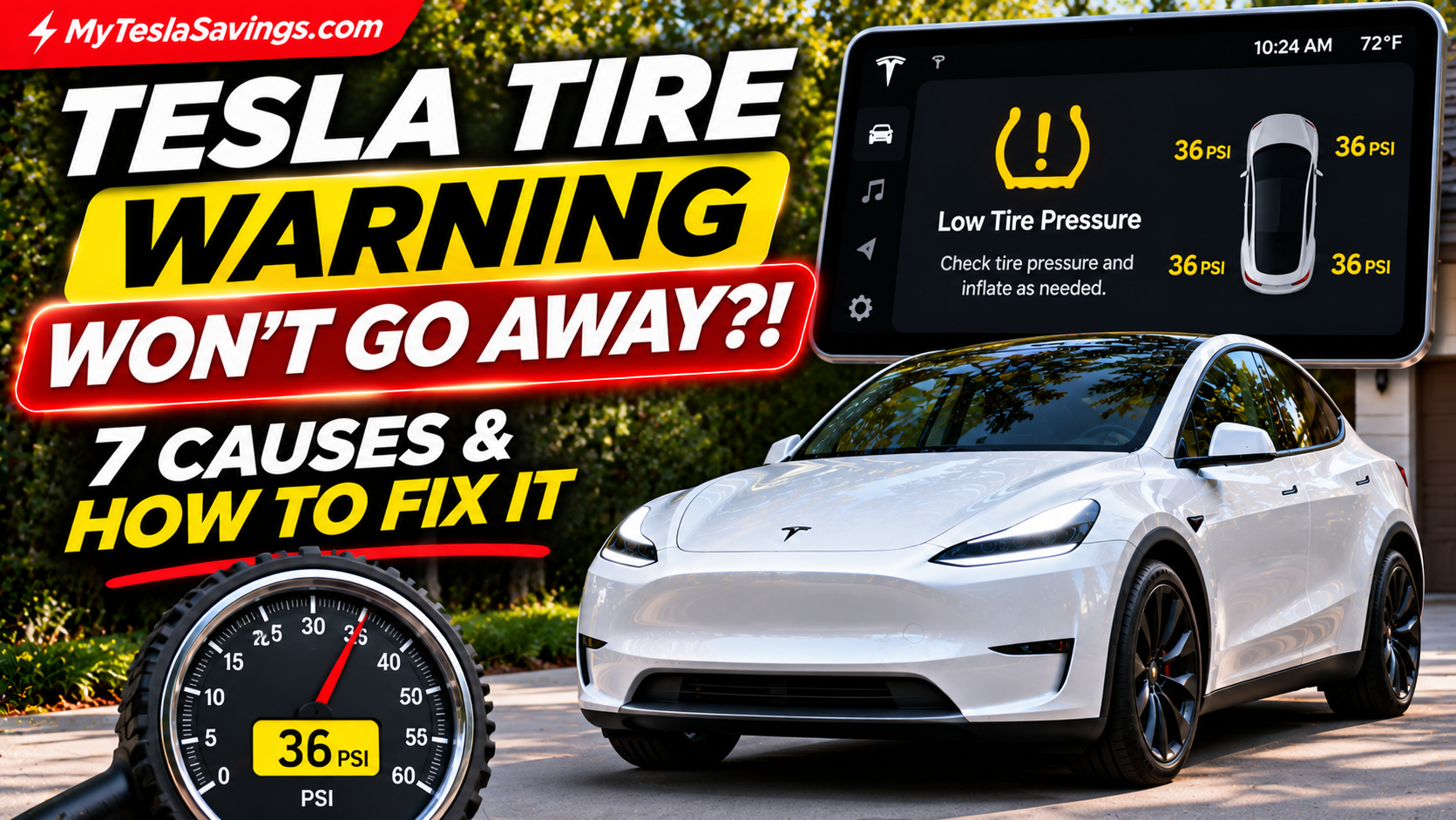
You just added air to your Tesla tires, checked the pressure, and everything looks normal. But there’s one problem: That annoying tire pressure warning is STILL showing on your touchscreen!
Does that mean something is wrong with your Tesla? Do you need to reset the system? Or will the warning eventually disappear on its own?
The good news is that a Tesla tire pressure warning that stays on after adding air doesn’t necessarily mean there’s a serious problem.
In many cases, your Tesla simply needs to update its tire pressure readings.
However, there are also situations where a persistent warning could indicate a slow leak, damaged tire, or Tire Pressure Monitoring System (TPMS) problem.
Here’s what every Tesla Model 3 and Model Y owner should know.
Quick Answer: Why Won’t My Tesla Tire Pressure Warning Go Away?
If you’ve already inflated your tires to the correct pressure, your Tesla may need to be driven before the warning disappears.
On vehicles with direct TPMS, Tesla recommends driving above 15 mph (25 km/h) for a short period so the system can update its readings.
Some Tesla troubleshooting alerts indicate that approximately 10 minutes of driving may be necessary.
But before assuming the warning just needs time, make sure your tires are actually inflated to the recommended cold tire pressure.
And here’s something important:
Not every Tesla uses the same tire pressure monitoring system. Some newer configurations use an indirect system that requires calibration after adjusting tire pressure.
1. Your Tesla Hasn’t Updated Its Tire Pressure Readings Yet
This is one of the most common explanations.
You add air to your tires, return to the driver’s seat, and expect the warning to disappear immediately.
But Tesla’s tire pressure monitoring system doesn’t always update while the vehicle is stationary.
On vehicles with direct TPMS, the system may need to receive fresh readings from the tire sensors while driving.
How to Fix It
- Check that all four tires are inflated to the recommended cold pressure.
- Inspect the tires for obvious damage.
- If the tires are safe, drive normally.
- On direct-TPMS vehicles, driving above 15 mph may help update the readings.
- Check whether the warning disappears.
If the warning remains after a normal drive, investigate the other possibilities below.
2. Cold Weather Lowered Your Tire Pressure
Ever notice that your Tesla’s tire pressure warning seems to appear when temperatures suddenly drop?
There’s a reason.
As outside temperatures fall, the air inside your tires contracts, reducing pressure.
Tesla notes that tire pressure can decrease by approximately 1 PSI for every 10°F drop in temperature.
For example:
| Temperature Change | Approximate Pressure Drop |
|---|---|
| 70°F to 60°F | 1 PSI |
| 70°F to 50°F | 2 PSI |
| 70°F to 40°F | 3 PSI |
| 70°F to 30°F | 4 PSI |
These are approximate changes, not guaranteed readings.
Why This Matters
Suppose your tires were correctly inflated during a warm afternoon.
A few days later, temperatures drop significantly.
Your Tesla may suddenly display a low tire pressure warning even though you haven’t driven over anything sharp.
How to Fix It
Check the tires when they’re cold and inflate them to the pressure recommended on your vehicle’s tire information label.
Don’t simply wait for warmer weather to make the warning disappear.
Even if the warning clears as the tires warm up, they may still need additional air when cold.
3. You’re Using the Wrong Recommended Tire Pressure
Here’s a mistake that can cause unnecessary confusion.
Some owners look at the tire sidewall to determine how much air to add.
But the pressure printed on the tire itself is not necessarily the recommended inflation pressure for your Tesla.
Instead, check the Tire and Loading Information label on the driver’s door pillar.
That label provides the recommended cold tire pressure for your vehicle’s configuration.
Is Every Tesla Supposed to Have 42 PSI?
No.
Although 42 PSI is a familiar number to many Tesla owners, you shouldn’t assume it applies to every Model 3, Model Y, wheel configuration, or model year.
Always use your vehicle’s specified pressure.
How to Find Your Recommended PSI
- Open the driver’s door.
- Locate the Tire and Loading Information label on the center door pillar.
- Find the recommended cold tire pressure.
- Check all four tires using an accurate gauge.
- Inflate them as necessary.
For vehicles with direct TPMS, you can also view tire pressures under Controls → Service.
4. You Checked the Tire Pressure While the Tires Were Hot
This is another common mistake.
Driving generates heat, and warmer tires generally show higher pressure readings.
That means your Tesla could display an acceptable PSI after driving but have lower-than-recommended pressure the next morning.
Example
Imagine your tire reads 42 PSI after a long drive.
When the tire cools, its pressure may drop several PSI.
If you only checked the warm reading, you might incorrectly assume the tire was properly inflated.
How to Fix It
Tesla recommends checking tire pressures when the vehicle has been stationary for more than three hours.
Use an accurate tire pressure gauge.
Important: Don’t release air from warm tires just to match the recommended cold pressure. That can leave the tires dangerously underinflated once they cool.
5. Your Tesla Has a Slow Tire Leak
If one tire repeatedly loses pressure while the others remain relatively stable, you may have a slow leak.
Common causes include:
- A nail or screw embedded in the tread
- A leaking valve stem
- A damaged wheel
- A leak around the tire bead
- Tire damage from a pothole
Warning Signs
Pay attention if:
- The same tire repeatedly triggers a warning.
- You add air every few days.
- One tire consistently reads lower than the others.
- You notice visible tire damage.
- You hear air escaping.
What Should You Do?
Have the tire inspected by a qualified tire professional.
Don’t ignore repeated pressure loss.
And if your Tesla warns that a tire is extremely low or flat, pull over safely and avoid continuing to drive on the damaged or severely underinflated tire.
6. Your Tesla Needs Tire Pressure Calibration
This is particularly important because Tesla has different TPMS configurations.
Direct TPMS
A direct system uses sensors to measure tire pressure.
If your Tesla displays individual numerical PSI readings for the tires, it uses direct TPMS.
After adjusting pressure, the vehicle generally updates readings automatically while driving.
Indirect TPMS
An indirect system estimates tire pressure loss rather than displaying individual pressure measurements.
Tesla’s current documentation indicates that some Model 3 and Model Y configurations use this system.
After inflating, repairing, rotating, or changing tires, manual calibration is required.
How to Calibrate Indirect TPMS
First, verify that all four tires are inflated to the correct cold pressure.
Then navigate to:
Controls → Service → Tire Pressure → Calibrate Tire Pressure
Follow the on-screen instructions.
Tesla states that calibration occurs during driving and may require at least 20 minutes above 15 mph.
Important: Only perform this procedure if your vehicle has indirect TPMS. Calibrating with incorrect pressures can cause inaccurate warnings.
7. Your Tesla Has a TPMS Sensor or System Problem
Sometimes the problem isn’t the tire pressure itself.
On vehicles with direct TPMS, a sensor may malfunction or fail to communicate properly.
Tesla notes that a TPMS malfunction can cause the tire pressure warning indicator to flash for approximately one minute before remaining illuminated.
Possible Causes
- A failed tire pressure sensor
- A sensor communication problem
- A replacement wheel with an incompatible sensor
- A system malfunction
What to Do
Check your tire pressures manually first.
If the warning indicates a TPMS malfunction or continues despite correct pressure and normal operation, schedule service through the Tesla app.
Tesla Tire Pressure Warning: What Each Situation Means
| What You Notice | Possible Explanation | What to Do |
|---|---|---|
| Warning remains immediately after adding air | System hasn’t updated | Verify pressure and follow the applicable driving/update procedure |
| Warning appears on cold mornings | Temperature-related pressure drop | Check and inflate cold tires |
| Same tire keeps losing PSI | Slow leak | Have tire inspected |
| Warning after tire rotation | Calibration or sensor relearning | Follow instructions for your TPMS type |
| Warning flashes before staying on | TPMS malfunction | Check tires and arrange service |
| Severe low-pressure or flat-tire alert | Potentially unsafe tire | Pull over safely |
How to Check Tire Pressure on a Tesla Model 3 or Model Y
On vehicles equipped with direct TPMS:
- Open Controls.
- Select Service.
- Look for the tire pressure display.
- Review the individual tire readings.
- Compare them with the recommended cold pressures.
Some configurations also show tire pressures in the Tesla mobile app.
Remember that the displayed readings may be from the last time the vehicle measured them.
If your Tesla uses indirect TPMS, it may show tire warnings without displaying individual PSI measurements.
Can Incorrect Tire Pressure Reduce Tesla Range?
Yes. Underinflated tires can reduce your Tesla’s efficiency.
When tire pressure is too low, rolling resistance generally increases.
That means your Tesla may need more energy to travel the same distance.
Underinflation can also contribute to:
- Uneven tire wear
- Reduced tire life
- Poor handling
- Increased tire temperatures
- Greater risk of tire damage
Maintaining the recommended pressure is one of the simplest ways to support tire longevity and vehicle efficiency.
However, overinflating your tires above the vehicle’s recommended pressure isn’t a safe shortcut to getting more range.
5 Tesla Tire Essentials Every Owner Should Keep Handy!
Don't wait until your Tesla displays a low tire pressure warning to get prepared! These five practical accessories can help you check tire pressure, handle minor roadside situations, and keep your emergency supplies organized. Check out these early Amazon Black Friday deal picks!
Portable Tire Inflator
A compact portable inflator can help you add air to your Tesla's tires without searching for a gas station air pump.
- Convenient tire inflation
- Useful during road trips
- Helps maintain proper tire pressure
Digital Tire Pressure Gauge
An easy-to-use pressure gauge helps you check tire PSI accurately, especially before driving when your tires are cold.
- Check tire pressure quickly
- Useful for cold-weather PSI checks
- Compact enough for your glovebox
Tire Tread Depth Gauge
Monitor your tire tread depth to recognize wear before it becomes a bigger problem.
- Monitor tire tread wear
- Identify uneven tread depth
- Small and easy to store
Emergency Roadside Kit
Be better prepared for unexpected roadside situations with a kit containing useful emergency equipment.
- Useful roadside preparedness
- Convenient emergency storage
- Great addition to your Tesla trunk
MIKKUPPA 65L Trunk Organizer with Lid
Keep your tire inflator, pressure gauge, roadside equipment, and other Tesla essentials neatly organized in one convenient location. The MIKKUPPA 65L offers spacious compartments, a removable lid, and a collapsible design.
- 65-liter storage capacity
- Multiple organizing compartments
- Removable lid keeps items covered
- Collapsible when extra space is needed
As an Amazon Associate, MyTeslaSavings.com earns from qualifying purchases. Prices, discounts, and availability are subject to change.
Tesla Tire Pressure Essentials Worth Keeping in Your Trunk
If you own a Tesla, consider keeping a few basic tire-maintenance accessories in your vehicle.
Early Amazon Black Friday deals below:
1. Portable Tire Inflator
A compact 12V or rechargeable tire inflator can help you adjust tire pressure when you’re away from home.
Check your Tesla’s available power connections and the inflator’s requirements before buying.
2. Digital Tire Pressure Gauge
An accurate gauge is useful for verifying pressure when your tires are cold.
3. Tire Tread Depth Gauge
Regularly checking tread depth can help you recognize tire wear before it becomes a bigger problem.
4. Emergency Roadside Kit
A flashlight, reflective safety equipment, and other basic emergency supplies can be valuable when dealing with an unexpected tire problem.
5. Trunk Organizer
Keeping your tire inflator, gauge, and emergency supplies organized makes them easier to locate when needed.
One option worth considering is the MIKKUPPA 65L Collapsible Trunk Organizer with Lid.
It offers multiple compartments, covered storage, and a collapsible design.
Check the MIKKUPPA 65L Trunk Organizer on Amazon
As an Amazon Associate, MyTeslaSavings.com earns from qualifying purchases.
Frequently Asked Questions
Why is my Tesla tire pressure warning still on after adding air?
Your Tesla may need to update its readings while driving, or an indirect TPMS configuration may require calibration. Verify the correct cold pressure first.
How long does it take for Tesla’s tire pressure warning to disappear?
On direct-TPMS vehicles, the warning may clear after driving a short distance. Certain alerts may require driving above 15 mph for approximately 10 minutes. Indirect TPMS requires a different calibration procedure.
Do I need to manually reset Tesla tire pressure sensors?
Not necessarily. Direct-TPMS vehicles generally update automatically. Indirect-TPMS vehicles require manual calibration after pressure adjustments.
Why does my Tesla show low tire pressure every morning?
Cold temperatures can lower tire pressure. Check the tires when cold and inflate them to the recommended specification.
Is 42 PSI correct for every Tesla?
No. Check the Tire and Loading Information label on your specific vehicle.
Can I drive with a Tesla tire pressure warning?
A low-pressure warning requires prompt inspection and correction. Do not continue driving on a severely underinflated, flat, or visibly damaged tire. Follow any instructions displayed by your vehicle.
Does the Tesla Model Y Juniper have tire pressure monitoring?
Yes. Current Model Y vehicles have tire pressure monitoring, but the system type and available settings can vary by configuration.
Will a Tesla tire pressure warning clear by itself?
It may clear after the system detects correct pressure. However, you should not assume the problem has resolved simply because the warning disappears as the tires warm up.
Final Verdict: Don’t Ignore a Tesla Tire Pressure Warning
A persistent Tesla tire pressure warning can be frustrating, especially when you’ve already added air.
But in many cases, the solution is straightforward.
Start by checking the correct cold tire pressure, then follow the appropriate procedure for your Tesla’s TPMS configuration.
If the warning continues, look for signs of a slow leak or sensor malfunction.
And remember that maintaining proper tire pressure isn’t just about removing an annoying warning.
It’s an important part of keeping your Tesla safe, efficient, and ready for the road.
Related Tesla Owner Guides
- Tesla Regenerative Braking Not Working?
- Tesla Battery Draining Overnight?
- Tesla Model Y Juniper Winter Accessories
- MIKKUPPA 65L Trunk Organizer Review
Official Tesla References
MyTeslaSavings.com publishes independent Tesla ownership guides. Always follow the Owner’s Manual and safety alerts applicable to your specific vehicle.
5 Tesla Tire Essentials Every Owner Should Keep Handy!
Don't wait until your Tesla displays a low tire pressure warning to get prepared! These five practical accessories can help you check tire pressure, handle minor roadside situations, and keep your emergency supplies organized. Check out these early Amazon Black Friday deal picks!
Portable Tire Inflator
A compact portable inflator can help you add air to your Tesla's tires without searching for a gas station air pump.
- Convenient tire inflation
- Useful during road trips
- Helps maintain proper tire pressure
Digital Tire Pressure Gauge
An easy-to-use pressure gauge helps you check tire PSI accurately, especially before driving when your tires are cold.
- Check tire pressure quickly
- Useful for cold-weather PSI checks
- Compact enough for your glovebox
Tire Tread Depth Gauge
Monitor your tire tread depth to recognize wear before it becomes a bigger problem.
- Monitor tire tread wear
- Identify uneven tread depth
- Small and easy to store
Emergency Roadside Kit
Be better prepared for unexpected roadside situations with a kit containing useful emergency equipment.
- Useful roadside preparedness
- Convenient emergency storage
- Great addition to your Tesla trunk
MIKKUPPA 65L Trunk Organizer with Lid
Keep your tire inflator, pressure gauge, roadside equipment, and other Tesla essentials neatly organized in one convenient location. The MIKKUPPA 65L offers spacious compartments, a removable lid, and a collapsible design.
- 65-liter storage capacity
- Multiple organizing compartments
- Removable lid keeps items covered
- Collapsible when extra space is needed
As an Amazon Associate, MyTeslaSavings.com earns from qualifying purchases. Prices, discounts, and availability are subject to change.