
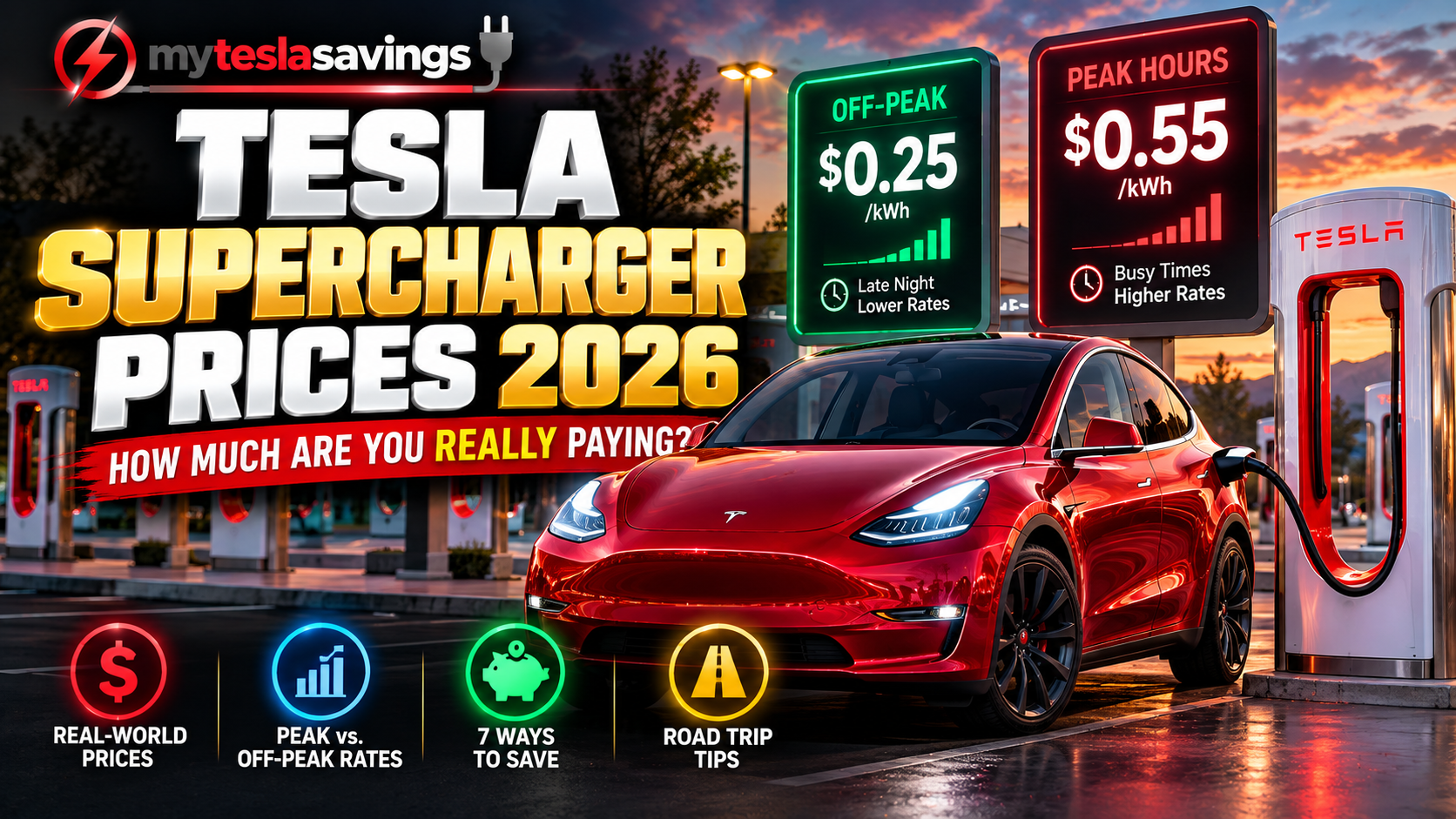
Think charging your Tesla is always cheaper than filling up a gas tank? It often is, but where and when you charge can make a surprisingly big difference.
Tesla Superchargers make owning an electric vehicle incredibly convenient. Whether you’re taking a cross-country road trip, commuting between cities, or simply need a quick charge, Tesla’s fast-charging network can get you back on the road without a lengthy stop.
But there’s one question every Tesla owner should ask:
How much does it actually cost to use a Tesla Supercharger in 2026?
The answer depends on several factors, including your location, electricity rates, the time of day, and how busy the charging station is.
In fact, two Tesla owners could charge the same amount of electricity at different Superchargers and pay dramatically different prices.
Let’s break down Tesla Supercharger pricing in 2026, calculate some real-world examples, and explore seven ways to save money every time you charge.
How Much Does Tesla Supercharging Cost in 2026?
Tesla Supercharger prices vary by location, and there’s no single nationwide rate.
For a useful benchmark, third-party charging data from DCFC Tracker shows that, as of October 2026, the average observed Tesla-driver/member rate was approximately $0.43 per kWh, while the standard nonmember rate at the locations tracked averaged approximately $0.62 per kWh.
These figures are averages from a third-party dataset, not official nationwide Tesla prices. The dataset tracks publicly accessible locations, uses peak prices at time-of-use stations, and does not necessarily represent the price a Tesla owner will pay at a particular time.
Your actual price could be considerably lower or higher.
Example Tesla Supercharging Costs
Here’s what you might pay for different amounts of electricity at various charging rates:
| Electricity Added | $0.25/kWh | $0.35/kWh | $0.45/kWh | $0.55/kWh |
|---|---|---|---|---|
| 20 kWh | $5.00 | $7.00 | $9.00 | $11.00 |
| 30 kWh | $7.50 | $10.50 | $13.50 | $16.50 |
| 40 kWh | $10.00 | $14.00 | $18.00 | $22.00 |
| 50 kWh | $12.50 | $17.50 | $22.50 | $27.50 |
| 60 kWh | $15.00 | $21.00 | $27.00 | $33.00 |
These are illustrative calculations, not guaranteed Supercharger rates. Additional applicable fees may affect the final total.
The basic calculation is simple:
Charging Cost = Electricity Added (kWh) × Price per kWh
For example:
If you add 40 kWh at a Supercharger charging $0.35 per kWh:
40 × $0.35 = $14.00
But if you add the same 40 kWh at a location charging $0.55 per kWh:
40 × $0.55 = $22.00
That’s an $8 difference for essentially the same amount of electricity.
Over multiple road trips, those differences add up.
Why Are Some Tesla Superchargers More Expensive Than Others?
Tesla Supercharger pricing isn’t identical across the country.
Several factors can affect what you pay.
1. Local Electricity Costs
Electricity prices vary significantly by state and utility provider.
Charging in a region with relatively inexpensive electricity may cost less than charging in an area with higher utility rates.
However, electricity costs aren’t the only factor determining a Supercharger’s price.
2. Time of Day
Some Supercharger locations offer different rates depending on when you plug in.
These are commonly called peak and off-peak rates.
A station might offer lower prices early in the morning or late at night while charging more during busy daytime periods.
3. Station Demand
Tesla also uses live pricing at certain locations.
When a station becomes busy, its charging price may increase. When fewer drivers are using the station, the price may decrease.
This encourages drivers who have flexible schedules to charge during quieter periods.
4. Location and Operating Costs
A Supercharger near a busy highway, popular shopping area, or major city may have different operating costs and pricing than one in a less crowded location.
The important takeaway?
Always check the actual Supercharger price before plugging in.
Tesla’s Dynamic Supercharger Pricing: What Owners Need to Know
One of the most important developments in Tesla charging is its use of dynamic pricing.
Rather than relying exclusively on fixed prices, Tesla can adjust rates at participating locations based on real-time demand.
Here’s a simple example.
Imagine you’re approaching a Supercharger with 20 charging stalls.
At 10:00 a.m., only four stalls are occupied.
At 5:30 p.m., nearly every stall is occupied.
With live pricing, Tesla may offer a lower rate during the quieter period and a higher rate when the station becomes busy.
Can Your Charging Price Change While You’re Plugged In?
According to Tesla, your charging rate is determined when you plug in.
If the displayed rate changes during your charging session, the new rate does not automatically replace the rate established at the start of your session.
However, the price shown while you’re driving toward a station may change before you arrive.
Money-saving tip: Check the price again when you reach the Supercharger, especially if you’ve been driving for a while.
How to Find Lower-Cost Superchargers
Tesla provides a useful feature at participating locations called View Lower Cost Charging.
When navigating to a busy Supercharger, your vehicle may offer alternative stations with lower prices.
Before committing to a charging stop, compare the options.
A nearby station could potentially save you several dollars.
Tesla Supercharger Peak vs. Off-Peak Pricing
One of the easiest ways to save money is to understand when a Supercharger charges less.
At participating stations, Tesla displays different rates for different periods.
For example, a hypothetical station might charge:
| Time | Example Rate |
|---|---|
| 12 a.m. – 6 a.m. | $0.25/kWh |
| 6 a.m. – 10 a.m. | $0.32/kWh |
| 10 a.m. – 7 p.m. | $0.49/kWh |
| 7 p.m. – 12 a.m. | $0.34/kWh |
Illustrative example only. Actual pricing windows and rates vary by location and may change.
Now imagine you need 50 kWh.
At $0.49 per kWh:
50 × $0.49 = $24.50
At $0.25 per kWh:
50 × $0.25 = $12.50
That’s a potential savings of $12 on one charging session.
Of course, it’s not always practical to wait until midnight to charge.
But if you’re traveling and have flexibility, checking off-peak pricing could make a noticeable difference.
How Much Does It Cost to Charge a Tesla Model 3 or Model Y?
Tesla Model 3 and Model Y owners often ask how much it costs to charge from 20% to 80%.
The answer depends on the vehicle’s usable battery capacity and the electricity price.
For an illustrative example, let’s assume a Tesla has a usable battery capacity of approximately 75 kWh.
Charging from 20% to 80% adds 60 percentage points of the battery’s usable capacity.
75 kWh × 60% = 45 kWh
Here’s what that amount of electricity would cost:
| Supercharger Rate | Approximate Cost |
|---|---|
| $0.25/kWh | $11.25 |
| $0.35/kWh | $15.75 |
| $0.45/kWh | $20.25 |
| $0.55/kWh | $24.75 |
| $0.65/kWh | $29.25 |
These figures represent a simplified calculation. Actual energy billed may differ because of battery conditioning, charging losses, vehicle energy use, and other factors.
Different Tesla trims and model years also have different battery capacities.
What About Charging to 100%?
Charging from 80% to 100% generally takes longer than charging through the lower portions of the battery.
That’s because charging speed typically decreases as the battery approaches a high state of charge.
For most road trips, you may save time by charging only enough to reach your next destination or charging stop.
Charging to 100% can still make sense when you need the additional range, but it isn’t always the fastest strategy.
Is Tesla Supercharging Cheaper Than Charging at Home?
For many Tesla owners, home charging is significantly cheaper than Supercharging.
Let’s compare a hypothetical home electricity rate of $0.15 per kWh with a Supercharger rate of $0.45 per kWh.
Cost to Add 50 kWh
At Home:
50 kWh × $0.15 = $7.50
At a Supercharger:
50 kWh × $0.45 = $22.50
Difference: $15.00
That’s three times as much at the Supercharger in this example.
The home-charging calculation excludes charging losses and any applicable fixed charges, while the Supercharger calculation assumes no additional fees.
What If You Charge 200 kWh Per Month?
Consider someone who needs 200 kWh of electricity for driving each month.
At home:
200 × $0.15 = $30
At a Supercharger:
200 × $0.45 = $90
Potential monthly savings: $60
Over 12 months, that becomes:
$720 in potential annual savings.
Your actual savings depend on your electricity rates, charging efficiency, and driving habits.
Find Out How Much You Could Save
Want to compare your own charging costs?
Visit the MyTeslaSavings.com Tesla Savings Calculator to explore your potential savings based on your driving and charging habits.
You can also use our charging calculators to compare home charging with public charging and evaluate whether installing a home charger makes financial sense.
Is Tesla Supercharging Still Cheaper Than Gas?
This is where things get interesting.
A Tesla can be cheaper to drive than a gasoline-powered vehicle, but the savings depend heavily on charging costs and vehicle efficiency.
Let’s compare two hypothetical vehicles traveling 1,000 miles.
Tesla Example
Assume the Tesla averages:
250 Wh per mile, equivalent to 0.25 kWh per mile.
For 1,000 miles:
1,000 × 0.25 = 250 kWh
At a Supercharger rate of $0.40 per kWh:
250 × $0.40 = $100
Gasoline Vehicle Example
Assume a gasoline vehicle averages:
30 miles per gallon
And gasoline costs:
$3.50 per gallon
For 1,000 miles:
1,000 ÷ 30 = 33.3 gallons
33.3 × $3.50 = approximately $116.67
Cost Comparison
| Vehicle | Cost for 1,000 Miles |
|---|---|
| Tesla at $0.40/kWh | $100.00 |
| Gas vehicle at $3.50/gallon | $116.67 |
| Tesla Savings | $16.67 |
In this example, the Tesla is still cheaper.
But consider what happens if the Supercharger rate increases to $0.55 per kWh.
250 × $0.55 = $137.50
At that price, Supercharging would actually cost more than fueling the hypothetical gasoline vehicle.
This is why it’s important not to assume every Supercharger session is cheaper than buying gas.
What If You Charge at Home?
Using the same Tesla efficiency and a home electricity rate of $0.15 per kWh:
250 × $0.15 = $37.50
Compared with the gasoline vehicle’s $116.67:
Potential savings: $79.17 per 1,000 miles.
These examples exclude charging losses, gasoline taxes beyond the assumed pump price, and other ownership costs. They’re intended to show how charging prices affect the comparison.
The lesson: Where you charge matters just as much as what you drive.
7 Ways to Save Money at Tesla Superchargers
You don’t need to change your entire driving routine to reduce Supercharging costs.
A few simple habits can help.
1. Check Prices Before You Arrive
Before navigating to a Supercharger, open its location details on your Tesla touchscreen or in the Tesla app.
Review the displayed charging rate and any applicable time-of-use pricing.
If several Superchargers are nearby, compare their prices.
Don’t assume the closest station is the cheapest.
2. Charge During Off-Peak Hours
If your schedule allows, use stations during lower-priced periods.
This can be especially useful when traveling overnight or stopping at a hotel near a Supercharger.
Even shifting one charging session to a less expensive time could save several dollars.
3. Use Tesla’s Lower-Cost Charging Suggestions
At supported locations, Tesla may suggest nearby Superchargers with lower prices.
Look for the View Lower Cost Charging option.
This is particularly useful when approaching a busy charging station.
Just remember to consider the extra driving distance and time before choosing an alternative.
4. Avoid Unnecessary Charging Above 80%
On road trips, charging to 100% isn’t always necessary.
If your next destination is comfortably within range, stopping at 70% or 80% may be more efficient.
Charging speed generally slows as the battery fills.
At busy Superchargers, additional congestion fees may also apply when certain conditions are met.
Use your Tesla’s navigation system to determine how much energy you need to reach your next stop safely.
5. Avoid Supercharger Congestion Fees
Tesla may charge congestion fees at busy stations when your battery reaches the applicable threshold, often 80%, or when your charging session ends.
Tesla provides a five-minute grace period before these fees begin.
To avoid unnecessary charges:
- Monitor your charging session in the Tesla app.
- Return to your vehicle before charging finishes.
- Move your Tesla promptly when you’re done.
- Pay attention to congestion notifications.
A charging session that initially seemed inexpensive can become more costly if you leave your vehicle occupying a stall after charging is complete.
6. Charge at Home Whenever Practical
For owners who have access to home charging, this is often the biggest opportunity to save.
Home charging also offers convenience.
Instead of making a separate charging stop, you can plug in when you arrive home and leave with the battery level you need.
If your utility offers lower overnight rates, scheduled charging may reduce costs further.
Use our Home Charger Payback Calculator to explore whether installing a home charger makes financial sense for your situation.
7. Plan Your Road Trips Around Charging Costs
A little planning can make a big difference on longer drives.
Instead of stopping at the first Supercharger you see, compare charging locations along your route.
Consider:
- Current charging prices
- Distance between stations
- Expected battery level on arrival
- Nearby food and rest stops
- Charging availability
- Whether an alternative station requires a detour
You don’t necessarily need to select the cheapest station every time.
Sometimes paying a little more is worth avoiding a long detour.
The goal is to find the best balance of cost, convenience, and travel time.
Try Our Tesla Road Trip Planner
Planning your next Tesla adventure?
Use the MyTeslaSavings.com Tesla Road Trip Planner to organize your route, explore charging stops, and estimate travel expenses.
It’s a useful starting point for planning a road trip without unnecessary surprises.
How to Check Tesla Supercharger Prices Before Charging
One of the easiest ways to avoid overpaying is to check the price before plugging in.
Using Your Tesla Touchscreen
- Open your Tesla’s navigation screen.
- Search for nearby Superchargers or select a charging location on the map.
- Tap the Supercharger location.
- Review the displayed charging price.
- Check for peak and off-peak pricing information.
- Compare nearby locations when available.
Tesla may also display predicted congestion and lower-cost alternatives.
Using the Tesla App
You can also review supported charging locations and prices through the Tesla app.
Available details may depend on the location and app version.
How to Check What You Actually Paid
After charging, you can review your Supercharging history.
According to Tesla, the process is:
- Open the Tesla app.
- Tap the menu in the upper-right corner.
- Select Charging.
- Tap Charging History.
- Select a charging session to review its details.
You can also download Supercharging invoices.
This is particularly useful if you want to track how much you’re spending on charging every month.
Are Tesla Supercharger Prices Increasing in 2026?
Recent charging-industry data suggests that Supercharger prices have increased in some markets.
An October 2026 report from InsideEVs, citing Paren’s third-quarter fast-charging data, reported that average Tesla nonmember Supercharging prices had increased approximately 15% year over year.
However, this does not mean every Tesla owner is paying 15% more.
Prices vary by location, membership or vehicle eligibility, time of day, and other factors.
Some locations may have lower prices during certain periods even while broader market averages increase.
For owners, the practical takeaway is simple:
Don’t rely on what a Supercharger cost six months ago. Check the current price before each session.
Tesla Supercharger Pricing FAQs
How much does it cost to fully charge a Tesla at a Supercharger?
It depends on the vehicle’s battery capacity, starting charge level, and electricity rate.
For example, adding 60 kWh at $0.40 per kWh costs approximately $24 before any additional applicable fees.
A full charge may require more or less electricity depending on your Tesla model.
Is Tesla Supercharging free?
Most Tesla owners pay for Supercharging.
However, certain vehicles or promotional offers may include free Supercharging benefits.
Check your vehicle’s specific eligibility rather than assuming free charging is included.
Are Tesla Superchargers cheaper at night?
Some are.
Participating stations offer time-of-use pricing, and certain locations adjust prices based on live occupancy.
Check the station’s displayed rates to see when charging is less expensive.
Do Tesla Supercharger prices change during charging?
Tesla states that the charging rate is determined when you plug in.
If the displayed rate changes afterward, your session’s established rate does not change mid-session.
Is it cheaper to Supercharge or charge at home?
Home charging is often cheaper, especially when your utility offers favorable residential or off-peak electricity rates.
However, actual savings depend on your home electricity price and local Supercharger rates.
Can I see Supercharger prices before arriving?
Yes.
Tesla displays location-specific pricing through supported vehicle navigation and Tesla app interfaces.
Can Supercharger congestion fees increase my bill?
Yes.
At busy locations, Tesla may apply congestion fees after the applicable conditions are met and the five-minute grace period expires.
Move your vehicle promptly when charging is complete.
Final Verdict: Is Tesla Supercharging Worth It in 2026?
Absolutely—when used strategically.
Tesla Superchargers remain an incredibly convenient option for road trips, unexpected charging needs, and situations where home charging isn’t available.
But convenience doesn’t always mean the lowest price.
As Tesla expands dynamic pricing and adjusts rates based on demand, knowing when and where to charge is becoming increasingly important.
The biggest money-saving opportunities come from:
Checking prices before plugging in, choosing lower-cost stations when practical, avoiding congestion fees, and charging at home whenever possible.
Even a few dollars saved per charging session can make a difference over time.
And if you frequently take road trips, those savings can add up quickly.
Calculate Your Tesla Charging Savings
Want to know whether you’re getting the best deal on charging?
Explore the free tools at MyTeslaSavings.com, including our Tesla Savings Calculator, Charging Savings Calculator, Home Charger Payback Calculator, and Tesla Road Trip Planner.
The more you understand your charging costs, the easier it becomes to get the most savings out of owning a Tesla.
Disclaimer: Charging prices and policies may change. All example calculations are illustrative and may not reflect your vehicle, electricity rates, charging losses, or applicable fees. MyTeslaSavings.com is an independent Tesla enthusiast website and is not affiliated with Tesla, Inc.