
Introduction
The electric vehicle revolution has been building for more than a decade, but 2026 may be the year that accelerates the transition faster than ever before. Tesla remains at the center of this transformation, pushing innovations in self-driving technology, charging infrastructure, and vehicle software while competitors race to keep up.
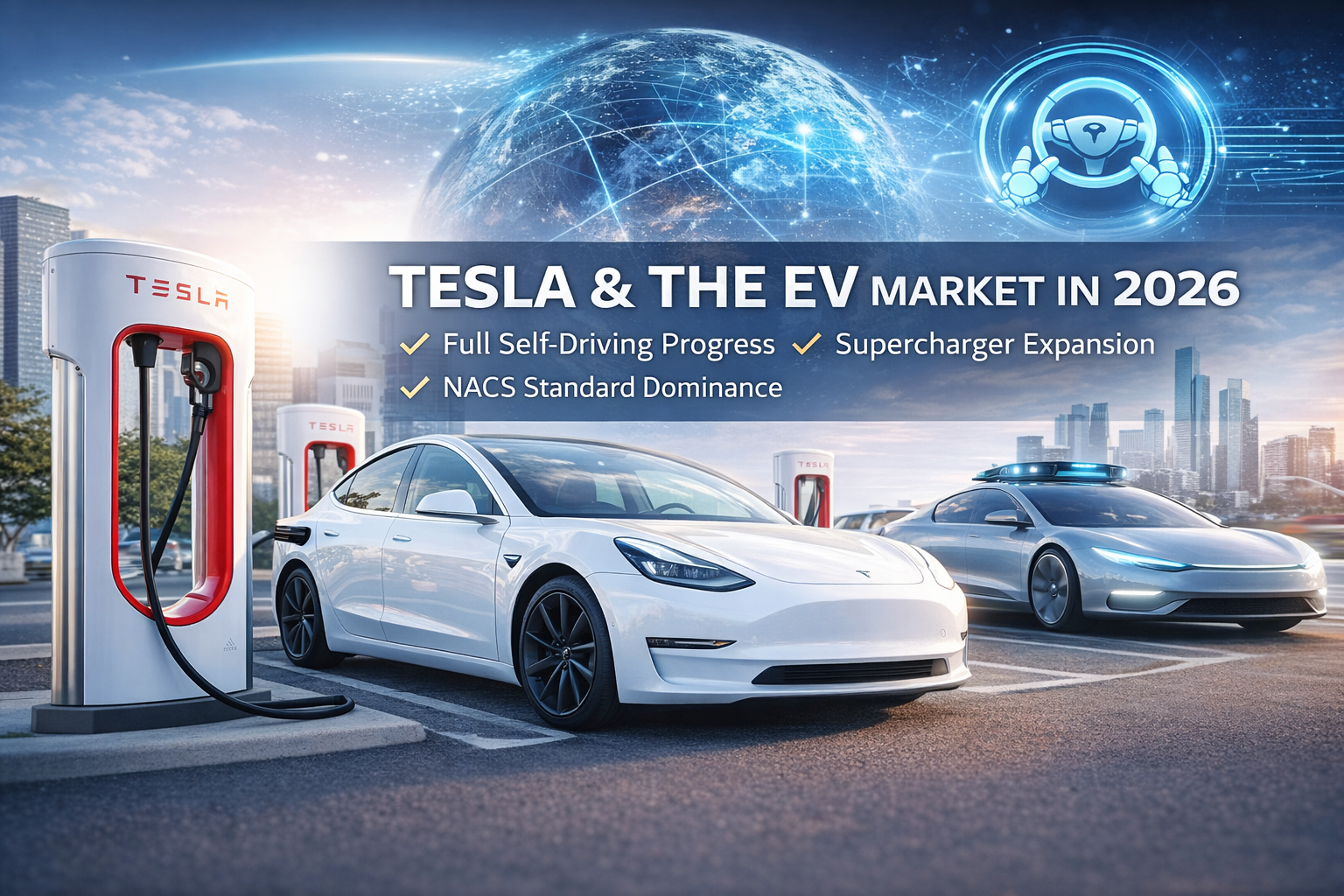
From the rapid expansion of Tesla’s Supercharger network to the global adoption of Tesla’s charging standard and major improvements to Full Self-Driving technology, the EV landscape is changing quickly.
For Tesla owners and EV enthusiasts, this is an exciting time. The company is evolving from simply being an electric car manufacturer into something much bigger: a technology platform that combines artificial intelligence, energy infrastructure, and transportation.
In this article, we’ll break down the biggest trends shaping Tesla and the EV market in 2026 and what they mean for current and future EV owners.
The Next Phase of Tesla’s Full Self-Driving Technology
One of the biggest Tesla stories right now is the continued development of Full Self-Driving (FSD) technology.
Tesla’s driver-assistance system allows vehicles to navigate city streets, highways, intersections, and traffic while the driver supervises the system. Tesla describes the technology as enabling a vehicle to drive “almost anywhere” with active driver supervision.
In recent months, improvements to Tesla’s AI driving stack have made the system significantly more capable.
According to industry reviews, Tesla’s latest FSD system is considered one of the most advanced driver-assistance systems currently available.
Tesla’s long-term goal is even more ambitious.
The company is working toward unsupervised self-driving, which could eventually allow vehicles to operate as autonomous robotaxis without a human driver.
Tesla has already begun testing autonomous capabilities in limited environments and aims to expand robotaxi programs in the coming years. Analysts believe the rollout of autonomous driving technology could be a defining milestone for Tesla’s growth trajectory.
If successful, this technology could reshape transportation entirely.
Tesla’s Robotaxi Vision
The robotaxi concept has been part of Tesla’s long-term strategy for years, but 2026 may be when the idea begins transitioning from theory to reality.
A robotaxi network would allow Tesla owners to add their vehicles to a shared autonomous ride-hailing platform. Instead of sitting idle in a parking lot, vehicles could potentially earn income while transporting passengers.
In theory, Tesla vehicles could operate similarly to ride-sharing services like Uber or Lyft, but without a driver.
While regulatory hurdles remain, Tesla continues pushing forward with the technology that would make this possible.
If the robotaxi concept succeeds, it could transform Tesla vehicles into income-producing assets, dramatically changing how consumers think about car ownership.
Tesla’s Supercharger Network Is Becoming the Industry Standard
One of Tesla’s biggest advantages over competitors has always been its charging infrastructure.
Tesla’s Supercharger network remains the largest and most reliable fast-charging network in the United States.
By the end of 2025, Tesla had deployed tens of thousands of fast-charging ports across the country and continued expanding rapidly.
For years, Tesla owners benefited from exclusive access to this network.
But now something major is happening.
Tesla has begun opening the Supercharger network to other electric vehicle manufacturers.
The Rise of NACS: Tesla’s Charging Standard Takes Over
Tesla’s charging connector, known as the North American Charging Standard (NACS), is rapidly becoming the dominant EV charging standard across the industry.
Major automakers including Ford, General Motors, Mercedes-Benz, Hyundai, Honda, BMW, and others have announced plans to adopt the NACS charging port.
This shift means that future EVs from many brands will be able to plug directly into Tesla’s Supercharger network.
Some automakers are already rolling out adapters to allow their vehicles to use Tesla chargers immediately.
For example, Stellantis announced that several of its upcoming electric vehicles will gain access to Tesla’s Supercharger network starting in 2026.
This development is a huge win for EV adoption because it solves one of the biggest concerns many drivers have about electric vehicles: charging reliability.
Tesla’s charging infrastructure is widely considered the most dependable fast-charging network available.
The 2026 Tesla Vehicle Lineup
Tesla’s vehicle lineup continues evolving with updates to its most popular models.
The Model 3 and Model Y remain the company’s best-selling vehicles, and both models have received recent upgrades.
Tesla has also updated naming and trim structures for entry-level vehicles, simplifying the lineup and introducing new configurations for buyers.
Meanwhile, the Model Y remains one of the most popular EVs in the world, competing directly with vehicles like the Hyundai Ioniq 5 and Ford Mustang Mach-E.
Recent improvements to the Model Y addressed several earlier shortcomings and helped keep the vehicle competitive in an increasingly crowded EV market.
Tesla continues refining its vehicles through software updates and incremental hardware improvements rather than relying on traditional multi-year redesign cycles.
Over-the-Air Updates Keep Tesla Vehicles Getting Better
One of Tesla’s most unique advantages is its software-driven architecture.
Tesla vehicles receive regular over-the-air (OTA) updates that add new features and improve performance without requiring a dealership visit.
This approach is becoming increasingly important in the EV world.
Modern electric vehicles are essentially computers on wheels, with software controlling everything from battery management to driver assistance features.
OTA updates allow Tesla to continuously improve vehicles even after they are sold.
For example, software updates have added features like:
- improved Autopilot functionality
- enhanced navigation systems
- new entertainment features
- better energy efficiency
- updated user interfaces
This means a Tesla purchased today could become significantly more capable over time.
EV Adoption Is Accelerating Worldwide
Despite some fluctuations in regional sales, the overall trend toward electric vehicles remains strong.
EV adoption continues rising globally as consumers look for cleaner, more efficient transportation options.
Several factors are driving this shift:
- improving battery technology
- longer driving ranges
- faster charging speeds
- expanding charging networks
- government incentives and policies
Some modern EVs are now approaching ranges of 350–450 miles per charge, making them practical for nearly all driving scenarios.
At the same time, charging speeds are improving dramatically, with new fast-charging systems capable of adding hundreds of miles of range in minutes.
Tesla’s Data Advantage
Another key advantage Tesla has in the self-driving race is data.
Every Tesla vehicle on the road collects driving data that helps train the company’s AI systems.
As of recent estimates, Tesla vehicles have accumulated billions of miles of real-world driving data used to improve autonomous driving algorithms.
This massive dataset provides Tesla with insights that competitors struggle to replicate.
The more miles Tesla vehicles drive, the smarter the system becomes.
EVs as Part of the Energy Ecosystem
Electric vehicles are also becoming part of a larger energy ecosystem.
New technologies such as vehicle-to-grid (V2G) and vehicle-to-home (V2H) systems allow EVs to function as mobile batteries.
In the future, EV owners may be able to power their homes or even supply electricity back to the grid during peak demand periods.
Tesla already operates in this space through products like:
- Powerwall home batteries
- solar energy systems
- grid-scale energy storage
The integration of transportation and energy systems could become a major part of Tesla’s long-term strategy.
Tesla’s Market Challenges
While Tesla remains a dominant player in the EV market, the company faces growing competition from other automakers.
Chinese EV manufacturers, traditional automakers, and new startups are all expanding their electric vehicle offerings.
Tesla has also faced fluctuations in international sales, including some recent challenges in certain European markets.
However, analysts still expect Tesla deliveries to return to growth as the company continues expanding production and technology capabilities.
Incentives and Pricing Adjustments
Tesla has also introduced various incentives to stimulate demand for its vehicles.
For example, the company has offered trade-in bonuses and discounts on certain models to encourage buyers to upgrade or switch to electric vehicles.
Pricing strategies like these help Tesla remain competitive as more automakers enter the EV market.
Why Tesla Still Leads the EV Industry
Despite increased competition, Tesla continues leading the EV industry in several key areas:
Software Integration
Tesla’s vehicles operate more like technology platforms than traditional cars.
Charging Infrastructure
The Supercharger network remains the gold standard for EV charging.
Data and AI
Tesla’s massive driving dataset gives it a unique advantage in autonomous vehicle development.
Brand Loyalty
Tesla has one of the most passionate customer communities in the automotive world.
Together, these factors create a powerful ecosystem that competitors are still trying to replicate.
The Future of Tesla and Electric Vehicles
Looking ahead, several trends will likely shape the EV market over the next decade:
- autonomous driving technology
- robotaxi networks
- longer-range batteries
- faster charging systems
- smart energy integration
Tesla continues pushing the boundaries in all of these areas.
If the company succeeds in delivering truly autonomous vehicles and expanding its energy ecosystem, Tesla could become far more than just a car manufacturer.
It could become one of the most important technology companies in the world.
Final Thoughts
Electric vehicles are no longer the future—they are the present.
Tesla helped start the EV revolution, and the company continues driving innovation across the industry.
From Full Self-Driving technology to charging infrastructure and energy integration, Tesla is reshaping how we think about transportation.
For EV owners, this means vehicles that are smarter, cleaner, and more capable than ever before.
And for Tesla enthusiasts, 2026 could be one of the most exciting years yet.
✅ Pro Tip:
If you’re planning to buy a Tesla, you can save $1,000 using my referral link:
https://www.tesla.com/referral/krista64171

