What if your Tesla didn’t just follow a navigation route but actually learned how you prefer to drive?
Imagine telling your Tesla:
“Take the scenic route home.”
“Avoid that intersection.”
“Find a Supercharger near a good restaurant.”
Or even:
“Park near the entrance, but away from other cars.”
Instead of simply calculating the fastest route, your Tesla could eventually understand your preferences, learn from other Tesla vehicles, and make smarter navigation decisions.
That future may be getting closer.
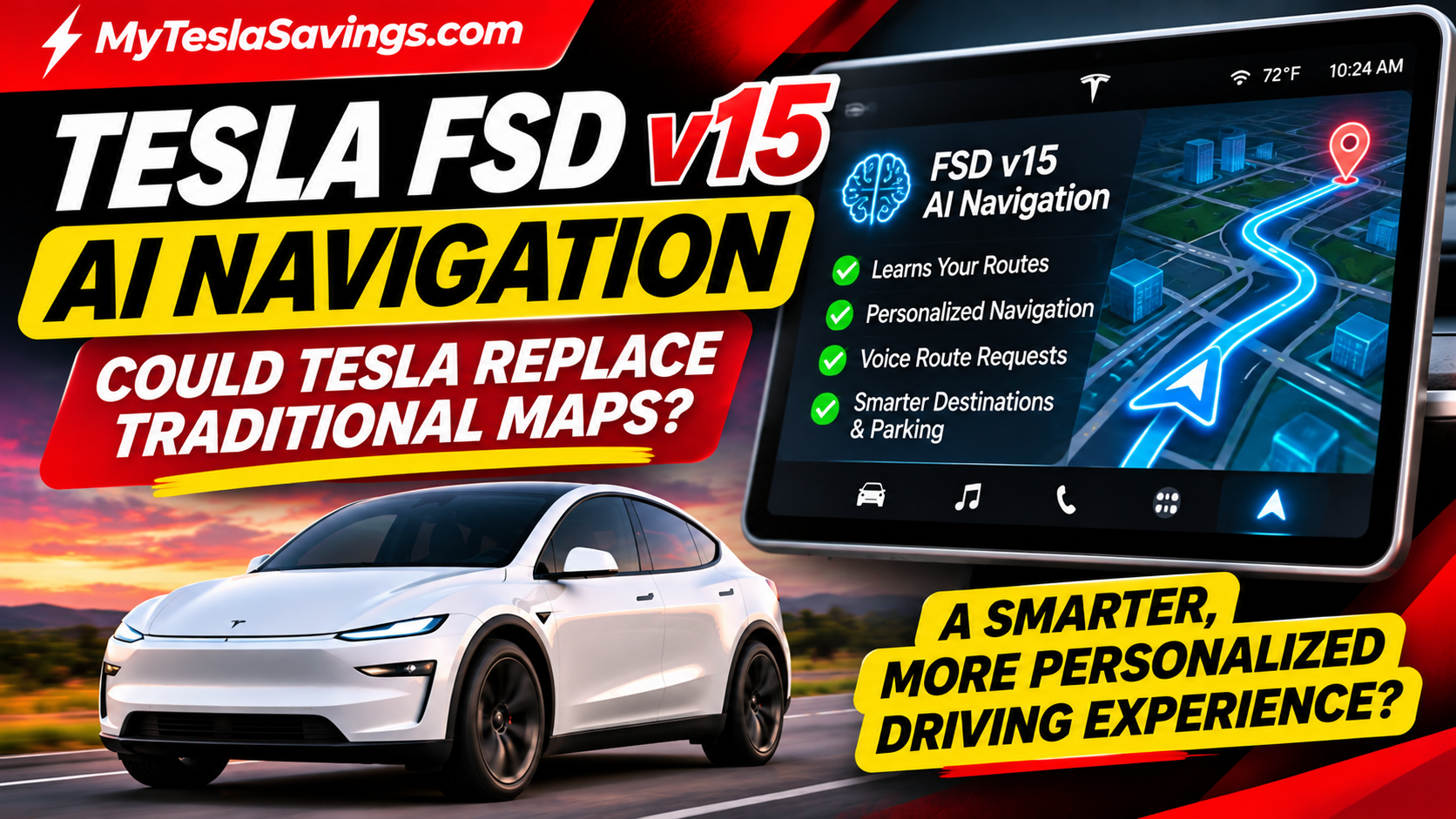
Tesla has officially confirmed that it’s developing an entirely new AI-based mapping and navigation system, with the first features expected to arrive alongside Full Self-Driving (FSD) v15.
The announcement came during Tesla’s October 21, 2026 earnings call, when Tesla VP of AI Ashok Elluswamy discussed plans to reduce the company’s dependence on third-party mapping providers.
But could Tesla’s new AI navigation eventually replace traditional maps altogether?
And more importantly, what does this mean for current Tesla owners?
Let’s break down what we know.
Tesla Is Building Its Own AI Navigation System
For years, Tesla has relied on a combination of third-party mapping information and its own navigation software.
While Tesla develops its navigation experience and route-planning functionality, external providers supply some of the underlying geographic information.
That approach works well in many situations, but it creates challenges for Full Self-Driving.
For example, FSD drivers sometimes experience:
- Incorrect speed-limit information.
- Unexpected route selections.
- Confusing parking-lot navigation.
- Difficulty identifying the best entrance to a destination.
- Unnecessary turns or inconvenient detours.
- Inconsistent destination and drop-off behavior.
During Tesla’s third-quarter 2026 earnings call, a shareholder asked why the company continued relying on external maps for some of these functions.
Ashok Elluswamy confirmed that Tesla is developing its own mapping architecture using artificial intelligence.
This represents an important step in Tesla’s effort to improve the overall FSD experience.
Rather than relying entirely on externally maintained information, Tesla wants its vehicles to contribute to a mapping system that improves through fleet-wide learning.
How Tesla FSD v15 AI Navigation Could Work
Traditional navigation systems typically depend on databases containing roads, intersections, addresses, speed limits, and points of interest.
These systems calculate routes based on available information such as distance, estimated travel time, and traffic conditions.
Tesla’s proposed approach could add a new layer of intelligence.
Instead of simply following a predetermined route, the system could incorporate what Tesla vehicles collectively learn from driving.
1. Learning From Millions of Tesla Vehicles
One of Tesla’s potential advantages is the amount of driving data available across its vehicle fleet.
As Tesla vehicles travel through cities, neighborhoods, highways, and parking lots, they encounter changing road conditions and navigation challenges.
Tesla says its new mapping architecture will use collective fleet intelligence.
In principle, that could help the system improve its understanding of:
- Commonly used routes.
- Road layouts and intersections.
- Parking-lot entrances.
- Destination access points.
- Frequently encountered navigation problems.
For example, imagine a shopping center where the navigation system repeatedly directs drivers to an entrance that is inconvenient or inaccessible.
A fleet-informed mapping system could potentially learn which entrances drivers actually use and improve future routing.
However, Tesla has not yet explained exactly how it will validate, process, or update this information.
2. Navigation That Learns Your Driving Preferences
This might be one of the most interesting parts of Tesla’s announcement.
Elluswamy said the new system is intended to learn personalized preferences.
Today, navigation systems generally prioritize factors such as travel time, traffic, and distance.
But the fastest route isn’t always the route you prefer.
Some drivers avoid busy intersections.
Others prefer highways over residential roads.
Some want to minimize left turns or avoid certain roads during rush hour.
Tesla’s AI navigation could eventually learn those preferences and incorporate them into route selection.
Example:
You drive home from work every afternoon.
Your Tesla’s navigation consistently recommends a particular highway exit, but you prefer a different exit because traffic usually moves more smoothly.
A personalized navigation system could potentially learn your preferred route and prioritize it in future trips.
Tesla already introduced Preferred Routes functionality in 2026, but its planned AI architecture could take personalized routing further.
The exact capabilities and controls have not yet been announced.
3. Voice-Controlled Navigation Could Change Everything
One of the confirmed goals for Tesla’s new navigation system is voice integration.
Elluswamy described a system where drivers can speak to the vehicle and request different routes.
This could make navigation more conversational.
Instead of opening menus and manually changing a destination, drivers might be able to communicate their preferences naturally.
Imagine These Future Tesla Voice Commands
“Take a different route home.”
Your Tesla could recalculate the trip using your request and available traffic information.
“Avoid the highway.”
The system could prioritize local roads when suitable.
“Find a charging stop along the way.”
AI navigation could potentially combine routing preferences with Tesla’s existing charging infrastructure.
“Take me to the parking garage instead of the main entrance.”
The system could eventually use improved destination information to select a more useful arrival point.
These are illustrative examples of what conversational navigation might enable, not a confirmed list of supported FSD v15 commands.
Tesla has confirmed voice-based routing as a development goal, but has not published a complete command list.
4. Smarter Parking and Destination Handling
If you’ve used Tesla FSD regularly, you may have noticed that reaching the destination isn’t always the same as arriving at the right place.
Your Tesla might navigate successfully through city streets but struggle with the final portion of a trip.
For example:
- Selecting the wrong shopping-center entrance.
- Stopping far from the intended destination.
- Taking an unnecessarily complicated route through a parking lot.
- Choosing an inconvenient pickup or drop-off location.
Tesla’s new AI navigation architecture is intended to address some of these problems.
According to Elluswamy, the initial FSD v15 implementation will focus on the beginning and end of trips.
Over the following months, Tesla plans to expand the system into navigation, parking, and destination handling.
Why This Matters
For truly autonomous transportation, a vehicle needs to do more than navigate public roads.
It must also understand where a trip should begin and end.
Consider a future Tesla Robotaxi arriving at a shopping mall.
Simply navigating to the mall’s street address isn’t enough.
The vehicle needs to identify an appropriate pickup or drop-off location and safely reach it.
Better mapping and destination handling could play an important role in making those experiences more reliable.
5. Could Tesla Finally Fix Incorrect Speed Limits?
One common frustration with driver-assistance systems is incorrect speed-limit information.
A navigation database may contain outdated speed limits.
Road signs can change.
Temporary construction zones may introduce new restrictions.
And sometimes the vehicle’s interpretation of the road doesn’t match the actual posted limit.
During Tesla’s earnings call, speed-limit recognition was specifically raised as a problem with current mapping.
Tesla’s new mapping architecture could help improve the information available to FSD.
For example, combining vehicle observations with mapping data might help identify inconsistencies between the expected speed limit and current road conditions.
However, Tesla has not announced specific speed-limit accuracy improvements or confirmed that FSD v15 will resolve these issues.
Important: Drivers must continue monitoring posted speed limits and vehicle behavior. FSD (Supervised) requires active driver supervision and does not make the vehicle autonomous.
Tesla FSD v15: What Features Are Actually Confirmed?
There’s a lot of excitement surrounding FSD v15, but it’s important to distinguish Tesla’s announcements from predictions.
Here’s what we currently know.
| Feature | Current status |
|---|---|
| Tesla-developed AI mapping architecture | Confirmed in development |
| Fleet-informed navigation | Announced |
| Personalized route preferences | Planned |
| Voice-based route requests | Planned |
| Improved trip start and end handling | Targeted for FSD v15 |
| Expanded parking and destination handling | Planned for subsequent months |
| Complete replacement of Google Maps data | Not confirmed |
| Exact public release date | Not confirmed |
As of November 3, 2026, Tesla has not provided a firm public release date for the full AI navigation system.
Its introduction is expected to be gradual rather than a single update that immediately replaces every navigation function.
Will Tesla Replace Google Maps?
This is probably the biggest question surrounding the announcement.
The answer: Tesla wants to reduce its reliance on external mapping providers, but it has not confirmed that Google Maps or other third-party map data will disappear entirely.
Tesla’s existing navigation experience combines information from multiple sources with Tesla-developed software.
The new architecture could allow Tesla to control more of the mapping and routing process itself.
But several questions remain unanswered.
Will Tesla continue displaying familiar map imagery?
Will external traffic data still be used?
Will points of interest come from Tesla’s own database?
Could Tesla eventually replace most third-party mapping services?
Tesla hasn’t provided those details.
It’s also important to understand that an AI-powered mapping system doesn’t necessarily mean the vehicle will stop using maps.
Instead, the maps themselves could become more dynamic, personalized, and integrated with the driving system.
Traditional Maps vs. Tesla’s Planned AI Navigation
| Feature | Traditional Navigation | Tesla’s Planned AI Navigation |
|---|---|---|
| Road and destination data | Mapping databases | Tesla-developed, fleet-informed architecture |
| Route preferences | Primarily predefined settings | Intended to learn driver preferences |
| Voice commands | Basic destination and route controls | Planned conversational route requests |
| Parking navigation | Depends on available map data | Planned improved destination handling |
| Updates | Provider and software updates | Potential fleet-informed improvements |
| Availability | Already widely available | Phased rollout planned |
Tesla’s proposed system is promising, but real-world testing will determine whether it delivers meaningful improvements.
Why Tesla’s New Maps Could Be Important for Robotaxis
Tesla’s long-term autonomous driving ambitions go beyond consumer vehicles.
The company is also developing Robotaxi services designed to transport passengers without a human driver in approved operating conditions.
For that model to work reliably, navigation must be extremely accurate.
A Robotaxi needs to understand more than the shortest route between two addresses.
It must also handle:
- Passenger pickup locations.
- Safe drop-off points.
- Parking and stopping areas.
- Complex intersections.
- Changes to road access.
- Unusual destination layouts.
An AI-based mapping system could help address some of these challenges.
During the October earnings call, Tesla also discussed plans for bringing additional customer vehicles into its Robotaxi ecosystem in the future.
However, the availability of unsupervised driving remains dependent on technical progress, operational limitations, and applicable regulatory requirements.
A new navigation system alone does not establish that a vehicle can safely drive without supervision.
Will Tesla FSD v15 Work on Hardware 3 and Hardware 4?
This is another major question for Tesla owners.
Tesla has not yet provided a complete hardware compatibility list for its new AI navigation architecture.
That means it’s too early to confirm whether all planned features will be available on older Hardware 3 vehicles.
Some navigation functionality could potentially be supported across multiple hardware generations, while more demanding FSD capabilities may have additional requirements.
Owners should wait for Tesla’s official release notes and compatibility information.
If you’re interested in the differences between Tesla hardware generations, read our guide:
Tesla Hardware 3 vs. Hardware 4: What FSD v15 Could Mean for Owners
Could AI Navigation Make Tesla Road Trips Better?
For Tesla owners who frequently travel long distances, smarter navigation could offer meaningful benefits.
Tesla already provides integrated trip planning that accounts for charging stops and estimated battery levels.
But imagine combining that technology with personalized AI routing.
A Potential Future Road Trip Experience
You tell your Tesla:
“I want to drive from Ohio to Miami, avoid heavy traffic, and stop somewhere interesting for lunch.”
Instead of simply selecting the fastest route, a more advanced AI system could potentially consider your preferences when planning the trip.
It might eventually recommend routes based on charging opportunities, destination preferences, and convenient stopping locations.
Tesla has not confirmed this complete functionality for FSD v15, but it illustrates the possibilities of combining AI navigation with existing trip-planning tools.
In the meantime, you can explore Tesla trip-planning resources at MyTeslaSavings.com.
What Are the Biggest Challenges for Tesla AI Navigation?
While the announcement sounds promising, building a reliable navigation system is a complicated task.
Keeping Maps Accurate
Roads change constantly.
Construction projects, new intersections, temporary closures, and traffic restrictions can make mapping information outdated.
Tesla will need reliable methods for validating and updating its map data.
Handling Conflicting Information
What happens when different Tesla vehicles encounter conflicting road conditions?
The system will need to determine which information is accurate and relevant.
Understanding Driver Preferences Safely
Personalized navigation could be useful, but preferences must never override traffic laws or safe driving practices.
Maintaining Reliable Coverage
A fleet-informed system may receive more observations in areas with many Tesla vehicles.
Less-traveled roads and rural regions could present additional challenges.
Protecting Privacy
Using fleet observations and personal preferences raises important questions about data collection, retention, and privacy.
Tesla has not yet detailed the data practices specific to its new mapping architecture.
When Will Tesla FSD v15 AI Navigation Be Released?
Tesla has linked the initial rollout of its AI-based mapping technology to FSD v15.
According to the October 2026 earnings call, the first capabilities are expected to focus on the beginning and end of trips.
Additional navigation and parking functionality is planned for the following months.
However, Tesla has not announced a specific release date or complete rollout schedule.
Owners should also remember that Tesla commonly distributes software updates in stages.
Even after a feature is officially released, availability may vary depending on vehicle configuration, software version, and region.
For more information about the next major FSD release, read:
Tesla FSD v15: Expected Features, Release Date & Everything We Know
Frequently Asked Questions About Tesla FSD v15 AI Navigation
Is Tesla developing its own maps?
Yes. Tesla confirmed in October 2026 that it is building an AI-based mapping and navigation architecture intended to reduce dependence on external mapping providers.
Will Tesla FSD v15 replace Google Maps?
Not necessarily. Tesla has not confirmed that it will completely eliminate Google Maps or other third-party mapping data.
Can Tesla AI navigation learn your favorite routes?
Tesla says personalized routing preferences are part of its planned architecture. The exact functionality has not yet been demonstrated in a public release.
Will FSD v15 allow voice-controlled navigation?
Tesla has announced plans for voice-based route requests as part of the new system. The complete list of supported commands remains unknown.
Will Tesla AI navigation improve parking?
Tesla plans to expand its mapping architecture into parking and destination handling after the initial rollout. The extent of those improvements remains to be seen.
Will Hardware 3 vehicles receive AI navigation?
Tesla has not confirmed complete hardware compatibility for the planned navigation features.
Is Tesla FSD v15 available now?
As of November 3, 2026, a confirmed general release of FSD v15 with the announced AI navigation features has not been established.
Final Verdict: Tesla Navigation Could Be About to Change in a Big Way
Tesla’s decision to build its own AI-based mapping system could represent one of the most significant navigation changes in the company’s recent software development.
The idea is compelling.
Instead of relying primarily on conventional mapping information, Tesla wants to combine fleet intelligence, personalized preferences, and conversational navigation into a more integrated driving experience.
For Tesla owners, that could eventually mean better routes, more useful parking guidance, and fewer frustrating destination errors.
But the technology still needs to prove itself.
Tesla has confirmed its direction, not the final performance or availability of every proposed feature.
The biggest takeaway: FSD v15 could mark the beginning of a shift from traditional navigation toward a more intelligent, personalized mapping system.
Whether Tesla eventually replaces third-party maps entirely remains an open question.
And for millions of Tesla owners, that’s a development worth watching.
Stay Ahead of Tesla Software Updates
At MyTeslaSavings.com, we cover Tesla software updates, FSD developments, ownership tips, and money-saving tools.
Whether you’re tracking FSD v15, looking for practical Tesla accessories, or planning your next road trip, our goal is to help you get more from your Tesla.
Visit MyTeslaSavings.com for more Tesla news, guides, and savings tips.