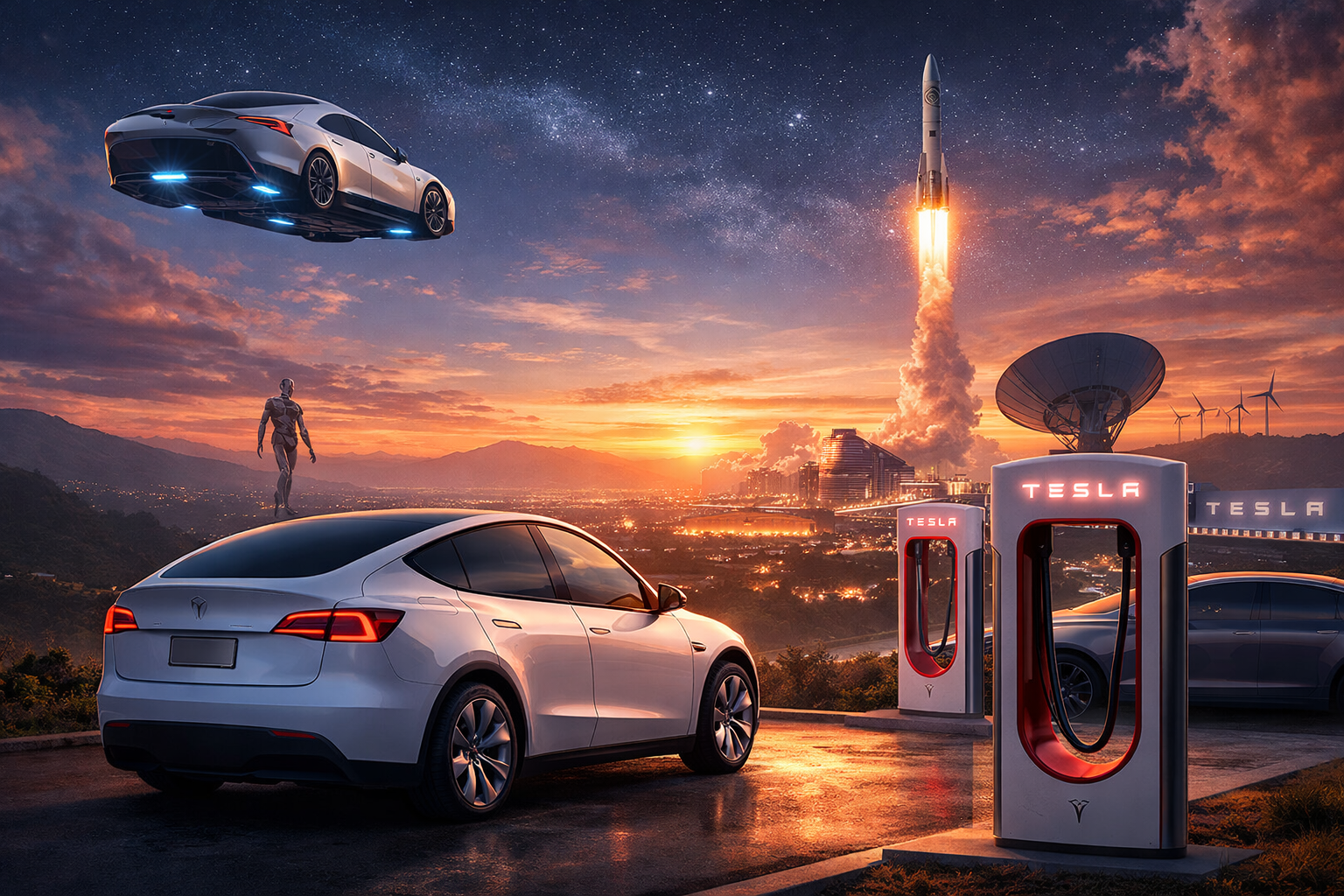
Tesla is no longer just a car company.
It’s an AI company.
A robotics company.
An energy company.
And possibly the most vertically integrated technology company on the planet.
As we move deeper into 2026, Tesla is entering one of the most important phases in its history — the large-scale rollout of next-generation Full Self-Driving (FSD) powered by its evolving AI stack.
For Tesla owners and future buyers, this isn’t just exciting tech news.
It could fundamentally change:
- How your car appreciates or depreciates
- How much you pay for insurance
- How your vehicle earns income
- How much time you spend driving
- The long-term value of your Tesla
Let’s break down what’s happening — and what it means for Tesla owners right now.
The Evolution of Full Self-Driving (FSD)
Tesla, Inc. has been refining Full Self-Driving for years. But recent updates powered by Tesla’s AI training cluster (often referred to as Dojo and beyond) have accelerated improvements dramatically.
The current FSD versions now demonstrate:
- More natural lane changes
- Better roundabout handling
- Reduced phantom braking
- Improved construction zone navigation
- Smoother city driving decisions
- More human-like turning behavior
The biggest shift? FSD is now trained almost entirely on real-world fleet data.
Tesla collects billions of miles of driving data from its vehicles worldwide. That data feeds neural networks that continuously improve real-world decision-making.
Unlike competitors using expensive lidar and HD-mapped cities, Tesla relies primarily on camera-based vision.
This is important.
Because if Tesla solves autonomy using vision at scale, it becomes exponentially cheaper to deploy globally.
Why This Matters for Tesla Owners
If full autonomy progresses to higher regulatory approval levels, Tesla owners could benefit in several ways.
1. Increased Resale Value
Vehicles equipped with FSD may become significantly more desirable if autonomy becomes more capable.
In previous years, FSD pricing has fluctuated from $6,000 to $15,000+. If Tesla achieves broader autonomy approval, early adopters who purchased FSD at lower prices could see:
- Stronger resale value
- Higher trade-in leverage
- Increased private sale demand
In certain scenarios, FSD could even act like a “software asset” rather than a depreciating option.
2. The Potential Robotaxi Network
Tesla’s long-term vision includes a decentralized robotaxi network.
While regulatory rollout will vary by region, the concept is simple:
- Your Tesla could operate autonomously.
- You could opt it into a shared network.
- The vehicle could generate income when not in use.
If this becomes reality, Tesla ownership shifts from liability to potential asset.
This is one of the biggest reasons long-term investors and enthusiasts closely watch FSD development.
AI Isn’t Just for Driving
Tesla’s AI push extends far beyond vehicles.
CEO Elon Musk has repeatedly emphasized that Tesla’s neural networks are foundational to multiple product lines.
Tesla is:
- Expanding AI training infrastructure
- Scaling autonomous robotics
- Improving vehicle manufacturing automation
- Refining real-time over-the-air software upgrades
Every Tesla vehicle is essentially a computer on wheels.
Over-the-air updates can improve:
- Range efficiency
- Acceleration
- Infotainment features
- Navigation routing
- Autopilot performance
- Energy management
Very few automakers offer this level of ongoing post-purchase improvement.
Hardware 4 and What It Means
Newer Tesla vehicles are equipped with updated hardware often referred to as Hardware 4 (HW4).
HW4 includes:
- Higher-resolution cameras
- Enhanced onboard compute
- Expanded AI processing capability
If you’re considering buying a Tesla in 2026, verifying hardware version is important — especially if autonomy development matters to you.
Owners with HW4 may benefit from longer-term compatibility with future software advancements.
Tesla Insurance and Autonomy Data
Tesla Insurance is expanding in more states and regions.
Why does this matter?
Tesla uses real driving behavior data to determine rates.
Factors like:
- Hard braking
- Aggressive turning
- Forward collision warnings
- Unsafe following distance
can influence your premium.
As FSD improves, safer autonomous driving could potentially lower risk metrics.
In the future, autonomy adoption could directly reduce insurance costs.
Energy Integration: The Underrated Advantage
Tesla’s ecosystem extends beyond vehicles.
Tesla Powerwall and Tesla Solar Roof integrate with Tesla vehicles for home energy management.
For example:
- Charging during off-peak hours
- Storing solar power
- Using vehicle-to-home energy concepts (future expansion potential)
Tesla owners can increasingly create self-contained energy ecosystems.
This reduces:
- Grid dependence
- Charging costs
- Exposure to volatile electricity rates
In certain markets, this dramatically improves total cost of ownership.
Charging Network Expansion
Tesla’s Supercharger network remains one of the company’s most powerful competitive advantages.
Tesla Supercharger stations are:
- Reliable
- Strategically located
- Increasingly open to non-Tesla EVs
Opening the network to other brands creates additional revenue streams for Tesla while preserving priority benefits for Tesla owners in many locations.
For owners, this means:
- Continued charging expansion
- Faster infrastructure growth
- Greater travel flexibility
Long road trips remain one of Tesla’s strongest ownership advantages compared to many competing EV brands.
Tesla Model Updates and Refresh Cycles
Tesla Model Y and Tesla Model 3 continue to receive refinement updates.
Recent and upcoming changes include:
- Interior upgrades
- Improved suspension tuning
- Enhanced sound insulation
- Refined UI features
- Updated lighting designs
Tesla often avoids traditional “model year” cycles and instead rolls out improvements continuously.
This means buying timing becomes strategic.
Watching production updates, hardware revisions, and pricing shifts can save buyers thousands.
Federal Tax Credits and State Incentives
While federal EV incentives have changed over time, qualifying Teslas may still be eligible for tax credits depending on battery sourcing and assembly requirements.
Buyers should verify:
- Current IRS guidelines
- State-level rebates
- Utility incentives
- Time-of-use electricity discounts
Stacking incentives can significantly reduce effective purchase cost.
MyTeslaSavings readers should always calculate:
- Purchase price
- Incentives
- Gas savings
- Maintenance savings
- Insurance changes
- Charging costs
Total ownership cost often beats traditional vehicles long-term.
Maintenance Savings: The Quiet Wealth Builder
Tesla vehicles require:
- No oil changes
- Fewer brake replacements (thanks to regenerative braking)
- Minimal routine service
- Fewer moving engine components
Over five to eight years, maintenance savings alone can reach thousands compared to gas vehicles.
Combine that with:
- Fuel savings
- Lower mechanical failure risk
- Software improvements
And the financial equation becomes compelling.
The Investment Angle
Tesla ownership isn’t just about driving — many owners also follow Tesla as an investment.
Tesla Inc. (TSLA) continues to attract long-term investors who believe Tesla’s AI, robotics, and energy integration provide upside beyond automotive margins.
While stock performance is never guaranteed, Tesla’s expansion into AI-driven infrastructure and robotics makes it unique among automakers.
Owners who understand Tesla’s long-term roadmap often feel more confident holding both the vehicle and potentially the stock.
What Could Slow Tesla Down?
No company is without risks.
Potential challenges include:
- Regulatory delays for autonomy
- Increased EV competition
- Battery supply constraints
- Economic downturns
- Political policy changes
However, Tesla’s vertical integration — from software to batteries to charging infrastructure — gives it flexibility that many automakers lack.
Should You Buy a Tesla in 2026?
Here’s the practical breakdown.
Consider buying if:
- You value software innovation
- You want long-term fuel savings
- You drive frequently
- You plan to keep the car 5+ years
- You believe in autonomy progress
Consider waiting if:
- You want confirmed full autonomy approval
- You prefer traditional dealership service models
- You’re waiting for a specific model refresh
Final Thoughts: Tesla Is Playing a Different Game
Most automakers are trying to build electric versions of traditional cars.
Tesla is building an AI-driven mobility platform.
The difference is massive.
Every over-the-air update, every AI improvement, every Supercharger expansion strengthens the ecosystem.
For Tesla owners, this means:
- A vehicle that improves over time
- Lower operating costs
- Potential autonomy upside
- Deep integration with energy systems
Whether you’re a long-time Tesla owner or considering your first purchase, 2026 may represent a turning point.
Autonomy is closer.
AI infrastructure is scaling.
Energy integration is expanding.
Tesla isn’t just updating cars.
It’s redefining transportation.

